Directly investing in the stock market is not everyone’s cup of tea, as it requires extensive research and involves significant risk. This is why exploring advanced stock market concepts for beginners, such as alternative investment options, can be a much better approach for average investors. By understanding these advanced stock market concepts for beginners, you can build a more stable and less risky portfolio while still participating in market growth.
Don’t Miss This: Read All Parts of the Stock Market Course for Beginners 2026 via the Links Below
Stock Market Basics for Beginners: Complete Guide 2026 Here
Stock Market Strategies for Beginners 2026 – Part 2 Here
Stock Market Fundamentals for Beginners Part 3 Here
Stock Market Terminology for Beginners: Key Concepts & Terms Explained (2026 Guide PArt 4) Here
What Is a Mutual Fund? A Beginner-Friendly Explanation (2026)
A Mutual Fund is an investment setup where many investors pool their money together. A professional fund manager then researches and invests this combined amount into different stocks, bonds, or other assets. This is one of the most practical advanced stock market concepts for beginners because it helps reduce risk and offers stable, average returns over time.
Simple Example:
Think of it like a cricket team where every player has a specific role. In a mutual fund, each stock or bond plays its part, while the coach (fund manager) designs the overall strategy. Understanding such advanced stock market concepts for beginners allows investors to grow their wealth without tracking the market every single day.
SIP (Systematic Investment Plan) in the Stock Market: The Power of Disciplined Investing
A SIP (Systematic Investment Plan) is one of the easiest and most disciplined ways to start investing in mutual funds. Instead of trying to time the market or investing a large amount at once, you invest a fixed sum—such as ₹1,000 or ₹5,000—every month.
One of the most important advanced stock market concepts for beginners is understanding how SIP helps reduce risk. SIP works through a method called Rupee Cost Averaging:
Market Down: You automatically buy more units
Market High: You buy fewer units
Over the long term, this lowers your average investment cost and protects your money from market volatility. By learning such advanced stock market concepts for beginners, investors can aim for steady returns without the stress of daily market fluctuations.
Simple Example:
Think of a SIP like a monthly EMI for your future wealth. Just as you pay for a car or house in installments, SIP helps you build a strong portfolio through small, regular, and disciplined investments.
Lumpsum Investment: Meaning, Benefits, and Risks for Beginners
A Lumpsum Investment means investing a large amount of money at one time. For example, if you have ₹50,000 and invest the entire amount at once into a mutual fund, that is called a lumpsum investment.
This approach is usually preferred when the market is at a low level and you believe prices may rise from there. However, since the entire amount is invested at once, the risk can be higher if the market moves in the opposite direction.
Simple Example:
It’s like buying all your groceries at once during a big sale. You can save a lot if your timing is right—but if the timing is wrong, you might end up with losses.
What Are Bonds in the Stock Market?
Bonds are like a loan that you give to a company or the government. In return, they promise to pay you fixed interest at regular intervals and return your money after a fixed time.
What Are the Benefits of Bonds?
- Less risky than stocks
- Provide stable and fixed income
- Help in balancing your investment portfolio
Simple Example
Think of bonds like lending money to a friend. Your friend agrees to pay you a fixed interest every year and returns the full amount after a certain period. Bonds work in the same way.
Short Selling in the Stock Market: How Traders Profit When Prices Fall

Short selling is a trading strategy where you borrow shares from your broker and sell them in the market immediately. Later, when the share price falls, you buy the same shares at a lower price and return them to the broker.
The difference between the selling price (higher) and the buying price (lower) becomes your profit.
Simple Example
Suppose you believe that HDFC Bank’s share price is going to fall. The current price is ₹1,500. You borrow the share from your broker and sell it at ₹1,500. By the end of the day, the price drops to ₹1,450. You buy it back at ₹1,450 and return it to the broker.
Your profit is ₹50 per share.
Risk Factor Short selling involves unlimited risk. If the share price rises instead of falling, your losses can increase rapidly. That is why short selling is recommended only for experienced traders, not beginners.
Exit Strategy & Market Volatility: Essential Advanced Stock Market Concepts for Beginners
A successful trade isn’t just about the right entry point; it depends heavily on your Exit Point. Without a solid exit strategy, most traders fall into the emotional traps of Greed and Fear, leading to poor decision-making.
- Greed: Holding a stock for too long in hopes of more profit, only to watch the gains vanish.
- Fear: Panic-selling during a minor dip or letting a small loss turn into a huge disaster.
Types of Exit Strategies
Exit Strategies to Master Advanced Stock Market Concepts for Beginners
| Exit Plan | What It Means | Simple Example |
|---|---|---|
| Profit Target | Pre-decide the price where you will book profits | Buy at ₹100, sell at ₹110 (10% gain) |
| Stop-Loss | Pre-decide the maximum loss you can accept | Buy at ₹100, stop-loss at ₹95 |
| Time-Based Exit | Exit after a fixed time, no matter the price | Exit after 30 days to free capital |
Example Explanation:
If you buy a stock at ₹100 with a target of ₹110, a stop-loss at ₹95, and a fixed time exit, you are following a structured approach. This disciplined method is a key part of understanding advanced stock market concepts for beginners and helps you avoid emotional trading decisions.
Mutual Funds: A Beginner’s Module Here
Understanding Market Volatility (Advanced Stock Market Concepts for Beginners)
| Volatility Type | Meaning | Easy Example |
|---|---|---|
| Low Volatility | Prices move slowly and remain stable | Like a calm river with steady flow |
| High Volatility | Prices move fast with sharp ups and downs | Like a stormy ocean during Budget Day, Elections, or major global news |
Understanding Market Cycles: 4 Stages of the Stock Market
Just like the seasons change (Summer, Winter, Monsoon), the stock market also moves in a Cycle. It goes through phases of growth (Expansion) and phases of falling (Contraction). To master advanced stock market concepts for beginners, you must understand these 4 stages:
| Market Stage | Also Called | What Happens | Easy Real-Life Example |
|---|---|---|---|
| Accumulation Phase | Buying Time | Market is at the bottom. Fear is high. Smart investors slowly start buying quality stocks. | Buying winter clothes in summer at very low prices |
| Markup Phase | Boom Time | Prices rise fast. News is positive. Public participation increases and profits grow. | A trend going viral on social media |
| Distribution Phase | Selling Time | Market reaches the top. Big players book profits while the market still looks strong. | Selling products at peak demand |
| Mark Down Phase | Crash Phase | Prices fall sharply. Panic selling starts. Late investors face losses. | End-of-season sale when prices collapse |
Pro Tip:
Understanding market cycles is a key part of advanced stock market concepts for beginners. It helps you avoid wrong timing and make smarter entry and exit decisions instead of reacting emotionally.
Liquidity in the Stock Market: Meaning and Importance for Beginners (2026)
Meaning: Liquidity means how easily a stock can be bought or sold in the market without affecting its price much.
High Liquidity: Buyers and sellers are easily available, so trading happens smoothly.
Low Liquidity: It is difficult to trade because buyers or sellers are limited, and you may have to compromise on price.
Why Liquidity Is Important in the Stock Market for Beginners
- High liquidity means faster exit and less impact on price
- Large-cap stocks usually have high liquidity
Good traders prefer trading in high-liquidity stocks
Circuit Breakers in the Stock Market: The Safety Switch Explained
Circuit breakers are automatic safety mechanisms used to stop the market from rising or falling too sharply in a single day.
This system is applied on both NSE and BSE. When a stock or the entire index (like Nifty or Sensex) moves beyond a fixed percentage in one day (such as 5%, 10%, or 20%), trading is automatically paused for some time. This gives investors time to think and prevents panic trading.
Upper Circuit:
When the price of a stock or index rises beyond the fixed upper limit in a day, trading is stopped. On that day, the stock cannot be bought.
Lower Circuit:
When the price of a stock or index falls beyond the fixed lower limit in a day, trading is stopped. On that day, the stock cannot be sold.
Market Manipulation in the Stock Market: Operators and Pump and Dump Schemes

Understanding illegal activities is one of the most critical advanced stock market concepts for beginners to ensure capital safety.
1. Operators Operators are individuals or groups who artificially manipulate a stock’s price. They usually target low-liquidity stocks where there are fewer buyers and sellers, making it easier to control the price.
Pump and Dump Scheme in the Stock Market: How It Works for Beginners
- Pump: Operators buy a small-cap stock and “pump” its price up by spreading fake rumors on social media. Innocent retail investors get trapped and start buying, pushing the price even higher.
- Dump: Once the price hits a peak, operators “dump” (sell) all their shares. The price crashes instantly, leaving common investors with huge losses.
Stock Market Manipulation: What It Is and How It Works (2026)
Manipulation means controlling a stock’s price by spreading false news or creating fake trading volumes. These activities are strictly against SEBI rules, and SEBI takes legal action against those involved. Learning these advanced stock market concepts for beginners is essential to stay safe from such traps.
Stock Surveillance and Risk Management: ASM, GSM, Beta, Lock-In & Margin Trading
ASM List in the Stock Market: Understanding Additional Surveillance Measures
SEBI and stock exchanges like NSE and BSE sometimes place certain stocks under the ASM List. This works as a warning signal that a stock is showing unusual price movement or abnormal trading volume.
Impact:
When a stock comes under ASM, margin requirements are increased, and intraday trading restrictions may be applied. This is done to protect retail investors.
Example:
If a small-cap stock rises 200% within a month without any real business news, SEBI may put it under the ASM list to alert investors. Understanding such advanced stock market concepts for beginners helps avoid risky and manipulated stocks.
GSM List in the Stock Market: Understanding Graded Surveillance Measures
The GSM List is used to closely monitor high-risk stocks. Under GSM, restrictions are applied step-by-step, such as:
- 100% margin requirement
- Trade-to-trade settlement
- Periodic call auctions
Example:
If a penny stock moves from ₹5 to ₹50 without any improvement in company performance, it may be shifted to the GSM list for strict monitoring.
Stock Risk Measurement in the Stock Market: Understanding Beta (β)
Beta is a number that shows how much a stock’s price moves compared to the overall market.
- Market Beta = 1.0
- High Beta (e.g., 1.5): The stock is more volatile than the market
Example:
If the market falls by 1%, a stock with a beta of 1.5 may fall by 1.5% or more. High beta stocks offer higher return potential but also carry higher risk.
Lock-in Period
A Lock-in Period is a fixed time during which shares cannot be sold. This is common in IPOs for promoters and anchor investors.Example:
If promoters have a 3-year lock-in period, they cannot sell their shares for 3 years. This helps control sudden selling pressure and keeps prices stable.
Margin Trading
Margin trading allows investors to borrow money from their broker to buy more shares than their actual capital.
Example:
If you have ₹50,000 and your broker offers 2× margin, you can buy shares worth ₹1,00,000. However, losses can also double if the market moves against you. Understanding these advanced stock market concepts for beginners helps investors use margin trading carefully and avoid unnecessary risk.
The Role of Depositories: CDSL and NSDL Explained 2026
What Is a Depository in the Stock Market? Beginner-Friendly Explanation (2026)
Think of a Depository as a digital locker where your shares and securities are kept safe. Gone are the days of physical share certificates; today, everything is handled electronically. In India, there are two major organizations that provide this service:
| Aspect | Explanation |
|---|---|
| What is a Depository? | An organization that holds shares in electronic (Demat) form |
| Main Depositories in India | CDSL (Central Depository Services Limited) & NSDL (National Securities Depository Limited) |
| Role | Keeps your stocks safe, just like a bank keeps your money |
| Account Used | Demat Account |
| When You Buy Shares | Shares are automatically credited to your Demat Account |
| When You Sell Shares | Shares are automatically debited from your Demat Account |
| Physical Certificates | Not required (paperless holding) |
| Investor Benefit | Safety, transparency, and easy online trading |
Example:
Suppose you buy 10 shares of Reliance. These shares are stored electronically in the systems of CDSL or NSDL. You can view these holdings through your Demat Account provided by brokers like Zerodha, Upstox, or Angel One.
Learning how these institutions safeguard your assets is a vital part of advanced stock market concepts for beginners, as it ensures you understand the infrastructure of the financial world.
Dos and Don’ts for Investors
| Do’s ✅ | Don’ts ❌ |
| Regularly check your Demat Account statements. | Never share your Client ID, Password, or TPIN with anyone. |
| Keep your OTP and login credentials secure. | Avoid keeping shares in physical paper form. |
| Monitor SMS/Email alerts from CDSL/NSDL. | Never trust unauthorized people with your account access. |
What Is an ETF (Exchange Traded Fund) in the Stock Market? Beginner-Friendly Explanation

An ETF (Exchange Traded Fund) is an investment product that combines the features of a mutual fund and a regular stock. Like a mutual fund, it pools money to invest in various assets, but like a stock, it is traded live on the stock exchange throughout the day.
How Does It Work?
An ETF represents a “basket of securities.” For example, a Nifty 50 ETF contains all 50 stocks of the Nifty index in the same proportion.
- You can buy and sell ETFs just like a normal share during market hours.
- The price of an ETF changes in real-time based on market demand and supply.
Types of ETFs (Exchange Traded Funds) in the Stock Market: Beginner-Friendly Guide
| ETF Type | What It Tracks | Simple Explanation | Example |
|---|---|---|---|
| Index ETF | Market indices | Follows major stock indices and moves with them | Nifty 50 ETF, Sensex ETF |
| Sector ETF | Specific industries | Invests only in one sector like Banking or IT | Bank Nifty ETF, IT ETF |
| Gold ETF | Gold price | Lets you invest in gold without holding physical gold | Gold ETF |
| International ETF | Global markets | Gives exposure to foreign markets like the US | Nasdaq ETF, S&P 500 ETF |
Practical Example
Imagine you want to invest in all 50 companies of the Nifty 50. Buying them individually would require a lot of capital and effort. Instead, you can simply buy one unit of a Nifty ETF and get instant exposure to all 50 companies in a single click.
Top Benefits of ETFs
Low Cost: Usually has lower management fees compared to mutual funds.
Automatic Diversification: Reduces risk by spreading your money across many stocks.
Real-Time Trading: Unlike mutual funds (where you get the end-of-day NAV), ETFs can be traded at current market prices.
Transparency: You always know exactly which stocks are inside your ETF.
Dos and Don’ts for Investors
- Do: Use ETFs for long-term wealth creation and check the liquidity (trading volume) before buying.
- Don’t: Never buy an ETF based on social media hype; always understand the underlying index or asset first.
Depository vs. ETF in the Stock Market: Quick Comparison for Beginners (2026)
| Feature | Depository (CDSL/NSDL) | ETF (Exchange Traded Fund) |
| Main Role | Keeping shares and securities safe. | Investing in a basket of securities. |
| How to Access | Via your Demat Account. | Via Stock Exchange (Live Trading). |
| Real-Life Example | Storing 10 shares of Reliance safely. | Buying the entire Nifty 50 in one click. |
PART 1 – Candlestick Charts & Moving Averages Explained for Beginners (2026 Guide)
Candlestick Charts in the Stock Market: Beginner-Friendly Guide
Candlestick charts are a visual tool that shows price movement for a specific time period. It displays four prices: Open, High, Low, and Close (OHLC).
Each candlestick has two main parts:
- Body: Shows the open and close price
- Wicks (or Shadows): Show the highest and lowest price
Colors:
- Green (or White): Price moved up (Bullish candle)
- Red (or Black): Price moved down (Bearish candle)
Example:
Suppose Reliance creates a daily candle with an opening price of ₹2,400, a closing price of ₹2,450, a high of ₹2,460, and a low of ₹2,380.
This means the price moved between ₹2,380 and ₹2,460 during the day and closed near the high, which is a bullish sign.
Why It Matters:
Candlesticks help identify trend reversal and continuation
Popular patterns like Hammer, Doji, and Engulfing explain market psychology These are important advanced stock market concepts for beginners to read price action correctly
Moving Average in the Stock Market: Beginner-Friendly Guide
A moving average is a simple indicator that smooths price data to show the overall trend.
- Simple Moving Average (SMA): Average of prices for a fixed period (example: 50-day or 200-day SMA)
- Exponential Moving Average (EMA): Gives more importance to recent prices, so it reacts faster
Example:
If Nifty’s 50-day SMA is at 19,800 and the 200-day SMA is at 18,500:
Price above both → bullish trend
Price below both → bearish trend
Why It Matters:
- Shows the trend direction
- Helps identify support and resistance
- Crossovers like Golden Cross and Death Cross give trading signals
- Moving averages are core advanced stock market concepts for beginners
PART 2 – RSI (Relative Strength Index) Explained for Beginners & How to Use Indicators Together
RSI is a momentum indicator that moves between 0 and 100.
- Overbought Zone: RSI above 70 (price may fall)
- Oversold Zone: RSI below 30 (price may bounce)
Example:
If Infosys has an RSI of 78, it means the stock is overbought and a small correction is possible.
Why It Matters:
- Shows trend strength
- Gives early reversal signals
- Divergence between price and RSI acts as a warning
How to Use Multiple Indicators in Stock Market Trading: Beginner-Friendly Guide
The best approach is to use multiple indicators instead of relying on just one.
Step-by-Step:
- Use candlestick charts to see short-term price action
- Use moving averages to confirm the long-term trend
- Use RSI to check momentum and overbought or oversold levels
Example Combination:
- Reliance price is above the 200-day SMA (bullish trend)
- A bullish engulfing candlestick pattern appears
- RSI is near 40 and moving upward
This combination can indicate a strong buying opportunity. Learning how to combine indicators is one of the most practical advanced stock market concepts for beginners.
Investment Styles for Beginners: Mutual Funds, SIP, and Lumpsum Explained (2026)
| Feature | Mutual Fund | SIP | Lumpsum |
| Risk | Moderate (Diversified) | Lowest (Averaging) | High (Timing dependent) |
| Amount | Any | Small monthly amounts | One-time large sum |
| Timing | Professional managed | Not required | Very Important |
Technical Indicators in Stock Market: Complete Trading Guide for Beginners (2026)
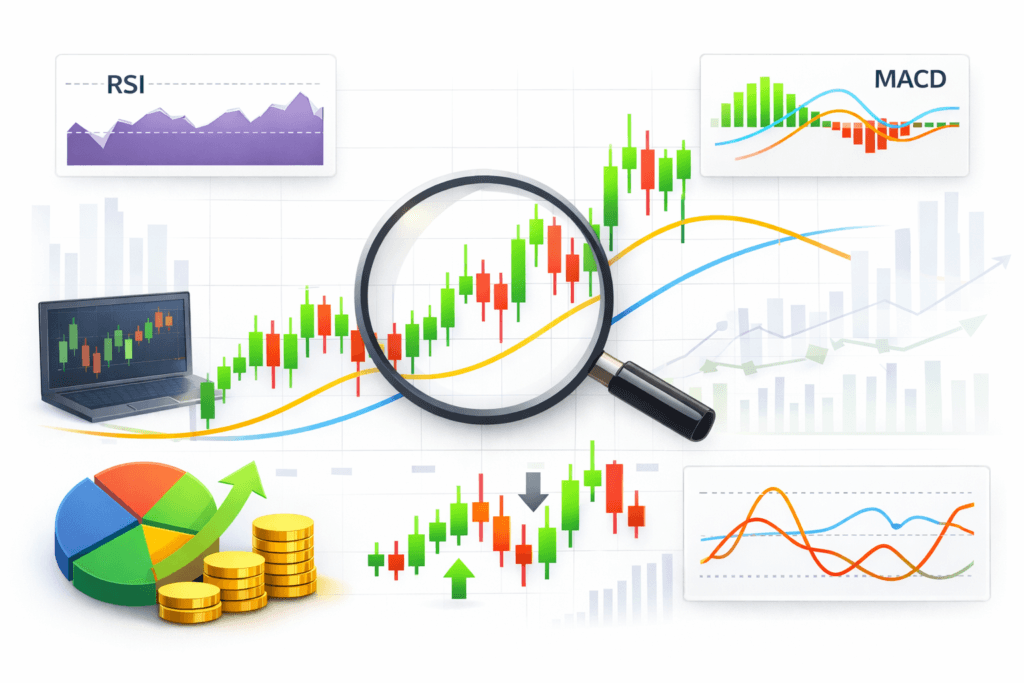
Use these advanced stock market concepts for beginners to identify market trends.
| Indicator | Purpose | Key Signal |
| Candlesticks | Shows market mood. | Patterns like Hammer/Doji. |
| Moving Average | Identifies the trend. | Above MA = Buy; Below = Sell. |
| RSI | Measures momentum. | <30 (Oversold); >70 (Overbought). |
Market Safety Red Flags: Warning Signs Every Investor Must Know
Protect your capital by staying away from these common market traps.
| Term | Meaning | Safety Tip |
| ASM / GSM | SEBI surveillance list. | Avoid investing in these. |
| Pump & Dump | Fake artificial price hike. | Ignore social media “Hot Tips”. |
| Manipulation | Controlling price/volume. | Stick to high-quality stocks. |
Risk Metrics in Stock Market: Understanding Beta and Liquidity for Beginners (2026)
| Metric | High Value | Low Value |
| Beta (β) | Highly volatile (Fast moves). | Stable (Slow moves). |
| Liquidity | Easy to buy/sell. | Hard to sell (Risk of getting stuck). |
Advance Stock Market Concepts for Beginners: Understanding Storage and Products
| Feature | Depository (CDSL/NSDL) | ETF (Exchange Traded Fund) |
| Role | Digital Locker for your shares. | A Basket of Stocks traded live. |
| Access | Via Demat Account. | Via Stock Exchange. |
| Example | Your safe share storage. | Nifty ETF (50 stocks in one click). |
Conclusion: Advanced Stock Market Concepts for Beginners Explained
Understanding Advanced Stock Market Concepts for Beginners is essential to make smarter investment decisions. These concepts provide clarity on risk management, trading strategies, and market behavior. By learning them, beginners can avoid common mistakes and build confidence in their stock market journey.
Applying these concepts consistently helps in long-term wealth creation and better portfolio management. In short, mastering Advanced Stock Market Concepts for Beginners is the key to becoming a successful investor.
Disclaimer
Market Risk: Stock market investments are subject to market risks. Please read all related documents carefully before investing.
Educational Purpose Only: This content is for educational purposes only and should not be considered financial advice.
Not a SEBI-Registered Advisor: We are not SEBI-registered advisors. Always consult a certified financial professional before making investment decisions.
No Profit Guarantee: Advanced stock market concepts for beginners can help reduce risk, but they do not guarantee profits. We are not responsible for any financial losses.