
BAF Course Details 2026: Specialised Accounting and Finance Degree After 12th Commerce
BAF course details 2026 are important for students looking for a specialised accounting and finance degree after 12th commerce. BAF (Bachelor of Accounting and Finance) is a 3-year undergraduate course that focuses on accounting, taxation, auditing, banking, and financial markets. It helps students build practical finance knowledge needed for modern careers.
The BAF course in 2026 follows current industry trends and prepares students for careers in accounting, banking, taxation, and financial analysis. It also builds a strong base for professional courses like CA, CMA, ACCA, and CFA, which improves long-term career growth.
If you want a career-focused commerce degree with good scope, BAF can be a smart choice. You can also explore BMS Course Salary, Eligibility, Syllabus and Career Scope in India ↗ to compare both courses and choose the right path.
What Is the BAF Course? A Simple Introduction for Commerce Students
BAF (Bachelor of Accounting and Finance) is not a typical general graduation course. It is a specialised undergraduate program focused on core finance subjects like accounting, taxation, auditing, banking, and financial markets. If you are searching for a specialised accounting and finance degree after 12th commerce, the BAF course in 2026 is becoming increasingly popular due to growing demand for skilled finance professionals in India and globally.
According to current trends, many commerce students prefer BAF because it offers practical knowledge aligned with modern industry requirements. Understanding the BAF course scope, eligibility, career opportunities, and salary potential in India helps students make a smarter and future-oriented career decision, especially if they plan to enter accounting, taxation, banking, or financial analysis roles.
If you are confused between multiple commerce degrees, don’t worry. On commercecare.in, the goal is to provide simple, honest, and updated guidance so you can confidently choose the right course based on your career goals. You can also explore detailed information about B.Com (Hons) course salary, eligibility, syllabus, and career scope in India ↗ to compare both programs and select the best option for your future.
BAF Course Eligibility Criteria 2026: Qualification, Percentage and Admission Requirements
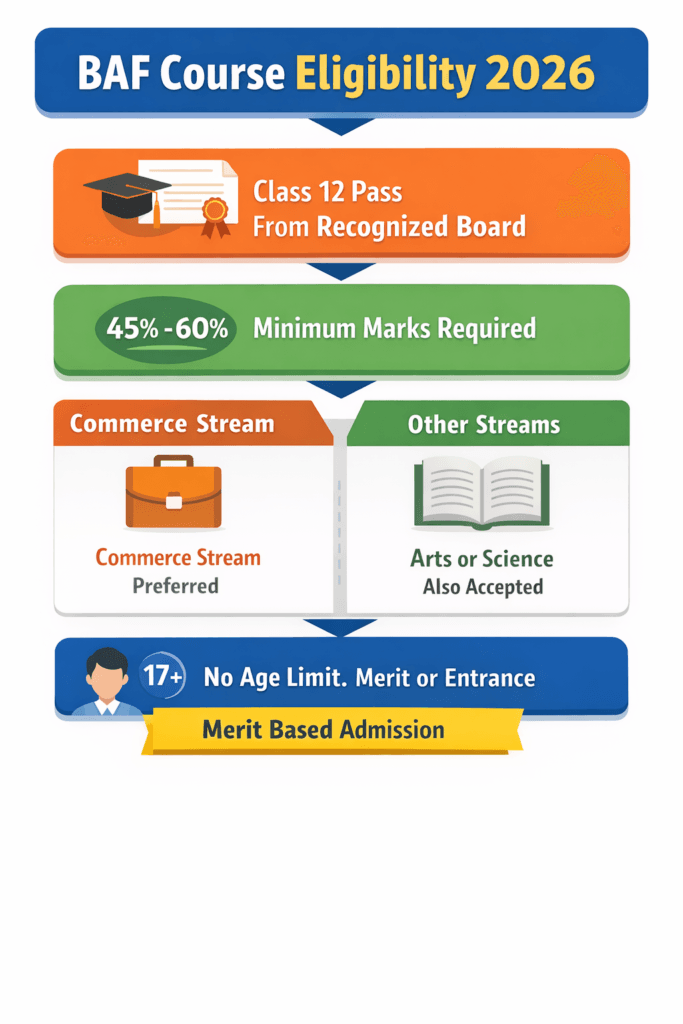
BAF course eligibility criteria 2026 require students to pass Class 12 from a recognized board with at least 45% to 60% marks. Commerce students are preferred because they already study accounting and finance basics, but many colleges also allow students from other streams based on merit and admission rules.
Minimum Qualification for BAF Course Admission 2026
The minimum qualification for BAF course admission 2026 is passing Class 12 (10+2) from a recognized board like CBSE, ISC, or State Board. Students must complete their higher secondary education before applying. This makes BAF course eligibility for commerce students simple and accessible after school.
Commerce students have an advantage because subjects like Accounts and Economics help in understanding the course faster. If you want to know what you will study, you can check the BAF Course Subjects and Syllabus 2026 for a complete semester-wise breakdown.
Minimum Marks for BAF Admission 2026
Minimum marks for BAF admission 2026 usually range between 45% and 60% in Class 12. Some top colleges may require higher marks depending on cut-off and competition. Students should always check college-specific requirements before applying to avoid admission issues later.
Higher marks can also help you get admission in better colleges with lower fees. You can compare college expenses in the BAF Course Fees in India 2026 guide before making your final decision.
BAF Course Eligibility for Commerce and Non-Commerce Students
BAF course eligibility for commerce students is straightforward because they already have accounting knowledge. However, many colleges also accept Science and Arts students if they meet the minimum marks requirement and basic admission criteria set by the college or university.
Non-commerce students may need extra effort in the first semester, but the course starts from basic concepts, so beginners can also adapt easily.
Age Limit and Admission Requirements
There is no strict age limit for BAF course admission in 2026. Students can apply after Class 12, and admission is mostly based on merit. Some universities may also use cut-off lists or simple admission processes depending on seat availability.
After confirming eligibility, the next step is understanding the BAF Course Admission Process 2026 to complete your registration correctly.
Quick Eligibility Summary Table
| Criteria | BAF Course Eligibility Requirement |
| Qualification | Pass Class 12 from recognized board |
| Minimum Marks | 45% to 60% depending on college |
| Stream | Commerce preferred, other streams allowed |
| Age Limit | No strict age limit |
| Admission Type | Merit-based in most colleges |
Meeting the BAF course eligibility criteria 2026 allows students to start a specialized career path in accounting, finance, banking, and taxation after Class 12.
BAF Course Duration 2026: Total Years and Semester Structure
BAF course duration 2026 is typically 3 years (6 semesters) for a regular degree, while the National Education Policy (NEP) offers an optional 4-year (8 semesters) Honours or Research track. This flexible timeline allows students to balance their graduation with professional certifications like the ACCA course for better global career prospects.
BAF Course Duration: Regular vs NEP Structure
The BAF course duration in India has evolved to offer more flexibility. While most colleges continue with the standard 3-year format, top universities now provide a 4-year Honours degree. This additional year is highly recommended for students who want to specialize in advanced financial modeling or international accounting standards.
| Program Type | Total Duration | Total Semesters | Outcome |
| Regular BAF Degree | 3 Years | 6 Semesters | Standard Bachelor’s Degree |
| BAF Honours (NEP) | 4 Years | 8 Semesters | Honours Degree with Specialization |
| BAF with Research | 4 Years | 8 Semesters | Research-focused Degree |
Choosing the 4-year track often provides better credits for those planning to study abroad. Before finalizing your college, make sure to check the BAF Course Fees 2026 to understand the year-wise cost of the extended program.
Semester-Wise Structure of BAF Course
The BAF course semester structure is designed to build financial expertise step-by-step. Each year is divided into two semesters of approx 6 months each. This ensures that students master basic bookkeeping before moving on to complex subjects like auditing, corporate law, and international taxation.
| Academic Year | Semester | Focus Area |
| First Year | Sem 1 & 2 | Fundamentals of Accounting, Economics |
| Second Year | Sem 3 & 4 | Corporate Accounting, Taxation, Finance |
| Third Year | Sem 5 & 6 | Advanced Finance, Auditing, Investments |
| Fourth Year (NEP) | Sem 7 & 8 | Research Project & Financial Strategy |
This progression is ideal for students who want to pursue the ACCA course alongside their degree, as many BAF subjects overlap with professional exam modules. To see the full list of topics, visit our BAF Course Subjects and Syllabus 2026 guide.
Exit Options Under NEP 2026 Structure
One of the most significant changes in the BAF course duration 2026 is the multiple exit policy. This system ensures that a student’s time and effort are recognized even if they cannot complete the full four-year program due to personal or professional reasons.
- Exit after 1 Year: Students receive a Certificate in Accounting.
- Exit after 2 Years: Students are awarded a Diploma in Finance.
- Exit after 3 Years: Students earn a standard Bachelor’s Degree (BAF).
- Completion of 4 Years: Students get a Bachelor’s Degree with Honours/Research.
This flexible duration makes it easier to manage the BAF Course Admission Process 2026 while keeping future career shifts in mind.
BAF Course Subjects and Syllabus 2026 (Semester-Wise)
The BAF course subjects and syllabus 2026 are designed to provide deep expertise in accounting, taxation, auditing, and financial management. Spread across 6 to 8 semesters under the NEP framework, the curriculum balances core theoretical knowledge with practical skills like financial modelling and data analytics to ensure students are industry-ready from day one.
Year-Wise Overview of BAF Course Subjects 2026
The BAF syllabus 2026 follows a progressive learning path. In the first year, students focus on foundational commerce subjects, while the subsequent years introduce complex corporate laws and international finance. This structured approach helps students transition smoothly from classroom learning to professional roles.
| Academic Year | Semester | Core Focus | Key Skill Developed |
| First Year | Sem 1 & 2 | Financial Accounting & Economics | Basic Bookkeeping & Analysis |
| Second Year | Sem 3 & 4 | Taxation, Business Law & Costing | Compliance & Internal Reporting |
| Third Year | Sem 5 & 6 | Auditing & Financial Management | Strategic Decision Making |
| Fourth Year | Sem 7 & 8 | Research & Advanced Specialization | Expertise in Financial Strategy |
BAF First Year Syllabus: Foundation Level
The BAF subjects for first year in 2026 emphasize the building blocks of finance. Under the new NEP guidelines, many colleges have also introduced “Skill Enhancement Courses” (SEC) like Digital Marketing or Excel for Finance in the very first year.
- Financial Accounting (I & II): Learning the double-entry system and final accounts.
- Business Economics: Understanding micro and macro market trends.
- Business Communication: Developing professional writing and presentation skills.
- Mathematics & Statistics: Essential for data-driven financial calculations.
- Indian Knowledge System (IKS): A new addition focusing on ancient Indian economic thoughts.
BAF Second Year Syllabus: Intermediate Level
BAF Second Year Syllabus: Intermediate Level
In the second year, the BAF course syllabus shifts toward corporate requirements. This is the stage where students handle specialized subjects like GST and Company Law. Many students start their ACCA course preparation during these semesters as the syllabus often overlaps with professional exam modules.
- Direct & Indirect Taxation: Focus on Income Tax and GST compliance.
- Corporate Accounting: Handling shares, debentures, and company balance sheets.
- Cost Accounting: Learning material, labor, and overhead costing.
- Business Law: Understanding the legal framework of Indian industries.
BAF Third Year Syllabus: Advanced Level
The third year is the most crucial part of the BAF degree subjects, focusing on high-level analysis and auditing. This year prepares you for the final placement rounds.
- Financial Management: Capital budgeting and working capital decisions.
- Auditing: Techniques of internal and statutory audit procedures.
- Investment Analysis: Learning about stock markets, portfolios, and risk.
- International Finance: Global exchange rates and multinational accounting.
Fourth Year BAF Subjects (NEP Honours Track)
For students opting for the 4th year in 2026, the syllabus becomes research-heavy. This year is designed for those who want to enter the fields of investment banking or academic research.
- Financial Modeling: Using software to predict financial performance.
- Data Analytics in Finance: Understanding Big Data and its impact on markets.
- Research Methodology: Conducting original studies in accounting trends.
- Strategic Financial Management: Advanced decision-making for large corporations.
Practical Training & Skill-Based Components

The BAF course 2026 is not just about books. Most autonomous colleges now include mandatory internships and software training.
- Tally Prime & GST: Hands-on training for real-world accounting.
- Advanced Excel: Creating complex financial dashboards.
- Internships: 2-3 months of industry exposure in the final years.
Meeting the BAF course eligibility 2026 allows you to dive into this rich syllabus. Once you are familiar with the subjects, you can plan your budget by checking the BAF Course Fees 2026 across various top-tier colleges.
BAF Course Fees in India 2026: Government and Private College Cost
BAF course fees in India 2026 range from ₹30,000 to ₹6,50,000 for the full program, depending on the college type and city. Government colleges offer lower fees, while private colleges charge more for better infrastructure and placements. Fees are usually higher in major education hubs like Mumbai, Delhi, and Bangalore due to strong industry exposure.
BAF Course Fees in Government Colleges 2026 (Affordable Option)
BAF course fees in government colleges 2026 usually range between ₹10,000 and ₹50,000 per year. These colleges are subsidized by the government, making them the best choice for students looking for quality education at a low cost.
| Fee Component | Average Cost per Year |
| Tuition Fee | ₹8,000 – ₹30,000 |
| Admission Fee | ₹1,000 – ₹3,000 |
| Examination Fee | ₹1,000 – ₹3,000 |
| Total Annual Fees | ₹10,000 – ₹50,000 |
Government colleges in cities like Mumbai and Delhi may charge slightly higher fees due to university regulations and additional facilities.
BAF Course Fees in Private Colleges 2026 (City-Wise Variation)
BAF course fees in private colleges 2026 typically range from ₹50,000 to ₹2,00,000 per year, with metro cities charging higher fees. Colleges in Mumbai, Bangalore, Pune, and Delhi often have higher costs because of better placement opportunities and corporate exposure.
| Fee Component | Average Cost per Year |
| Tuition Fee | ₹40,000 – ₹1,80,000 |
| Admission & Registration Fee | ₹3,000 – ₹10,000 |
| Examination Fee | ₹2,000 – ₹6,000 |
| Lab and Library Charges | ₹5,000 – ₹15,000 |
| Total Annual Fees | ₹50,000 – ₹2,00,000 |
Private colleges also provide internship programs, accounting software training, and placement preparation.
Total BAF Course Cost in India (Complete Program Cost)
The total BAF course fees in India for 2026 usually range between ₹30,000 and ₹6,50,000 depending on college type, city, and NEP honours structure.
| College Type | Total Course Fees |
| Government College | ₹30,000 – ₹1,50,000 |
| Semi-Private College | ₹90,000 – ₹3,50,000 |
| Private College | ₹1,50,000 – ₹6,50,000 |
Students choosing metro cities may pay higher fees, but they also get better career exposure and placement opportunities.
Scholarships and Fee Reduction Options for BAF Students
Many colleges and government schemes offer scholarships to reduce BAF course fees for eligible students. This makes the course more affordable even in private institutions.
- Merit-based scholarships for high marks in Class 12
- Need-based scholarships for financially weaker students
- State government scholarship programs
- College-specific fee waivers for top performers
Students can check official scholarship and university fee guidelines through the University Grants Commission website for authentic and updated information (https://www.ugc.gov.in).
Official Reference for Professional Accounting Course Fee Comparison – (https://www.imanet.org).
Explore Next: US CMA Course Fees 2026, Duration, Salary and Career Scope →
BAF Course Admission Process 2026: Step-by-Step Guide
BAF course admission process 2026 usually includes online registration, merit list or entrance exam selection, document verification, and fee payment. Most colleges give admission based on Class 12 marks, while top universities may require exams like CUET or NPAT. Applying early improves your chances of getting a top finance college.
Step 1: Check BAF Course Eligibility and Subject Requirements
BAF course eligibility for admission 2026 requires passing Class 12 from a recognized board with at least 45% to 60% marks. Commerce students get preference, but many colleges also accept Science and Arts students. Having subjects like Accountancy, Mathematics, or Economics is helpful for admission and future finance careers.
Before applying, you can also check the BAF Course Subjects and Syllabus 2026 to understand what you will study after admission.
Step 2: Register for Entrance Exams (If Required)
Some universities use entrance exams instead of direct merit for BAF admission 2026. These exams help colleges select students based on aptitude and academic ability.
Major entrance exams include:
- CUET UG – For Central Universities like DU and BHU
- NPAT (NMIMS) – For NMIMS Mumbai and other campuses
- SET / MHT-CET – For colleges in Maharashtra
- IPU CET – For GGSIPU colleges in Delhi
Step 3: Fill the Online Application Form
BAF admission form 2026 must be filled on the official university or college website. Students need to complete registration and upload required documents.
You will need to submit:
- Personal details and contact information
- Class 10 and Class 12 marksheets
- Photo and identity proof
- College preferences
- Application fee (₹100 – ₹500 approx.)
Many universities use centralized portals like University of Mumbai admission portal for registration.
Step 4: Check Merit List and Cut-Off Percentage
BAF admission is finalized through merit lists released by colleges. If your marks meet the cut-off, your name will appear in the selected list.
| Merit List Round | Expected Timeline | Purpose |
| 1st Merit List | June 2026 | Highest cut-off, best colleges |
| 2nd Merit List | Late June 2026 | Slightly lower cut-off |
| 3rd Merit List | July 2026 | Final chance for admission |
Top colleges may have cut-offs between 75% and 95%, depending on demand.
Step 5: Document Verification and Fee Payment
After selection, students must complete document verification and pay the admission fees to confirm their seat. Missing the deadline can result in seat cancellation.
Required documents include:
- Class 10 and 12 marksheets
- Transfer Certificate
- Identity proof
- Passport size photos
- Category certificate (if applicable)
After verification, students must pay the first-year BAF Course Fees 2026 to secure admission.
Official Admission Updates and Application Portal
Students should always verify admission dates and process from official university websites such as the University Grants Commission to avoid missing deadlines.
Top BAF Colleges in India 2026: Ranking, Fees, and Placement Details
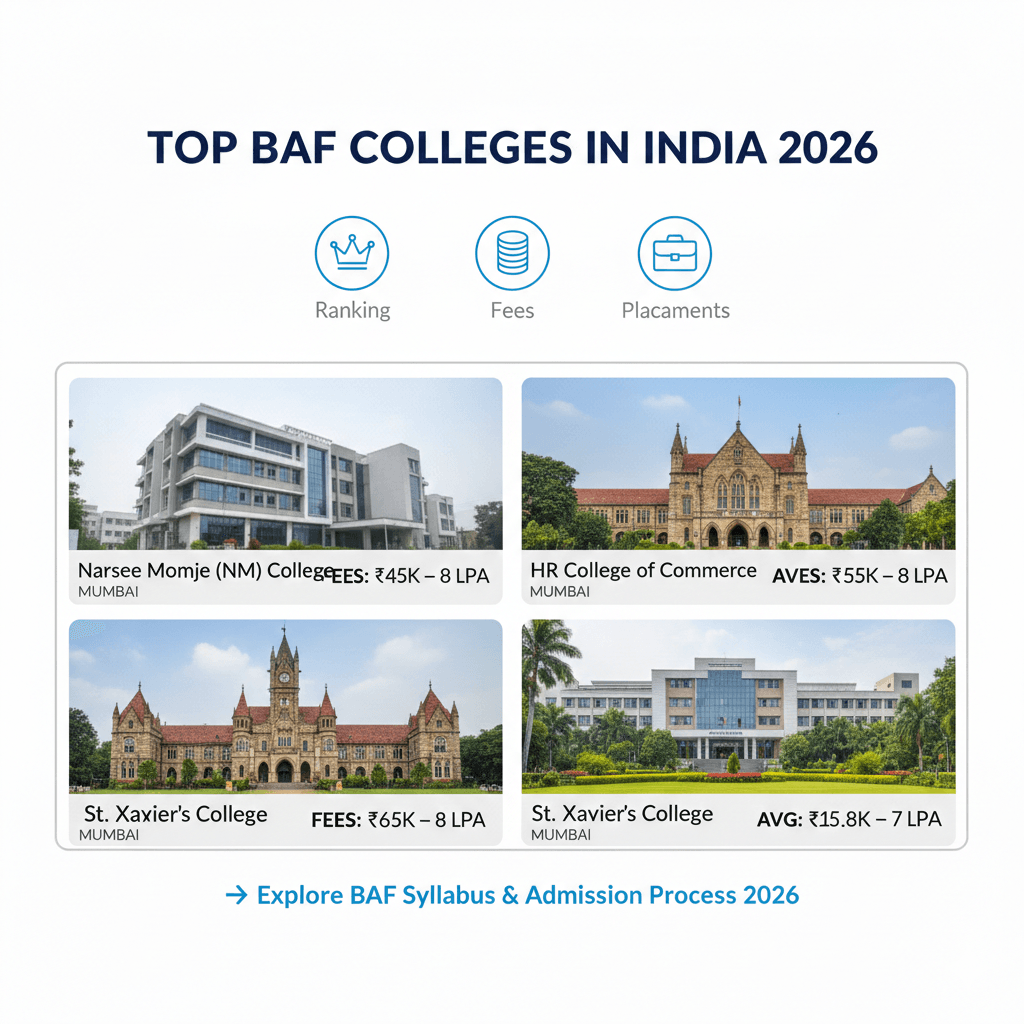
Top BAF colleges in India 2026 include HR College, NM College, and Christ University, known for strong placements and industry exposure. The BAF course offers average salary packages ranging from ₹6 LPA to ₹12 LPA, especially in finance hubs like Mumbai, Bangalore, and Delhi. Students should compare placement records, ROI, and NEP-aligned curriculum before selecting a college.
Best BAF Colleges in Mumbai 2026 (Highest Placement Hub)
Mumbai is the financial capital, making it the best location for BAF aspirants. Most top colleges here are now autonomous or part of cluster universities like HSNC, which gives them more flexibility in their syllabus and internship tie-ups.
| College Name | 2026 Avg Package (Approx) | Annual Fees (Approx) |
| Narsee Monjee (NM) College | ₹7 LPA – ₹12 LPA | ₹40,000 – ₹55,000 |
| HR College of Commerce | ₹6.5 LPA – ₹10 LPA | ₹45,000 – ₹60,000 |
| St. Xavier’s College | ₹7 LPA – ₹11 LPA | ₹30,000 – ₹50,000 |
| Mithibai College | ₹6 LPA – ₹9 LPA | ₹40,000 – ₹1,40,000 |
| Jai Hind College | ₹6 LPA – ₹10 LPA | ₹50,000 – ₹70,000 |
Top BAF Colleges Outside Mumbai (National Level Options)
Beyond Mumbai, universities are offering specialized finance programs that are equivalent to BAF in terms of career scope. These colleges often require entrance exams like CUET UG 2026 or NPAT.
- Christ University (Bangalore): Offers B.Com in Finance & Investment. Known for its rigorous academic culture and packages up to ₹10 LPA.
- SRCC (Delhi): While it offers B.Com (Hons), its finance track is the gold standard in India with average packages often exceeding ₹10.5 LPA.
- Symbiosis (SCMS), Pune: A great option for corporate networking with an average package of ₹6.5 LPA – ₹9 LPA.
- Loyola College (Chennai): Best for students targeting traditional accounting and banking roles in South India.
How to Choose the Best BAF College for Finance Career
Selecting a college is a big decision. In 2026, don’t just go by the name; verify these three updated factors:
- Entrance Exam Requirements: Check if the college accepts CUET or has its own test like NPAT or XET.
- NEP 2026 Structure: Ensure the college offers the 4th-year “Honours with Research” option, which is vital for pursuing a Master’s abroad.
- Industry Integration: Look for colleges that have tie-ups for US CMA or ACCA certifications to save on professional fees.
A top-tier BAF college can help you secure a starting salary of ₹5 LPA to ₹12 LPA, depending on your skills and internships. For more details on the application steps, you can read our BAF Course Admission Process 2026 guide.
Career Opportunities After BAF Course 2026: Jobs and Growth Options
The BAF course offers strong career opportunities in accounting, finance, banking, and corporate sectors. After completing BAF in 2026, graduates can work in roles like Accountant, Financial Analyst, Auditor, or Tax Assistant, with starting salaries typically ranging from ₹3 LPA to ₹6 LPA. With experience and certifications, career growth and salary increase significantly.
Top Job Roles After BAF Course
- Accountant – Manage financial records, GST, and company accounts
- Financial Analyst – Analyze financial data and support business decisions
- Tax Consultant – Handle income tax, GST filing, and tax planning
- Auditor – Verify financial statements and ensure compliance
- Banking Executive – Work in private banks, NBFCs, and financial institutions
Top Recruiters Hiring BAF Graduates
BAF graduates are hired by accounting firms, banks, and MNCs such as Deloitte, EY, KPMG, PwC, ICICI Bank, HDFC Bank, and Infosys.
Higher Study and Certification Options for Better Growth
To increase salary and career scope, many students pursue professional courses like:
- ACCA (Global accounting career) – Explore ACCA Course Details, Fees, and Career Scope →
- US CMA (Management accounting and corporate finance) – View Complete US CMA Course Guide, Eligibility, and Salary →
- CA (Chartered Accountant) – Check CA Course Full Details, Duration, and Career Path →
- MBA in Finance
BAF Course Salary in India 2026: Freshers and Experienced Salary
BAF course salary in India 2026 typically ranges from ₹2.5 lakh to ₹5 lakh per year for freshers, depending on skills, city, and job role. With 3–5 years of experience, salary can increase to ₹5 lakh to ₹10 lakh per year or more in finance and accounting roles. These figures are based on industry salary data from platforms like Glassdoor and job listings.
For example, fresher accounting and finance graduates in India earn around ₹3 lakh to ₹4 lakh per year on average, while experienced professionals can earn ₹6 lakh or higher depending on role and company.
BAF Course Fresher Salary in India 2026
Students completing the BAF course usually start in entry-level roles such as Accounts Executive, Finance Assistant, or Audit Associate.
Average fresher salary range:
- ₹18,000 to ₹33,000 per month (₹2.2 lakh to ₹4 lakh per year) in finance associate roles
- Around ₹3 lakh to ₹4 lakh per year average for accounting and finance freshers
- Entry-level accounting graduates may earn about ₹19,000 to ₹21,000 per month depending on company and location
Higher salaries are possible in metro cities like Mumbai, Bangalore, and Delhi, especially in corporate finance or investment firms.
BAF Course Salary After 3–5 Years Experience
With experience and strong skills in accounting, taxation, or financial analysis, salary increases significantly.
Typical experienced salary range:
- ₹5 lakh to ₹8 lakh per year in finance and accounting roles
- Top performers may earn ₹8 lakh to ₹12 lakh per year or more in senior roles
- Corporate finance professionals in large companies can earn even higher depending on role and certification
BAF Course Salary by Job Role
| Job Role | Average Salary Range (Per Year) |
| Accounts Executive | ₹2.5 lakh – ₹4.5 lakh |
| Audit Assistant | ₹3 lakh – ₹5 lakh |
| Financial Analyst | ₹4 lakh – ₹8 lakh |
| Tax Consultant | ₹4 lakh – ₹7 lakh |
| Finance Executive | ₹3 lakh – ₹6 lakh |
Factors That Affect BAF Course Salary
Your salary after BAF depends on several important factors:
📍 City (Mumbai, Bangalore, Delhi offer higher salaries)
🎓 Skills (Excel, Tally, Financial Analysis)
🏢 Company size and industry
📜 Professional certifications like ACCA, US CMA, or CA
💼 Internship and practical experience
BAF vs BMS vs B.Com (Hons): Which is Better in 2026?
BAF vs BMS vs B.Com (Hons) comparison 2026 shows that BAF is best for accounting careers, B.Com (Hons) is best for CA and global finance certifications, and BMS is best for management and MBA. In 2026, the average starting salary ranges from ₹4 LPA to ₹12 LPA depending on college quality, internships, and technical skills like Excel, Data Analytics, and Financial Modelling.
Detailed Comparison: BAF vs BMS vs B.Com (Hons) 2026
Choosing between these three depends on your aptitude. If you love numbers, go for BAF or B.Com (Hons). If you enjoy strategy, communication, and leading teams, BMS is your best bet.
| Feature | BAF Course | BMS Course | B.Com (Hons) |
| Core Focus | Accounting & Taxation | Business Management | Commerce & Economics |
| Difficulty | High (Numerical) | Moderate (Theory) | High (Concept-based) |
| Best Career Path | Investment Banking, Audit | Marketing, HR, Ops | CA, CFA, ACCA, Banking |
| Avg Salary (2026) | ₹4.5 LPA – ₹9 LPA | ₹4 LPA – ₹8 LPA | ₹5 LPA – ₹12 LPA |
| MBA Advantage | Good for Finance MBA | Best for all MBA tracks | Strong Foundation |
BAF Course FAQ 2026: Skills, Cutoff, Salary, and Career Questions
1. What skills will you learn in the BAF course?
BAF course teaches accounting, taxation, auditing, financial analysis, and Excel skills. You also learn practical tools like Tally and gain analytical skills needed for finance jobs.
2. What cutoff percentage is required for BAF admission?
BAF course cutoff usually ranges from 75% to 95% in Class 12, depending on the college. Top Mumbai colleges generally require higher percentages.
3. What is the salary after BAF course in the Middle East?
BAF graduates can earn around AED 4,000 to AED 9,000 per month at entry level. Salary increases with experience and professional certifications.
4. Is internship compulsory in the BAF course 2026?
Many colleges include internships in the final year. It helps students gain practical experience and improves placement opportunities.
Disclaimer
The information provided in this BAF course guide is for educational and informational purposes only. Fees, salary, admission criteria, and career outcomes may vary by college, location, and individual performance. Readers should always verify details from official university websites or authorized sources before making any academic or financial decisions.
We do not promote or guarantee admission, salary, or career outcomes, and this content is not intended as financial, career, or professional advice.