What Is MIS? Complete Beginner Guide for Commerce Students (2026)
MIS (Management Information System) is a computer-based system that collects, organizes, and analyzes business data to help managers make smart decisions. In 2026, the demand for structured data reporting is increasing rapidly, which is why MIS Career in India 2026 is becoming a stable and practical option for commerce students.
If you are studying commerce and thinking about future career options, understanding MIS is very important. Let’s break it down in simple words.
What Does MIS Stand For? (MIS Full Form Explained)
MIS full form is Management Information System.
Every business generates large amounts of data every day — sales numbers, customer details, stock levels, expenses, profits, and performance reports.
MIS works like a smart system that:
- Collects raw data
- Organizes it properly
- Processes it using tools like Excel or reporting software
- Converts it into simple reports and dashboards
Raw Data → MIS Processes It → Useful Information → Better Business Decisions
MIS is not only about computers. It is a combination of business knowledge and technology tools. That is why commerce students feel comfortable in this field — because it connects accounts, finance, and business understanding with reporting tools.
As companies in India depend more on data-driven decisions, MIS Career in India 2026 offers strong job opportunities for students who understand numbers and basic technology tools.
If you want to master MIS reporting and dashboards in Excel, check out these practical guides:
Why MIS Is a Smart Career Choice After B.Com, BBA, or BMS in 2026
MIS is a smart career choice after B.Com, BBA, or BMS because it combines business knowledge with practical data skills like Excel, reporting, and analytics. It offers stable job opportunities, decent starting salaries, and strong long-term growth in India’s growing corporate sector.
If you are a commerce graduate wondering what to do next, MIS can be a practical and realistic option. Unlike purely technical fields, MIS does not require advanced coding. Instead, it builds on what you already studied — accounts, finance, business management, and statistics.
That is why many students now consider MIS Career in India 2026 as a stable and low-risk career path.
MIS Course Details After 12th Commerce in India (2026): Best Colleges, Fees, Duration & Eligibility
MIS course after 12th commerce in India is usually pursued through B.Com, BBA, or BMS programs with MIS, IT, or Information Systems specialization. The course duration is typically 3 years, fees range from ₹20,000 to ₹6 lakh depending on the college, and eligibility requires passing 12th from a recognized board. This pathway builds the foundation for a stable MIS Career in India 2026.
What is the duration of MIS course after 12th commerce?
Undergraduate Degree (B.Com / BBA / BMS): 3 years (6 semesters)
Some universities under NEP 2020: 4 years (with honors option)
Diploma / Certification: 6–12 months
For long-term career growth, a full graduation degree is recommended before entering the MIS Career in India 2026 job market.
What is the eligibility for MIS course after 12th commerce in India?
Academic Requirement — Completion of 12th grade from CBSE, ICSE, or any recognized State Board.
Minimum Marks — Most colleges expect around 45–50% aggregate, though the exact cutoff may vary by institution.
Stream Background — Commerce is preferred in many cases, but it is not mandatory for admission.
Mathematics Requirement — Basic knowledge of Mathematics or Statistics can be helpful, yet it is usually not compulsory.
Admission Process — Entry may be based on merit or through university-level entrance tests such as CUET UG, SET, or IPU CET, depending on the university.
Entrance Difficulty Level — There is generally no highly technical or engineering-style entrance examination required.
Which are the best colleges for MIS course after 12th commerce in India (2026)?
Here are reputed institutions offering strong MIS-related electives:
Shri Ram College of Commerce (SRCC), Delhi University
Course Focus — B.Com (Hons) program with Information Technology (IT) or MIS-related electives integrated into the curriculum.
Total Fees — Approximately ₹90,000 to ₹1,00,000 for the complete program (may vary slightly by institution).
Program Duration — Typically 3 to 4 years, depending on the university structure.
Placement Strength — Known for a solid placement record with opportunities in business analytics, operations, and corporate roles.
Loyola College, Chennai
Course Structure — B.Com or BBA program with a strong focus on systems, business technology, and management applications.
Fee Range — Approximately ₹50,000 to ₹1.5 lakh for the full course, depending on the institution.
Duration — Standard 3-year undergraduate program.
Christ University, Bangalore
Course Structure — BBA or B.Com program integrated with Information Systems subjects and technology-oriented business modules.
Fee Range — Approximately ₹2 lakh to ₹4 lakh for the complete program, depending on the institution and facilities offered.
Duration — Usually 3 to 4 years, based on the university curriculum structure.
Symbiosis Centre for Management Studies (SCMS)
Course Structure — BBA program with a dedicated specialization in IT or Business Systems, focusing on technology-driven management concepts.
Fee Range — Approximately ₹3 lakh to ₹5 lakh for the full course, depending on the institution and infrastructure.
Duration — Standard 3-year undergraduate program.
NMIMS University, Mumbai
Course Structure — BBA or B.Com program supported by Analytics or IT-focused electives, designed to build business and data-driven decision-making skills.
Fee Range — Approximately ₹3 lakh to ₹6 lakh for the complete program, depending on the institution and facilities offered.
Duration — Generally 3 to 4 years, based on the university curriculum framework.
Government universities under Delhi University, Mumbai University, and state universities offer more affordable options.
What is the fees for MIS course after 12th commerce in India?
| Type of College | Approx Total Fees (3 Years) |
| Government / Aided | ₹20,000 – ₹1 lakh |
| Private Universities | ₹1.5 lakh – ₹6 lakh |
| Diploma Courses | ₹15,000 – ₹60,000 |
Hostel and additional costs may range from ₹50,000–₹1.5 lakh per year if studying outside your city.
Why Choose MIS Course After 12th Commerce in 2026?
Because businesses now depend heavily on structured data and reporting. MIS programs teach:
Data management
Business reporting
ERP basics
Excel & analytics tools
After graduation and skill development, students can apply for entry-level MIS Executive roles with starting salaries around ₹3–4.5 LPA. As demand increases, MIS Career in India 2026 continues to offer steady opportunities in banking, IT services, manufacturing, retail, and startups.
How to build a strong foundation for MIS career after 12th commerce?
To build a strong foundation for an MIS career after 12th commerce, choose a B.Com or BBA program with IT or analytics subjects and start learning Excel, basic data analysis, and business processes early. Focus on improving logical thinking and communication skills, as MIS combines technology with management decision-making.
- Choose BBA IT/Systems or B.Com with MIS electives
- Prepare for CUET UG if targeting central universities
- Start learning Excel during first year of college
- Add Power BI or SQL certification before graduation
With the right degree and practical skills, MIS Career in India 2026 can become a stable and growth-oriented career path.
MIS Salary and placement in India 2026: Freshers to Senior Level Salary Breakdown (Detailed Guide) 2026
MIS Salary in India 2026 ranges from ₹3–4.5 LPA for freshers and can go up to ₹25 LPA or more at senior levels depending on experience, company, and location. MIS professionals work in reporting, dashboards, data management, and business analysis roles across IT, banking, retail, and manufacturing sectors.
What Is the MIS Salary for Freshers in India in 2026?
Fresh graduates from B.Com, BBA, or BMS typically earn between ₹3–4.2 LPA.
- Average starting salary: ₹3–3.5 LPA
- Monthly in-hand: ₹20,000–35,000
- Metro cities may offer ₹4–5 LPA
- Strong Excel, SQL, or Power BI skills can increase salary by 20–30%
Most freshers begin as:
- MIS Executive
- Junior MIS Analyst
- Reporting Executive
This is the entry point for a stable MIS Salary in India 2026 growth path.
What is the MIS salary after gaining 2 to 6 years of experience?
Mid-level professionals usually earn between ₹5–9 LPA.
- Monthly income: ₹40,000–75,000
- Common roles: MIS Analyst, Senior MIS Executive
- Switching to Data Analyst roles can increase pay further
At this stage, professionals who upgrade skills in Power BI, SQL, and automation see faster salary growth.
What is the MIS salary for senior professionals in India?
With 8+ years of experience, salaries typically range between ₹10–25 LPA.
- Monthly income: ₹80,000–2 lakh+
- Roles: MIS Manager, Senior MIS Manager
- Leadership and domain knowledge increase compensation
In large companies and metro cities, packages may go beyond ₹25 LPA depending on responsibility.
This shows how MIS Salary in India 2026 increases steadily with experience.
MIS Salary Breakdown Table (2026 Estimate)
Fresher MIS Executive (0–2 Years)
Average Salary — ₹3–4.2 LPA
Monthly In-Hand — ₹20,000–35,000
Growth Potential — ₹5–6 LPA
MIS Analyst (2–6 Years)
Average Salary — ₹5–9 LPA
Monthly In-Hand — ₹40,000–75,000
Growth Potential — ₹10–12 LPA
MIS Manager (8+ Years)
Average Salary — ₹10–25+ LPA
Monthly In-Hand — ₹80,000–2L+
Growth Potential — ₹30+ LPA
Which Companies Offer MIS Placements in India in 2026?
Many IT and corporate companies regularly recruit MIS professionals.
Common recruiters include:
- TCS
- Wipro
- Infosys
- Accenture
- Cognizant
- Genpact
- Banks and retail companies
Freshers can apply through job portals like Naukri, LinkedIn, and Indeed. Many companies also offer remote or hybrid roles.
Is MIS a good career option for commerce students in terms of salary?
Yes, MIS is a smart career choice because entry barriers are low and growth is steady. It does not require advanced coding, and corporate demand remains stable. Career progress depends mainly on skills, and professionals can later move into Data Analyst or Business Analyst roles. With consistent skill development, MIS salary in India can grow significantly within three to four years.
Which Career Is Better for Commerce Students in 2026: MIS, Data Analyst, or Business Analyst?
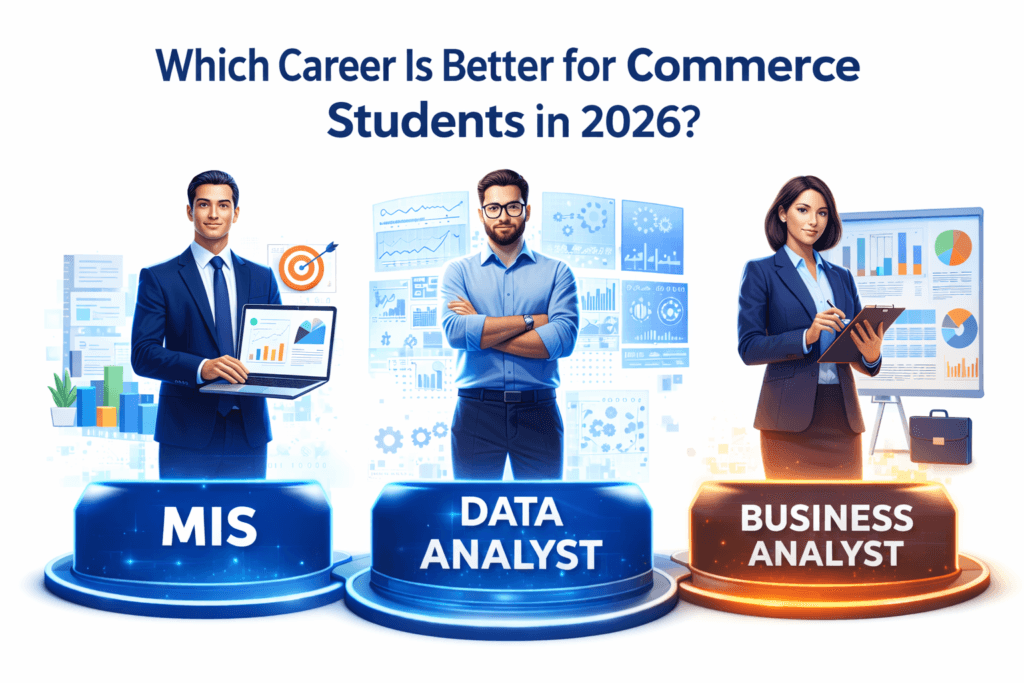
MIS, Data Analyst, or Business Analyst? The right choice depends on your skills, learning capacity, and salary goals. MIS is the easiest entry option, Data Analyst offers faster salary growth, and Business Analyst provides strong long-term leadership opportunities.
For many students, MIS Career in India 2026 remains the safest starting point because it requires fewer technical skills and offers stable job openings.
Quick Comparison Table (India 2026)
MIS (India 2026)
Entry Difficulty — Easy
Fresher Salary — ₹3–4.2 LPA
Mid-Level Salary — ₹5–9 LPA
Senior Salary — ₹10–25+ LPA
Technical Skills — Low to Moderate
Growth Speed — Steady
AI Risk — Low
Data Analyst (India 2026)
Entry Difficulty — Medium
Fresher Salary — ₹3.5–6.5 LPA
Mid-Level Salary — ₹6–12 LPA
Senior Salary — ₹12–25+ LPA
Technical Skills — Moderate to High
Growth Speed — Fast
AI Risk — Medium
Business Analyst (India 2026)
Entry Difficulty — Medium
Fresher Salary — ₹4–8 LPA
Mid-Level Salary — ₹6–13 LPA
Senior Salary — ₹13–20+ LPA
Technical Skills — Moderate
Growth Speed — Fast
AI Risk — Low
Which career offers higher salary growth in India – MIS or Data Analyst?
Data Analyst roles usually offer faster salary growth.
Career Advantage — Usually offers faster salary growth compared to MIS roles.
Core Tools — SQL, Power BI or Tableau, basic Python, and strong data interpretation skills.
Starting Salary — Generally slightly higher than entry-level MIS positions.
Growth Potential — Rapid career progression possible with consistent improvement in technical skills.
Best For — Students who are comfortable learning technical tools and working with data-driven systems.
Final Decision Guide for Commerce Students (2026)
Choose MIS if you want the fastest and safest job entry.
Choose Data Analyst if you aim for higher salary growth.
Choose Business Analyst if you prefer strategy and communication roles.
For most students, starting with MIS Career in India 2026 is practical because it builds a strong foundation in reporting and business data.
How will AI affect MIS, Data Analyst, and Business Analyst jobs?
- MIS: Low impact (business understanding still required)
- Data Analyst: Moderate impact (automation helps but does not replace analysis)
- Business Analyst: Low impact (human decision-making remains important)
Automation may reduce repetitive work, but human interpretation and business logic remain essential.
What Are the Top MIS Interview Questions for Freshers in 2026?
MIS interview questions for freshers in India 2026 mainly focus on Excel skills, reporting methods, SQL basics, dashboard creation, and practical data-handling scenarios. Preparing around these common interview patterns can significantly improve your selection chances and strengthen your overall MIS career preparation.
1. What is MIS?
MIS stands for Management Information System. It involves collecting, organizing, and analyzing business data to support decision-making. In practical roles, MIS professionals create structured reports and dashboards using tools like Excel or SQL to help management make informed decisions.
2. What are the responsibilities of an MIS Executive?
An MIS Executive prepares daily, weekly, or monthly reports for management.
The role also includes maintaining data accuracy, coordinating with departments, and ensuring that reports are delivered on time without errors.
3. Which Excel skills are important for MIS jobs?
Excel is the backbone of MIS roles. Functions like VLOOKUP or XLOOKUP, Pivot Tables, IF formula, and SUMIFS are commonly used.
These tools help in analyzing large datasets, creating summaries, and preparing professional reports efficiently.
4. What is a Pivot Table?
A Pivot Table is an Excel feature that summarizes large amounts of data quickly.
It helps in grouping, filtering, and calculating totals without changing the original dataset, which is very useful in reporting.
5. How do you ensure accuracy in MIS reports?
Accuracy is ensured by checking formulas, validating totals, and removing duplicate data.
Cross-verifying reports with source data before submission is also an important step.
6. What is SQL and why is it useful in MIS?
SQL is a database language used to retrieve specific data from large databases.
In MIS roles, SQL helps extract required records so that accurate reports can be generated.
7. What is the difference between MIS and Data Analyst?
MIS mainly focuses on structured reporting and data maintenance.
A Data Analyst focuses more on deep data interpretation and business insights using advanced tools.
8. How do you handle large datasets?
Large datasets can be managed using filters, sorting, and Pivot Tables.
Organizing data into structured formats improves efficiency and reduces errors.
9. Why should we hire you for an MIS role?
I have strong Excel knowledge and attention to detail.
I can prepare accurate reports, manage data efficiently, and support management decisions effectively.
Which Are the Best Certifications for MIS Career in India in 2026? (SAP, Power BI, SQL & More)
MIS career in India is growing steadily in 2026, especially for commerce students and freshers targeting MIS Executive or MIS Analyst roles. The right certification can help you get shortlisted faster because companies now expect practical skills in Excel, Power BI, and basic SQL instead of only theoretical knowledge.
Below are the most valuable and realistic certifications for beginners in 2026.
1. Microsoft Power BI Data Analyst Associate (PL-300)
This is currently the most in-demand certification for MIS roles.
It covers data modeling, DAX formulas, dashboard creation, data transformation, and report publishing.
Duration: 2–4 months
Cost: Around ₹4,800 exam fee (training resources available free & paid)
Why choose it: In 2026, many companies use Power BI for MIS reporting. This certification adds strong resume value.
2. Microsoft Excel Certification (MOS – Excel Associate/Expert)
Excel is still the foundation of MIS jobs.
This certification focuses on Pivot Tables, advanced formulas, charts, Power Query, and data analysis tools.
Duration: 1–2 months
Cost: ₹4,000–6,000 (exam fee)
Why choose it: More than 80% of MIS job postings require advanced Excel knowledge.
3. Google Data Analytics Professional Certificate
This is a beginner-friendly certification available online.
It covers Excel, SQL, Tableau, data cleaning, and basic reporting concepts.
Duration: 4–6 months
Cost: Affordable monthly subscription (financial aid available)
Why choose it: Good starting point if you are completely new to data tools.
4. Basic SQL Certifications
SQL is important for extracting data from company databases.
You can choose beginner certifications like Azure Data Fundamentals or practical SQL platforms that offer completion certificates.
Duration: 1–2 months
Cost: Free to ₹5,000
Why choose it: Even basic SQL knowledge increases your job opportunities in MIS roles.
5. Tableau Desktop Specialist
Tableau is another data visualization tool used in consulting and finance companies.
It covers dashboard building, calculations, and data storytelling.
Duration: 2–3 months
Cost: ₹8,000–9,000 exam fee
Why choose it: Useful if the company you are targeting uses Tableau instead of Power BI.
6. SAP Beginner Modules (Optional but High Value)
SAP certifications are useful in manufacturing and large corporate environments.
You can start with beginner-level SAP modules and later move to advanced certifications.
Duration: 3–6 months
Cost: Higher compared to other certifications
Why choose it: Strong long-term career growth potential.
Which Certification Should You Do First in 2026?
Start with Advanced Excel and Power BI. These two certifications alone can make you eligible for most entry-level MIS Executive roles.
After that, add basic SQL knowledge. If you want extra advantage, choose either Google Data Analytics or Tableau depending on your career goal.
Final Advice for Students
If you focus on Excel + Power BI + basic SQL, your chances of getting selected in MIS career in India roles will increase significantly in 2026.
How to Get Your First MIS Job in India: Step-by-Step Practical Guide 2026
Looking for how to get your first MIS job in India? If you’re a commerce student from any cities, this guide is perfect for you. MIS career in India offers easy entry for B.Com/BBA grads with basic skills like Excel, Power BI, and SQL. Thousands of MIS Executive fresher openings exist today, and with the right approach, you can land your first role fast.
Step 1: Build the Must-Have Skills (1–3 Months)
Skills required for MIS career in India include:
- Advanced Excel: Pivot tables, VLOOKUP, INDEX-MATCH, charts, Power Query
- Basic SQL: SELECT, WHERE, JOIN, GROUP BY queries
- Power BI/Tableau: Dashboards, slicers, basic DAX
- Reporting basics: Daily/weekly sales, inventory, or expense reports
Free ways to learn:
- YouTube channels: ExcelIsFun, Chandoo, Power BI tutorials
- Coursera / Google Data Analytics Professional Certificate (free audit)
- Microsoft Learn: Free Power BI/SQL paths
Practice projects: 2–3 sample projects like sales dashboard, expense tracker, or inventory report. Keep screenshots for portfolio.
Step 2: Create a Strong Fresher Resume & LinkedIn Profile
Resume tips for MIS career in India
- Keep it 1 page: Education (B.Com/BBA), skills, projects, certifications
- Use keywords like: “MIS Executive”, “Excel reporting”, “Power BI dashboards”, “data analysis”
- LinkedIn: Professional photo, headline “B.Com Fresher | Seeking MIS Executive Role | Excel + Power BI”
- Add portfolio links for 2–3 sample dashboards or reports
Step 3: Get Certifications to Stand Out (Optional but Powerful)
Certifications to boost MIS career in India
- Microsoft Power BI Data Analyst (PL-300) – most asked
- Advanced Excel (MOS Expert)
- Google Data Analytics Certificate (Coursera)
These make your profile ATS-friendly and impress recruiters.
Step 4: Apply on the Best Platforms
Job portals for MIS career in India
- Naukri.com – Search “MIS Executive Fresher” or “MIS Analyst 0-1 year” and apply 10–15 daily
- LinkedIn – Follow companies like TCS, Wipro, Genpact; use Easy Apply
- Indeed.in – Filter “Entry Level” + “MIS”; many remote/WFH options
- Company Career Pages: TCS, Wipro, Infosys, Accenture, Hexaware
- Internshala / Apna – Local & remote roles for Bihar/Patna
Tip: Apply to mass recruiters first – they hire freshers in bulk.
Step 5: Prepare for Interviews & Get Shortlisted
Long-tail keyword start: Interview preparation for MIS career in India
- Resume screen → Aptitude/Excel test → HR round → Technical (Excel/SQL demo)
- Practice top questions: “What is MIS?”, Pivot tables, SQL queries
- Highlight projects: “I built a Power BI dashboard analyzing sample sales data”
Step 6: Follow Up & Track Applications
- Maintain Excel sheet: Job title, company, date applied, status
- Follow up politely on LinkedIn after 1 week if no response
- Aim for 50–100 applications per month – rejection is normal, persistence wins
Realistic Timeline & Expectations in 2026
- Prep + apply: 1–3 months → First interview calls
- Fresher salary: ₹3–4.2 LPA (₹20k–35k/month)
- Remote/WFH: Many roles allow working from any cities
- Growth: Use first MIS Executive job to gain experience, then switch to Data Analyst or MIS Analyst for higher pay
Bottom Line: Starting your MIS career in India from Patna is realistic and stable. Focus on Excel + Power BI + SQL, complete a small portfolio, and apply smartly. Within a few months, you can land your first MIS Executive role and start your growth path.
Best Platforms & Courses to Learn MIS Skills Free in 2026
Free platforms to learn MIS skills in 2026 are perfect for commerce students or freshers from Patna and Bihar. If you want to kickstart your MIS career in India, focus on practical tools like Advanced Excel, basic SQL, and Power BI dashboards – these are exactly what companies like TCS, Wipro, and Genpact ask for in MIS Executive roles.
You don’t need expensive classes – free or low-cost courses with hands-on projects like sales reports, employee dashboards, or inventory trackers will make your resume stand out.
Top Free Platforms and Courses to Learn MIS in 2026
Microsoft Learn (Official & Completely Free)
Platform Focus — Covers Power BI, Excel, and foundational SQL skills relevant for MIS roles.
Power BI Path — Includes data modeling, DAX formulas, dashboard building, and guided hands-on labs.
Excel Path — Focuses on pivot tables, advanced formulas, and Power Query for reporting automation.
Why It Stands Out — Official Microsoft platform, practical learning approach, ad-free experience, and strong preparation base for the PL-300 certification exam.
Where to Start — microsoft.com/learn
Coursera (Free to Audit + Certificates with Financial Aid)
Course Structure — Beginner-friendly, well-structured programs that include practical projects for hands-on learning.
Popular Program — Google Data Analytics Professional Certificate covering Excel, SQL, and Power BI or Tableau basics (can be audited free; certificate available at approximately ₹1,200 per month).
Power BI Options — Multiple Microsoft Power BI courses available with free starting access.
Why It’s Valuable — Focuses on real-world projects and holds strong recognition in the Indian job market.
Smart Tip — Apply for financial aid to potentially earn certificates at no cost.
Great Learning Academy (100% Free + Certificates)
Course Format — India-focused short courses designed to be completed in 1–3 hours.
Excel Training — Covers pivot tables, dashboard creation, lookup formulas, and reporting basics.
SQL Learning — Includes introductory SQL and SQL for Data Science modules.
Best For — Freshers targeting MIS jobs who prefer practical examples aligned with Indian business scenarios.
Simplilearn SkillUp (Free Courses + Certificates)
Excel Course — Free training covering charts, essential formulas, and core functions used in reporting.
Power BI & SQL — Beginner-level courses designed to build dashboard and database fundamentals.
Why It Helps — Short and practical modules that strengthen your resume and improve job readiness for entry-level MIS roles.
LearnVern (Free in Hindi – Perfect for Bihar, UP, Jharkhand etc Students)
Course Offering — Complete MS Excel course with a free certificate upon completion.
Skill Coverage — Includes advanced Excel topics commonly used in MIS reporting and data analysis.
Best Feature — Clear Hindi explanations, mobile-friendly access, and completely free learning option.
Quick MIS Skill Development Plan (1–3 Months)
Week 1–4: Advanced Excel (Microsoft Learn + Great Learning)
Week 5–8: Basic SQL (Great Learning or Simplilearn)
Week 9–12: Power BI dashboards (Microsoft Learn + YouTube)
Build 2–3 projects: Monthly sales report, employee dashboard, inventory tracker
Where and How to Apply for MIS Jobs in India (Best Platforms List) 2026
Top platforms to apply for MIS Executive and MIS Analyst jobs in India in 2026 make your MIS career in India journey easier. Focus on applying through trusted sites to get fresher-friendly openings and remote options.
- Naukri.com – Search “MIS Executive Fresher” or “MIS Analyst 0–1 year” and apply daily.
- LinkedIn – Use “Easy Apply”, follow companies like TCS, Wipro, Genpact, and showcase your MIS projects.
- Indeed.in – Filter by “Entry Level” + “MIS” for thousands of openings, including WFH.
- Company Career Pages – TCS, Infosys, Accenture, HCL regularly hire MIS freshers.
- Internshala / Apna – Great for local or remote roles from Patna/Bihar.
Practical tip: Track applications in Excel, follow up politely, and highlight your projects. A focused approach ensures your MIS career in India gets the best start.
MIS Career Growth Plan (5–10 Years): From Executive to Manager
Step-by-step roadmap for building a strong MIS career in India in 2026 shows how commerce students can grow from an MIS Executive to a Senior MIS Manager. By focusing on essential skills like Excel, SQL, Power BI, and reporting, you can ensure steady salary growth and promotions in your MIS career in India.
Year 0–1: MIS Executive
Career Level — Entry-Level (0–1 Year Experience)
Skills to Learn — Advanced Excel, basic SQL, and Power BI fundamentals.
Top Recruiters — TCS, Wipro, Genpact, banking institutions, and corporate offices.
Average Salary — ₹3–4.2 LPA (varies by city and company).
Key Responsibilities — Preparing daily reports, building dashboards, and handling basic business data analysis.
Year 2–3: MIS Analyst
Career Level — Mid-Level (2–4 Years Experience)
Skills Upgrade — Intermediate SQL, advanced Power BI, and basic VBA for automation.
Average Salary — ₹5–8 LPA (depends on company and performance).
Key Responsibilities — Preparing monthly and weekly reports, automating dashboards, and supporting managers with data-driven insights.
Year 4–6: Team Lead
Career Level — Upper Mid-Level (5–7 Years Experience)
Leadership Role — Leading small MIS teams, improving reporting processes, and implementing automation systems.
Average Salary — ₹8–12 LPA (varies by industry and organization size).
Recommended Certifications — Tableau certification and beginner-level SAP modules to strengthen technical and enterprise system knowledge.
Year 7–10: MIS Manager
Career Level — Senior Management (8–10 Years Experience)
Leadership Scope — Leading the MIS department, handling strategic reporting, tracking KPIs, and managing cross-functional teams.
Average Salary — ₹12–25+ LPA (based on company size and industry).
Advanced Certifications — SAP specialization and advanced Power BI mastery to support enterprise-level reporting and automation.
What Is the Future Scope of MIS in India by 2030? Will AI Replace MIS Jobs?
Future scope of MIS in India by 2030 looks very promising for commerce students. While AI and automation will handle routine reporting, MIS career in India will remain safe because businesses still need human insights, decision-making, and customized dashboards. Upskilling in Excel, SQL, and Power BI ensures steady growth and job security in the long term.
Disclaimer:
The information on this page about MIS career in India is for educational and informational purposes only. We do not guarantee job placements, salaries, or results. Readers should verify details independently before making any career or investment decisions.