
BMS Course Details 2026: Full Form, Meaning, Career Scope and Salary in India
BMS full form is Bachelor of Management Studies. The BMS course is a 3-year undergraduate management degree that teaches business management, finance, marketing, and leadership skills. In 2026, the updated BMS curriculum focuses on practical business knowledge and industry skills, helping students prepare for careers in management, marketing, consulting, and corporate roles.
Many commerce students also compare this program with B.Com Course Details and career scope after commerce, because both degrees offer strong career opportunities in business, finance, and management fields.
What is BMS Course? Bachelor of Management Studies Meaning and Overview (2026)
BMS (Bachelor of Management Studies) is a 3-year undergraduate management degree that students can pursue after completing 12th from any stream. The 2026 BMS curriculum focuses on business management, finance, marketing, leadership, and modern business skills used in companies. It helps students prepare for careers in management, corporate operations, marketing, and entrepreneurship.
Students interested in modern business technology skills often also explore Data Analytics Course Details and career opportunities in business data analysis, because companies today use data to make better management and marketing decisions.
BMS Course Eligibility Criteria 2026: Admission Requirements After 12th Commerce
To join the BMS course in 2026, students must complete Class 12 (10+2) from a recognized board with around 50–60% minimum marks. Students from commerce, science, or arts streams can apply. However, some top colleges require Mathematics or Statistics in Class 12 and may conduct entrance exams like CUET, NPAT, or SET for admission.
Students who plan to build a high-level career in finance, investment, and global business management after graduation often explore CFA Course Details, eligibility, and career scope in finance →
BMS Course Duration and Semester-Wise Updated Syllabus 2026
The BMS course duration in India is usually 3 years with 6 semesters. Under the NEP education framework, some universities now offer a 4-year BMS Honors program with advanced specialization and research options. The 2026 BMS syllabus includes core management subjects along with modern skills like Digital Marketing, Business Analytics, and Business Ethics to prepare students for corporate careers.
BMS Subjects List 2026: Semester-Wise Breakdown (2026 Updated)
The BMS semester-wise subjects list may vary slightly by university, but most top institutions in India follow a similar structure.
| Year | Semester | Key Subjects and Focus Areas |
| Year 1 | Semester 1 & 2 | Principles of Management, Financial Accounting, Business Economics, Business Communication |
| Year 2 | Semester 3 & 4 | Marketing Management, Human Resource Management (HRM), Business Law, Macroeconomics |
| Year 3 | Semester 5 & 6 | Strategic Management, Digital Marketing, Business Analytics, Elective Specializations (Finance, Marketing, HR) |
Students who want to build international careers in accounting, finance, and corporate management often explore ACCA Course Details, eligibility, and global career opportunities →
Top BMS Course Subjects: Core Specializations in Finance, Marketing and HR
The BMS course (Bachelor of Management Studies) includes core management subjects and industry-focused specializations. In 2026, the BMS curriculum combines business fundamentals with modern skills such as Digital Marketing, Business Analytics, AI in Business, and Sustainability (ESG).
Students usually choose a major like Finance, Marketing, or Human Resource Management (HR) during the final year.
BMS Subjects List 2026: Major Specializations and Key Subjects (2026 Updated)
The BMS subjects list varies slightly by university, but most colleges in India follow a similar specialization structure based on industry demand.
| Specialization | Key Subjects Covered |
| Marketing Management | Consumer Behavior, Digital Marketing Strategy, Brand Management, Market Research, Sales Management |
| Finance | Corporate Finance, Investment Analysis, Portfolio Management, Financial Accounting, Financial Modeling |
| Human Resource Management (HR) | Organizational Behavior, Industrial Relations, Talent Management, Performance Management, HR Analytics |
| Operations & Supply Chain | Supply Chain Management, Logistics Management, Production Planning, Quality Management |
| Business Analytics & AI | Data Visualization, Business Analytics, Management Information Systems (MIS), Big Data in Business, AI in Business Decision Making |
| Entrepreneurship & Sustainable Business | Entrepreneurship Development, Startup Strategy, Business Plan Development, Sustainable Business and ESG |
Students who want to build global careers in finance, accounting, and corporate management after completing a management degree often explore CFA Course Details, eligibility, and career opportunities in investment and finance →
BMS Course Fees in India 2026: Government vs Private College Cost Comparison
BMS course fees in India in 2026 usually range from ₹15,000 to ₹60,000 per year in government colleges and ₹1.5 lakh to ₹4 lakh in private universities. The total 3-year cost depends on college reputation, location, and facilities. Students often compare fees with expected salary to evaluate the course Return on Investment (ROI).
Top Colleges for BMS: Fee Structure Examples 2026
Top colleges provide different value based on their brand and placements. Government colleges are very affordable, while private universities charge for premium infrastructure.
- Shaheed Sukhdev College (DU): Very low fees, approx ₹15,000 – ₹35,000 per year.
- NMIMS Mumbai: Premier private university, approx ₹2.5 lakhs – ₹3.8 lakhs per year.
- HR College (Mumbai): Moderate fees, approx ₹20,000 – ₹55,000 per year.
- Official Data: You can check the latest university fee updates for 2026 here to plan your admission budget.
Scholarships and Financial Aid for BMS Students
Students can reduce their education costs through various financial aid options available in 2026:
- Merit Scholarships: Offered by universities like NMIMS or Symbiosis for top entrance scores.
- Government Schemes: Students can apply through the National Scholarship Portal (NSP) official website for central government scholarship programs.
- State Support: Fee waivers for reserved categories and low-income background students.
Return on Investment (ROI) and Salary Trends 2026
ROI helps you understand if the degree is worth the investment. It is the balance between the fees you pay and the salary you get.
- Starting Salary: Usually ranges from ₹4 LPA to ₹8 LPA for fresh graduates.
- High Growth: Metro cities like Mumbai and Delhi offer better placements but have higher living costs.
BMS Course Fees and ROI Comparison in India (2026 Updated)
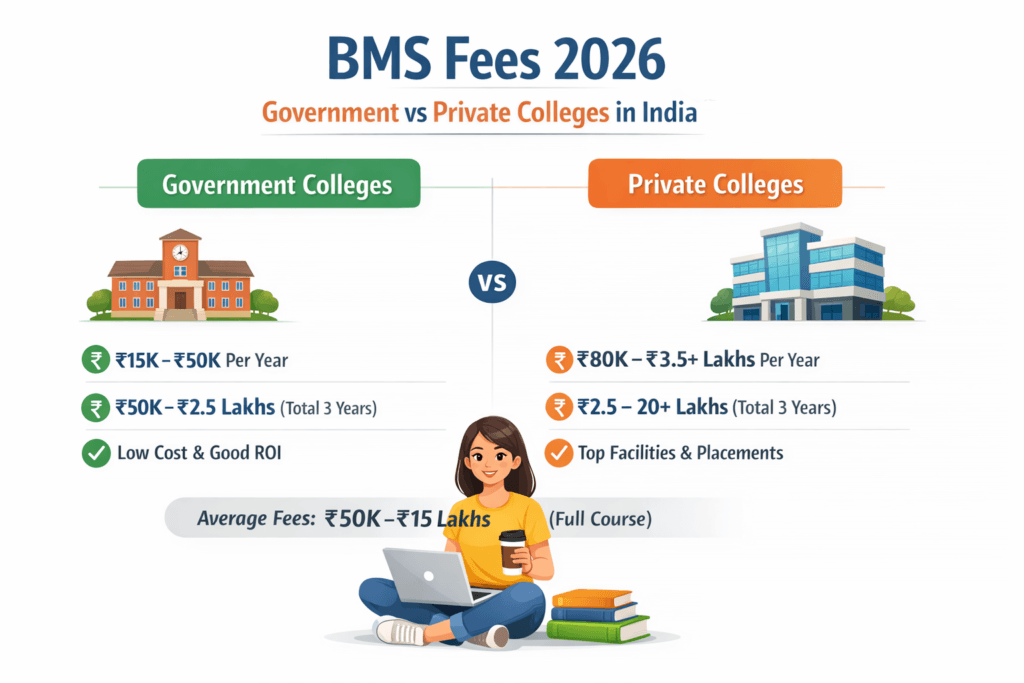
| College Category | Approx Annual Fees | Expected Starting Salary (ROI) |
| Top Government Colleges | ₹15,000 – ₹45,000 | ₹6 LPA – ₹10 LPA (Excellent) |
| Top Private Universities | ₹2 Lakhs – ₹4 Lakhs | ₹5 LPA – ₹9 LPA (Good) |
| Tier-2 Private Colleges | ₹80,000 – ₹1.6 Lakhs | ₹3 LPA – ₹5 LPA (Average) |
Top BMS Colleges in India 2026: Admission Process and Entrance Exams (CUET/NPAT)
BMS admission in India in 2026 is mainly based on entrance exams like CUET, NPAT, SET, and MAH CET. Most colleges require students to pass Class 12 with 50–60% marks. After clearing the exam, universities may conduct counselling, group discussion (GD), or a personal interview (PI) before final admission.
Major Entrance Exams for BMS in 2026
To get into a top college, you must appear for these common entrance tests. These exams usually test your English, Mathematics, and Logical Reasoning skills.
- CUET (Common University Entrance Test): Mandatory for Delhi University (DU) and other central universities.
- NPAT: The official entrance test for NMIMS Mumbai and its various campuses.
- SET (Symbiosis Entrance Test): Required for admission into Symbiosis management institutes.
- MAH CET: Used by many top colleges in Maharashtra for state-level management admissions.
Top BMS Colleges in India (2026 Updated)
These institutions are famous for high placements and strong industry connections.
- Shaheed Sukhdev College of Business Studies (SSCBS), Delhi: The top-ranked government college for BMS in India.
- Keshav Mahavidyalaya, Delhi: A prestigious Delhi University college known for its management faculty.
- NMIMS (Narsee Monjee), Mumbai: A premier private university with excellent corporate links.
- Jai Hind College, Mumbai: Known for providing strong internship opportunities and an industry-focused curriculum.
- HR College of Commerce and Economics, Mumbai: A top choice for commerce students looking for management degrees.
- St. Xavier’s College, Mumbai: Famous for its brand name and high academic standards.
BMS Cutoff and Selection Trends 2026
Admission to top colleges is very competitive. For example, SSCBS (Delhi University) often requires a 90%+ score or very high CUET percentiles. Most top-tier colleges have high cutoffs because of limited seats and a large number of applicants. You can check the latest registration dates on the official entrance exam portals to avoid missing any important deadlines.
Students who want to build international finance and investment careers after graduation often explore CIMA Course Details, eligibility, and career scope in investment management →
Top BMS Colleges in India and Entrance Exams (2026 Updated)
| College Name | Location | Main Entrance Exam |
| Shaheed Sukhdev College (SSCBS) | Delhi | CUET |
| Keshav Mahavidyalaya (DU) | Delhi | CUET |
| NMIMS Mumbai | Mumbai | NPAT |
| Jai Hind College | Mumbai | Entrance / Merit |
| Symbiosis Centre for Management | Pune | SET |
BMS vs BBA: Which Course is Better for High Salary Careers in 2026?
Bachelor of Management Studies (BMS) and Bachelor of Business Administration (BBA) are two popular management courses after Class 12. The key difference is that many BMS programs require Mathematics and focus on analytical business skills, while BBA offers broader management education and usually accepts students from any stream.
BMS vs BBA Course Comparison in India (2026 Updated)
| Factor | BMS (Bachelor of Management Studies) | BBA (Bachelor of Business Administration) |
| Course Focus | Analytical management, finance, consulting, business analytics | General business management and leadership skills |
| Mathematics Requirement | Often required in top colleges like SSCBS (DU) | Usually not mandatory in many universities |
| Duration | 3 years (6 semesters) | 3 years (6 semesters) |
| Specializations | Finance, Marketing, HR, Business Analytics | Marketing, Finance, HR, International Business |
| Top Colleges | SSCBS (DU), NMIMS, HR College | IIM-IPM programs, NMIMS, Christ University |
| Average Starting Salary | ₹4 LPA – ₹8 LPA | ₹3.5 LPA – ₹7 LPA |
| Top Recruiters | Consulting firms, finance companies, analytics roles | Corporate management, operations, marketing roles |
Which Course Gives Higher Salary in 2026?
For high-paying consulting, finance, and analytics roles, BMS has a slight advantage because the course focuses on data-driven decision making and business strategy. Graduates from top colleges often receive strong placements in consulting and financial firms.
However, BBA can also lead to very high salaries, especially if students pursue programs like IIM Integrated Program in Management (IPM) or an MBA from top business schools.
Final Verdict: BMS vs BBA for High Salary
Choose BMS if:
- You studied Mathematics in Class 12
- You want careers in finance, consulting, or analytics
- You aim for top colleges like SSCBS
Choose BBA if:
- You want flexibility without Mathematics
- You plan to pursue MBA or IIM-IPM later
- You prefer general management and business roles
Simple rule:
- Analytics & consulting career → BMS slightly better
- Flexible management path → BBA is a strong option
Career Options After BMS Course in 2026: Job Profiles and Average Salary Ranges

Bachelor of Management Studies (BMS) graduates in 2026 can enter high-growth fields like consulting, finance, analytics, and marketing. The average BMS salary for fresh graduates usually ranges between ₹4 LPA and ₹9 LPA, depending on college reputation, internships, and specialization. Higher salaries are possible with experience, professional certifications, or an MBA.
Top Job Profiles After BMS in India (2026)
Companies now prefer graduates who understand business strategy and data-driven decision making. Popular job roles include:
- Business Analyst – Studies business data and market trends to improve company performance and efficiency.
- Management Consultant – Helps organizations solve complex problems and improve strategy and operations.
- Financial Analyst – Evaluates financial reports, investments, and market trends for companies or clients.
- Digital Marketing Manager – Manages SEO, online campaigns, brand strategy, and digital growth.
- Operations Manager – Handles logistics, supply chain management, and daily business operations.
Average Salary After BMS in India (2026 Updated)
The starting salary after BMS depends on factors like college ranking, industry demand, and internship experience. Below are the typical salary ranges for fresh graduates.
| Job Profile | Average Starting Salary (Annual) | Top Hiring Sectors |
| Business Analyst | ₹5 LPA – ₹9 LPA | IT, Fintech, E-commerce |
| Management Consultant | ₹6 LPA – ₹11 LPA | Consulting, Strategy Firms |
| Financial Analyst | ₹5 LPA – ₹8.5 LPA | Banking, Investment Firms |
| Marketing Executive | ₹4 LPA – ₹7 LPA | FMCG, Digital Marketing |
| HR Executive | ₹3.5 LPA – ₹6 LPA | Corporate Offices, MNCs |
For verified industry salary trends and hiring data, students can explore Industry Hiring Reports published by National Association of Software and Service Companies.
Top Recruiters for BMS Graduates in 2026
Graduates from reputed BMS colleges often receive opportunities from multinational companies across consulting, technology, and FMCG sectors.
Consulting & Finance Firms
- Deloitte
- KPMG
- EY
- PwC
- Goldman Sachs
- JPMorgan Chase
Tech & E-commerce Companies
- Amazon
- Tata Consultancy Services
- Infosys
FMCG & Retail Sector
- Hindustan Unilever
- ITC Limited
- PepsiCo
- Reliance Retail
Higher Studies After BMS: Best Courses Like MBA, PGDM and Global Certifications
After completing Bachelor of Management Studies (BMS), students often choose higher studies like MBA, PGDM, US CMA, or CFA to improve their salary and reach senior management roles. In 2026, these programs are popular because they develop advanced skills in finance, leadership, analytics, and global business management.
Top Postgraduate Degrees for BMS Graduates
After finishing your BMS degree, these postgraduate programs can help you specialize and move into higher management roles.
MBA (Master of Business Administration)
The most popular management degree after BMS. Students can specialize in Finance, Marketing, Human Resources, or Operations Management.
PGDM (Post Graduate Diploma in Management)
An industry-focused program offered by autonomous business schools. PGDM courses usually include practical projects and corporate exposure.
MMS (Master of Management Studies)
A management degree offered by universities such as University of Mumbai. The curriculum is similar to an MBA and focuses on business management and leadership skills.
Master’s in Data Science or Business Analytics
A fast-growing option in 2026 for students who want to enter high-demand fields like data analytics, fintech, and business intelligence.
Global Professional Certifications After BMS Course
Students who want careers in international finance or multinational companies often pursue these certifications.
Certified Management Accountant (US CMA)
A professional certification focused on management accounting, corporate finance, and strategic decision making. It is widely recognized by global companies.
Chartered Financial Analyst (CFA)
One of the most respected certifications for careers in investment banking, portfolio management, and financial analysis.
Skill-Based Certifications for Business Careers

Some students also choose short professional courses to develop modern business skills.
Digital Marketing Certifications
Useful for careers in SEO strategy, online advertising, social media management, and brand marketing.
Business Analytics Certifications
These courses help students learn data analysis, visualization tools, and business intelligence techniques.
Students can explore official program details through organizations such as CFA Institute and Institute of Management Accountants.
Best Courses After BMS: Fees vs Salary Growth Comparison (2026)
| Course Name | Duration | Average Fees (Approx) | Potential Salary Growth |
| MBA (Top Tier Institutes) | 2 Years | ₹10 Lakhs – ₹25 Lakhs | 100% – 200% |
| PGDM | 2 Years | ₹8 Lakhs – ₹20 Lakhs | 80% – 150% |
| US CMA | 6 – 12 Months | ₹1.2 Lakhs – ₹2.5 Lakhs | 40% – 60% |
| CFA (All Levels) | 2 – 3 Years | ₹3 Lakhs – ₹5 Lakhs | 50% – 90% |
Is BMS Course Worth It in 2026? Advantages, ROI and Future Market Value
Yes, BMS is worth it in 2026 for students who want careers in business, consulting, finance, or marketing. The Bachelor of Management Studies (BMS) program builds analytical thinking, management knowledge, and business strategy skills. With internships or higher studies like MBA, the degree can lead to strong career growth and good long-term salary potential.
Key Advantages of Studying BMS Course
BMS Course provides practical knowledge about how modern businesses work. Some important advantages include:
- Strong Business Foundation – Students learn management, marketing, finance, and business strategy.
- Industry-Relevant Skills – The course develops analytical thinking, communication, and leadership abilities.
- Wide Career Opportunities – Graduates can work in consulting, banking, marketing, technology, and startup sectors.
- Pathway to Higher Studies – BMS creates a strong base for programs like MBA, PGDM, or global certifications.
Return on Investment (ROI) After BMS Course
One reason many students choose BMS course is the balanced cost and career potential. Compared to many professional courses, the total investment is relatively affordable.
| Factor | Typical Range in India |
| Average Total Course Fees (3 Years) | ₹50,000 – ₹4 Lakhs |
| Average Starting Salary | ₹4 LPA – ₹8 LPA |
| Salary After MBA or Experience | ₹10 LPA+ (varies by role and company) |
Typical fee difference by college type:
- Government Colleges: Usually around ₹15,000 – ₹60,000 per year
- Private Universities: Usually around ₹1.5 Lakhs – ₹4 Lakhs per year
Because of this cost difference, students from government colleges often achieve a very high return on investment within the first few working years.
Future Scope and Market Demand After BMS Course 2026
The demand for business and management professionals continues to grow in sectors like consulting, finance, technology, and e-commerce. Companies such as Deloitte, Amazon, and Infosys regularly hire graduates with strong analytical and management skills.
New industries such as business analytics, digital marketing, and fintech are also creating more career opportunities for BMS graduates.
Final Verdict: Is BMS a Good Course in 2026?
BMS can be a strong career choice in 2026 for students interested in management and business careers. The course offers affordable education, diverse job roles, and a solid pathway to MBA or international certifications.
Students who want to explore the complete career roadmap can also read “Career Options After BMS Course in 2026” to understand job roles, salaries, and growth opportunities after graduation.
Frequently Asked Questions (FAQ) About BMS Course 2026
What subjects are taught in the BMS course?
The BMS syllabus usually includes subjects related to business and management. Common topics include Principles of Management, Business Economics, Marketing Management, Financial Accounting, Business Law, and Human Resource Management. Many universities also add modern subjects like Business Analytics, Entrepreneurship, and Digital Marketing in later semesters.
Can a student pursue BMS Course without Mathematics in Class 12?
Yes, many universities allow students to pursue BMS Course without Mathematics in Class 12. However, some top colleges may prefer or require Mathematics because the course includes analytical subjects like statistics and business data analysis. Students should check the eligibility criteria of the college before applying.
Is BMS Course better than B.Com for management careers?
BMS Course is generally better for students who want careers in management, consulting, marketing, or business strategy. The course focuses more on leadership, decision making, and business operations. In comparison, B.Com focuses more on accounting, finance, and commerce subjects.
Which entrance exams are required for BMS Course admission in India?
Many universities conduct entrance exams for BMS admission. The most common exams include CUET, NPAT, SET, and MAH CET. Some colleges may also offer admission based on Class 12 merit or internal entrance tests, depending on the university rules.
Can BMS students start their own business after graduation?
Yes, BMS graduates can start their own business because the course teaches management, marketing, finance, and entrepreneurship skills. Many students also gain practical knowledge through internships and projects, which helps them understand how to run and grow a business successfully.
Disclaimer
The information provided in this article is for educational and informational purposes only. While every effort has been made to ensure accuracy, course details such as fees, eligibility, salary ranges, admission processes, and career opportunities may change over time depending on universities, institutions, and industry trends.
Readers are advised to verify the latest information from official university websites, entrance exam authorities, or professional organizations before making any academic or career decisions.
This website does not represent any specific college, university, or certification body. Any references to courses, institutions, or companies are provided only for informational purposes and should not be considered official endorsements.