During my conversations with students, even before I started CommerceCare, I noticed one common confusion again and again. Almost everyone asked the same question:
“What should I do Business Intelligence after my graduation—B.Com, BBA, BMS, etc.?”
Many students had a wrong assumption in their minds. They believed that MBA is the only option to get a good job. Some also felt that commerce students have very limited computer skills to choose from—only Tally, SAP, or basic accounting software. Because of this thinking, many students felt stuck and unsure about their future.
Digital Marketing Course 2026: Complete Beginner-Friendly Guide
MarTech Tools 2026: Complete Beginner-Friendly Guide
The Biggest Myth Among Commerce Students
When I started talking to them, I explained that this is not the full picture. Commerce students actually have many more career options than they realize. Today, companies do not look only for degrees. They look for people who understand business and can work with data, systems, and digital tools. The good news is that not all computer-based careers require advanced mathematics or heavy coding.
I introduced students to several computer and analytics-related courses that can be learned with basic or even minimal math knowledge. These courses focus more on logic, business understanding, and practical thinking rather than complex formulas. Fields like Business Intelligence, Data Analysis (non-coding), MIS reporting, digital accounting tools, and business software applications are now open to commerce graduates.
Once students understood this, their mindset started to change. They realized that commerce is not a “limited” stream. With the right guidance and skill selection, a commerce graduate can build a strong, high-growth career without feeling forced into MBA or traditional paths.
This realization became the foundation of CommerceCare—to guide commerce students, clear their confusion, and show them practical, skill-based career paths that match the current job market.
What Is Business Intelligence? (Understanding the Real Meaning)
Many people think that Business Intelligence is only about creating attractive charts and graphs. But in reality, Business Intelligence is the skill of converting data into money-driven insights and smart business decisions.
Imagine a large retail company with 500 stores across India. Every day, thousands of sales transactions take place. Now, the management wants clear answers to questions like:
- Which city is currently making the highest losses?
- Which product is likely to go out of stock next month?
- How much discount should be offered during a particular festival?
All these answers are already hidden inside raw data—spread across Excel sheets, databases, and software systems. However, raw data on its own is confusing and difficult to understand.
This is where Business Intelligence professionals come in. They clean the data, organize it properly, and use tools like Power BI or Tableau to create simple, interactive dashboards. These dashboards are designed in such a way that even a CEO or manager can look at them and take quick, confident decisions.
In simple words:
Business Intelligence = Right Data + Right Time + Right Decision
Why Business Intelligence Is a Perfect Match for Commerce Students
Many students believe that working with data is only meant for engineers or technical backgrounds. This is completely wrong.
As a commerce student, you already have a powerful advantage that most engineers do not—business sense.
You understand how debit and credit work, how to calculate Return on Investment (ROI), and how supply chains, costs, pricing, and profits move inside a business. These are not technical skills; these are decision-making skills.
Business Intelligence tools are just the medium.
The real job is to understand the business story behind the data.
When you build a dashboard, you are not simply displaying numbers. You are showing:
- where the company is making profit,
- where it is losing money,
- and what actions management should take next.
This is exactly why Business Intelligence suits commerce students so well.
At CommerceCare, we always say that BI is not a completely new subject for commerce graduates. It is simply a digital upgrade of your existing commerce knowledge—one that makes you more relevant, more confident, and more valuable in the modern job market.
BI vs Data Analytics vs Data Science: Clear the Confusion
For Commerce students, the choice depends on one thing: Do you want to write code, or do you want to drive business decisions?
Comparison Table (2026 Updated)
| Feature | Business Intelligence (BI) | Data Analytics | Data Science |
| Main Focus | Past & Present (What happened?) | Patterns (Why did it happen?) | Future (What will happen next?) |
| Typical Tools | Excel, Power BI, SQL | SQL, Python, Statistics | Python, R, Machine Learning |
| Coding Level | Minimal (Logic-based) | Moderate | Very Heavy |
| Maths Requirement | Basic (Business Math) | Medium (Statistics) | High (Calculus & Algebra) |
| Salary (Fresher) | ₹4.5L – ₹7L PA | ₹4L – ₹6.5L PA | ₹6L – ₹9L PA |
| Job Availability | Very High (Every Sector) | High | Moderate (Specific Tech) |
| Success Rate | ~85% (High Completion) | ~60% | ~30% (Coding Barrier) |
| Best Suited For | Commerce & Management | Analytical thinkers | Tech & Math enthusiasts |
Final Verdict for Commerce Students
If you are not comfortable with heavy coding but enjoy business logic, decision-making, and understanding how companies work, then Business Intelligence is the safest and most growth-oriented entry point. It has the highest success rate because it doesn’t overwhelm you with programming. You get to enter the high-paying “Data World” using your existing commerce strengths.
Explore More: Free BI Resources for Students
Click here to access interactive dashboards, practice datasets, and step-by-step BI tutorials
Core Skills: What Do You Need to Learn?
To become a Business Intelligence professional, you do not need a PhD or a highly technical background. You only need to build strong skills around these four core pillars.
A. Advanced Excel (The Foundation)
Excel is the soul of Business Intelligence. Even in 2026, no BI tool can completely replace Excel.
- What to learn: VLOOKUP/XLOOKUP, Pivot Tables, Power Query, and data cleaning techniques
- Why it matters: Nearly 80% of data cleaning work is still done in Excel
B. SQL (The Language of Data)
There is no need to be afraid of SQL (Structured Query Language). It is not traditional coding; it is simply a way to communicate with databases.
- Purpose: To extract specific data from a database
(for example: “I need only the sales data of North India for the year 2025.”) - Commerce Advantage: You already understand how ledgers and tables work. SQL is just a digital extension of the same concept.
C. Power BI / Tableau (The Visualizers)
These are the most in-demand visualization tools in today’s market.
- Power BI: A Microsoft tool, which makes it very easy to learn for Excel users. It currently has the highest demand in India.
- Tableau: Known for its premium interface and strong visual capabilities. Many large MNCs prefer Tableau for advanced data visualization.
D. Data Storytelling
Creating graphs alone is not enough. You must be able to explain what the data actually means.
For example: “The red line is going down, which means our marketing spend is not giving the expected returns.” This ability to turn visuals into clear business meaning is called Insight Generation.
The Truth About Python: Is It Really Necessary?
This is a question almost every student asks. The honest answer is: No, it is not required in the beginning.
Nearly 90% of Business Intelligence roles work without Python. Python becomes useful only when you move towards advanced data science or automation. If you are a fresher, your first priority should be Excel and Power BI. Once you get a job and gain confidence, you can slowly start learning Python step by step.
Career Roles and Salary Reality Check (2026)
After learning Business Intelligence, multiple job opportunities open up for you:
- BI Analyst: Analyzes data and prepares reports.
- Reporting Analyst: Creates daily and weekly dashboards for management.
- Business Analyst: Uses data to solve business problems and improve decisions.
- Data Visualizer: Converts complex data into easy-to-understand visuals.
Salary in India
- Freshers: ₹4.5 lakhs to ₹7 lakhs per year
- 2–5 years of experience: ₹8 lakhs to ₹15 lakhs per year
- Lead BI roles: Can go up to ₹20 lakhs+ per year
Note: Salary depends on your city (Bangalore/Pune vs Tier-2 cities), your skills, and the quality of your portfolio projects.
BI Course Details: How Much Time and Money Will It Take?
If you are serious, you can become job-ready in 4 to 6 months.
- Fees: ₹25,000 to ₹75,000 (depending on whether you learn self-paced or with a mentor)
- Education: Best suited for B.Com, BBA, and MBA graduates
- CommerceCare Tip: Do not chase certificates only. Build a strong portfolio on LinkedIn by creating dashboards using real-world data.
Business Intelligence Roadmap: Step by Step
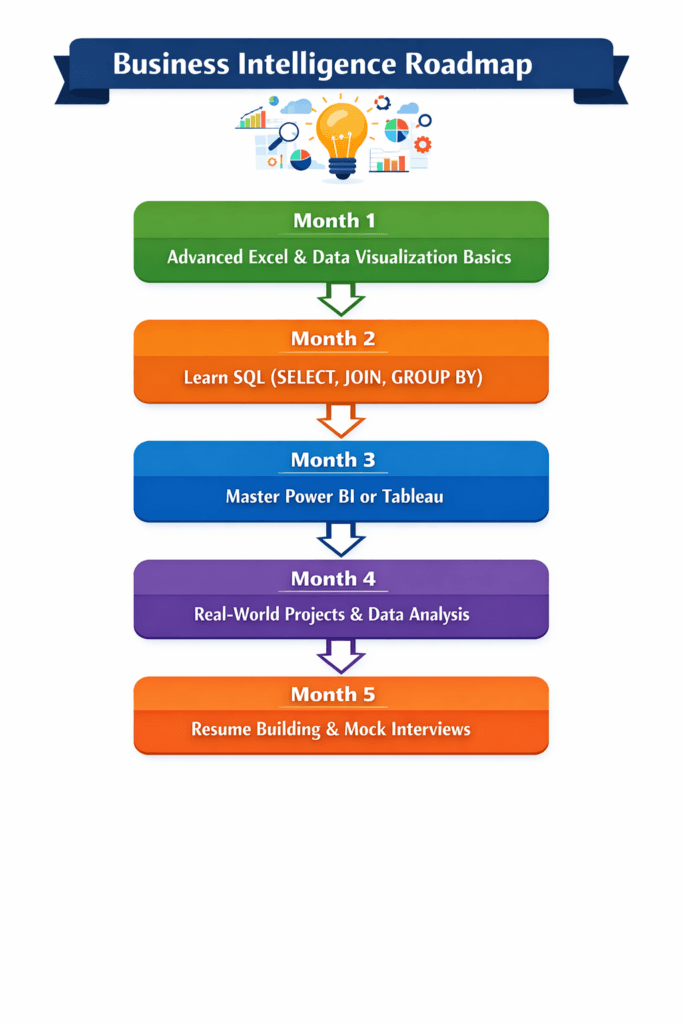
Here is a clear plan on how you should start:
- Month 1: Learn Advanced Excel and the basics of data visualization
- Month 2: Learn SQL (SELECT, JOIN, GROUP BY queries)
- Month 3: Choose one tool—Power BI or Tableau—and focus on mastering it
- Month 4: Work on real-world projects (for example, analyzing cricket statistics or e-commerce sales data)
- Month 5: Resume building and mock interviews
Common Mistakes (What You Should Avoid)
- Tool Hopping: Don’t try to learn Power BI and Tableau at the same time. Focus on mastering one tool first.
- Ignoring Business Knowledge: If you don’t understand concepts like Gross Margin, you won’t be able to create good reports. Keep learning business terminology.
- Theoretical Learning Only: Watching videos alone won’t make you a BI professional. Your brain only clicks when you actively work with data and practice cleaning it yourself.
Frequently Asked Questions About Business Intelligence
What is Business Intelligence and why is it important in 2026?
Business Intelligence helps companies convert raw data into useful insights for better decisions. In 2026, businesses rely heavily on BI to understand performance, reduce losses, and plan growth.
Can commerce students build a career in Business Intelligence?
Yes. Business Intelligence is a strong career option for commerce students because it focuses on business understanding, reporting, and decision-making rather than heavy coding.
Do I need coding skills to learn Business Intelligence?
Basic SQL is helpful, but Business Intelligence does not require advanced coding. Most BI roles work with Excel, Power BI, and dashboards.
What tools should beginners learn for Business Intelligence?
Beginners should start with Advanced Excel, SQL basics, and one BI tool such as Power BI or Tableau. These tools form the core of Business Intelligence skills.
Is Business Intelligence better than Data Science for beginners?
For beginners and non-technical backgrounds, Business Intelligence is easier and more practical than Data Science. It offers faster job readiness and clear career paths.
Conclusion: Is BI Worth It in 2026?
Absolutely! With AI and automation becoming mainstream in 2026, the value of BI professionals has increased even more. Why? Because AI can provide data, but only a human can interpret it from a business perspective and turn it into a strategy.
For commerce students, BI is not just a job—it is a growth engine. If you can befriend numbers and translate them into the language of business, this career can give you respect and a salary that traditional roles might take years to reach.
Be patient, keep practicing, and let the data speak for itself.
Disclaimer:
All career guidance, salary figures, and job opportunities are indicative and based on 2026 trends.
Actual results may vary depending on skills, location, and effort.
CommerceCare does not guarantee placements, salaries, or job offers.
Students should verify current industry requirements before enrolling in any course.