CA Course Details 2026: Eligibility, Fees, Duration, Syllabus, and Career Scope

The CA course details 2026 in India help students understand how to become a Chartered Accountant after Class 12 or graduation. The course has three levels—Foundation, Intermediate, and Final—plus articleship training. The total CA course duration after 12th is around 4 to 5 years, depending on exam progress.
The Chartered Accountant course eligibility, fees, and career scope in India make it a top choice for commerce students. After completing the CA course, students can work in accounting, taxation, auditing, and finance roles with strong career growth.
→ CS Course Details 2026: Eligibility, Fees, Duration, and Career Scope
The CA course in India 2026 is a prestigious professional program conducted by the ICAI to certify Chartered Accountants. It consists of three levels—Foundation, Intermediate, and Final—along with a mandatory 2-year practical training called articleship. This course usually prepares students for high-level roles in auditing, taxation, and financial management.
Full Form of CA and Its Professional Value
The full form of CA is Chartered Accountant. A CA is a globally recognized finance professional responsible for managing a company’s financial health through auditing and taxation. In 2026, the value of this qualification remains among the top choices for commerce students due to its rigorous training and professional ethics.
Key Role and Responsibilities of a Chartered Accountant
The role of a Chartered Accountant involves auditing financial statements, filing tax returns, and providing strategic financial advice. CAs ensure that businesses comply with the latest tax laws and accounting standards. They also play a crucial part in budget planning, forensic accounting, and risk management for various organizations.
Why Choose CA as a Career in 2026?
Choosing a CA career in 2026 offers high job security, professional respect, and an attractive salary package. As India’s economy grows, the demand for skilled CAs in MNCs and startups is increasing. Freshers can usually expect a starting salary ranging from ₹6 LPA to ₹12 LPA approx, depending on their skills and cities.
→ ACCA Course Details 2026: Eligibility, Fees, Duration, Salary, and Career Scope
What is the CA Course in India 2026?
The CA course in India 2026 is a prestigious professional program conducted by the ICAI to certify Chartered Accountants. It consists of three levels—Foundation, Intermediate, and Final—along with a mandatory 2-year practical training called articleship. This course usually prepares students for high-level roles in auditing, taxation, and financial management.
Full Form of CA and Its Professional Value
The full form of CA is Chartered Accountant. A CA is a globally recognized finance professional responsible for managing a company’s financial health through auditing and taxation. In 2026, the value of this qualification remains among the top choices for commerce students due to its rigorous training and professional ethics.
Key Role and Responsibilities of a Chartered Accountant
The role of a Chartered Accountant involves auditing financial statements, filing tax returns, and providing strategic financial advice. CAs ensure that businesses comply with the latest tax laws and accounting standards. They also play a crucial part in budget planning, forensic accounting, and risk management for various organizations.
Why Choose CA as a Career in 2026?
Choosing a CA career in 2026 offers high job security, professional respect, and an attractive salary package. As India’s economy grows, the demand for skilled CAs in MNCs and startups is increasing. Freshers can usually expect a starting salary ranging from ₹6 LPA to ₹12 LPA approx, depending on their skills and cities.
→ ACCA Course Details 2026: Eligibility, Fees, Duration, Salary, and Career Scope
CA Course Eligibility Criteria 2026 in India: After 12th, Graduation, Marks, and Age Limit
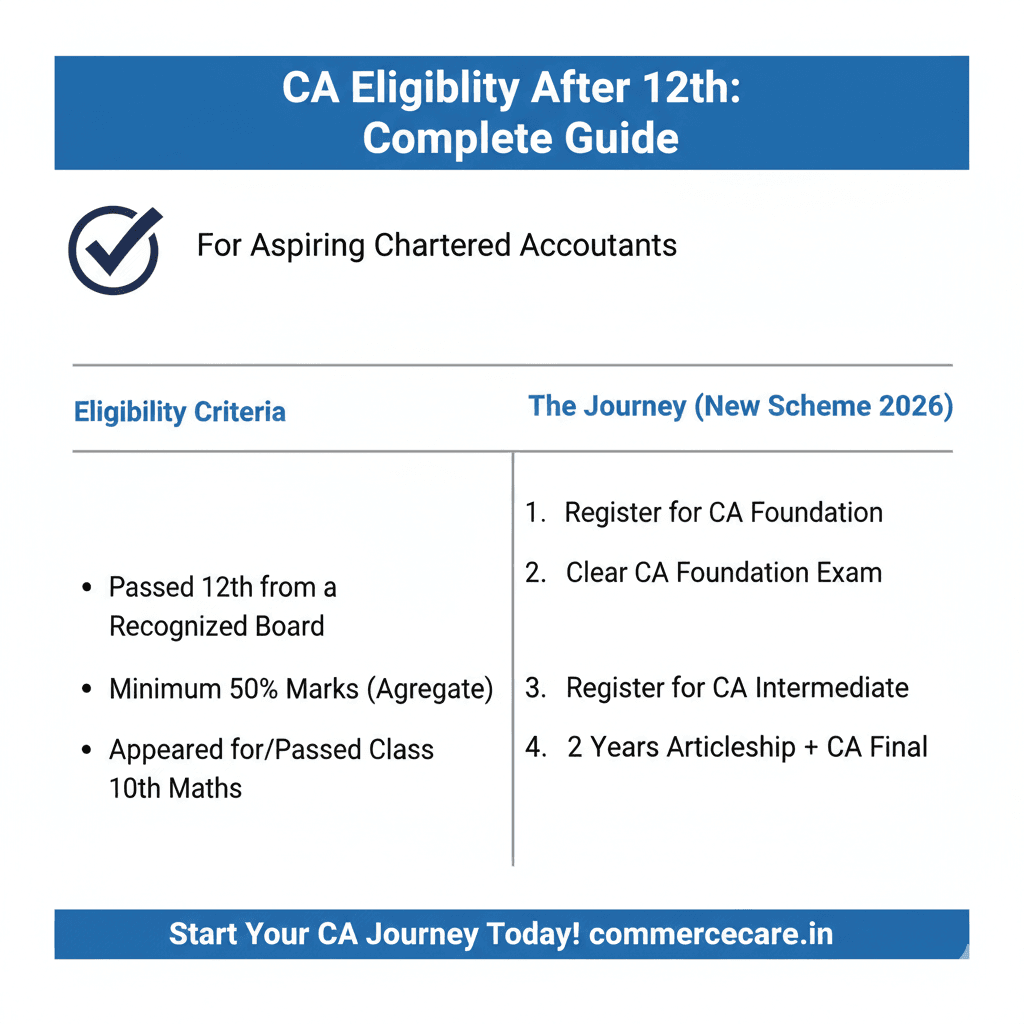
The CA course eligibility 2026 in India allows students to register for the Chartered Accountant program under the ICAI New Scheme 2026. Students can enter after Class 12 or graduation. The course includes Foundation, Intermediate, and Final levels, along with a mandatory 2-year articleship training period, preparing candidates for professional roles in auditing, taxation, and finance.
What is the CA Course Eligibility After 12th in 2026?
The CA course eligibility after 12th in India 2026 requires passing Class 12 from a recognized board like CBSE, ICSE, or State Boards. Students from Commerce, Science, or Arts streams can register for CA Foundation, and there is no minimum percentage requirement, making it a flexible path for aspiring finance professionals.
Key Highlights for 12th Eligibility:
- Qualification: Pass Class 12 from a recognized board
- Stream: Open for Commerce, Science, and Arts students
- Registration: Apply through the ICAI portal under the ICAI New Scheme 2026
- Next Step: Eligible for CA Foundation exams after a 4-month study period
CA Course Eligibility After Graduation (Direct Entry Route)
The CA course eligibility after graduation 2026 allows candidates to skip the Foundation level and join CA Intermediate directly. Commerce graduates generally need approx 55% marks, while non-commerce graduates require approx 60% marks. After registration, candidates must complete the mandatory 2-year articleship training as per ICAI 2026 guidelines.
Direct Entry Highlights:
- Skip Level: No need to appear for CA Foundation exam
- Entry: Join CA Intermediate directly
- Training: Start the 2-year mandatory articleship under ICAI New Scheme 2026
- Efficiency: Faster route to becoming a Chartered Accountant
What are the Minimum Marks for CA Course Registration?
The minimum marks for CA course registration vary by entry route:
- After 12th: Only a “Pass” certificate from a recognized board is needed
- Direct Entry Route: Commerce graduates ~55%, Non-commerce graduates ~60% (approx)
These criteria ensure students have a solid academic foundation before starting professional CA training.
Is There an Age Limit for CA Course in India 2026?
There is no minimum or maximum age limit for CA course registration in India 2026. Students can register immediately after Class 12 or after graduation/work experience. This makes the Chartered Accountant program a flexible finance career option for everyone.
→ Check CMA India Course Details 2026: Eligibility, Fees, Duration, and Career Scope
CA Course Duration in India 2026: Level-wise Timeline
The CA course duration in India 2026 under the ICAI New Scheme usually takes 3.5 to 4.5 years depending on the entry route and exam attempts. It covers Foundation, Intermediate, and Final levels, along with a mandatory 2-year articleship. Students become eligible for the Final exam 6 months after completing articleship. Official ICAI Details
Total Duration of CA Course After 12th in 2026
The total CA course duration after Class 12 is approx 4–4.5 years if cleared in the first attempt. Students first complete Foundation (4–6 months), then Intermediate (total 8 months for both groups combined), followed by a 2-year mandatory articleship, and finally appear for the Final exam 6 months after articleship.
Step-by-Step Duration Breakdown:
- CA Foundation: 4–6 months (Registration to Exam)
- CA Intermediate: 8 months total study period for both groups (Mandatory)
- Articleship Training: 2 years (Fixed under New Scheme)
- CA Final Exam: Eligible 6 months after articleship
CA Course Duration After Graduation (Direct Entry Route)
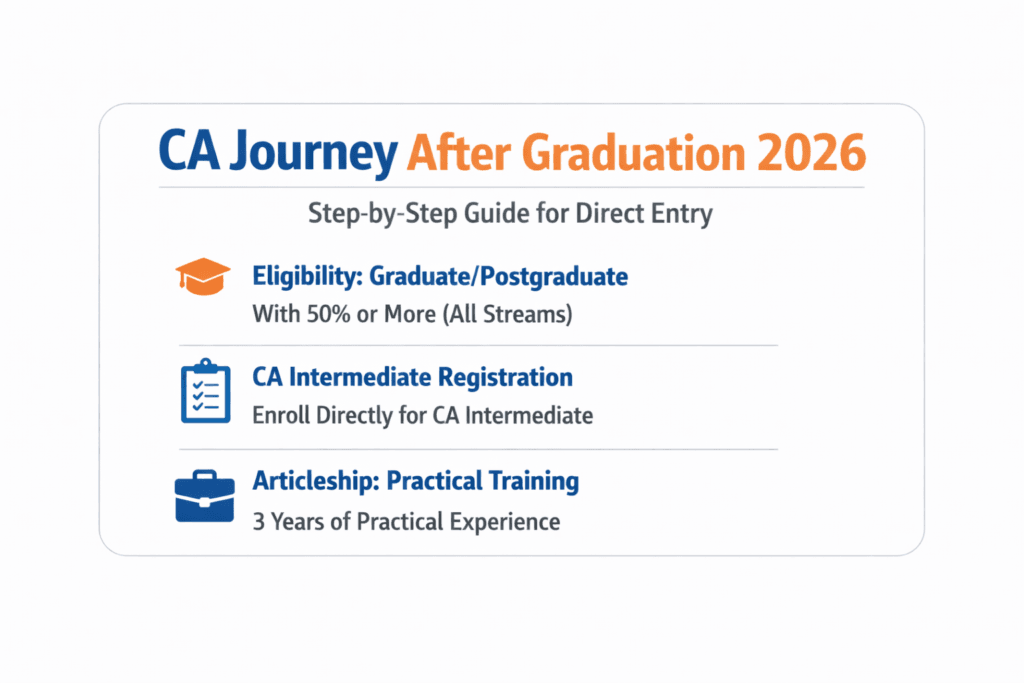
Graduates using the Direct Entry Route skip the Foundation, making the total course duration approx 3.5 years. They register directly for Intermediate, study for 8 months total, and start the 2-year articleship after clearing both groups.
Direct Entry Highlights:
- Exemption: Skip CA Foundation
- Study Period: 8 months total for Intermediate
- Articleship: 2 years, starts after both Inter groups
- Total Duration: 3.5 years approx
Mandatory Articleship Duration and Training Period
The mandatory articleship under ICAI New Scheme 2026 is 2 years. Students gain practical exposure in auditing, GST filing, taxation, and corporate accounting, required to appear for the Final exam.
Articleship Training Rules 2026:
- Duration: 2 Years (No reduction)
- Eligibility: Clear both Intermediate groups
- Leaves: Max 48 days allowed
- Final Exam: Eligible 6 months after articleship
Visual Timeline Suggestion
12th Pass → CA Foundation (4–6 months) → CA Intermediate (8 months total) → Articleship (2 yr) → CA Final (6 months wait)
Graduates → CA Intermediate (8 months total) → Articleship (2 yrs) → CA Final (6 months wait)
CA Course Fees Structure 2026 in India (Complete & Updated)
The CA course fees 2026 in India typically range from about ₹90,000 to ₹1,40,000, including registration, exam fees, and mandatory training programs under the ICAI New Scheme 2026. This covers the Foundation, Intermediate, and Final levels, plus ICITSS and AICITSS training, which are required for exam eligibility. For complete official fee details, visit the official ICAI website.
📝 CA Foundation Fees 2026
- Registration Fee: Approx ₹9,000
- Exam Form Fee: ₹1,500 (both groups)
- Prospectus & Journal: ₹200–₹400 (optional)
Total Foundation Fees: ₹11,000–₹12,000 approx
💼 CA Intermediate Fees 2026
The CA Intermediate registration fees for both groups under ICAI New Scheme 2026 are approx ₹18,000 (registration + activity + articled assistant fees).
- Intermediate Registration: ₹15,000
- Student Activity Fee: ₹2,000
- Articled Assistant Fee: ₹1,000
- Exam Form Fee: ₹2,700 (both groups)
Total Inter Fees: ₹20,000–₹21,000 approx
🧠 Mandatory Training Fees (ICITSS / AICITSS)
Before appearing for the Intermediate and Final exams, students must complete:
- ICITSS (Information Technology + Soft Skills)
- AICITSS (Advanced IT + Management & Communication Skills)
Combined Training Fees: Approx ₹28,000–₹30,000 (ICITSS + AICITSS)
These programs are mandatory under the New Scheme before Final exam eligibility.
📜 CA Final Fees 2026
- Final Registration Fee: ₹22,000
- Final Exam Form Fee: ₹3,300 (both groups)
- Optional Journals / Study Material: ₹200–₹400
Total Final Fees: ₹25,000–₹27,000 approx
📊 Updated Mobile‑Friendly Fee Table (2026)
| Fee Category | Approx Amount (INR) |
| CA Foundation Total | ₹11,000–₹12,000 |
| CA Intermediate Total | ₹20,000–₹21,000 |
| CA Final Total | ₹25,000–₹27,000 |
| Mandatory Training (ICITSS + AICITSS) | ₹28,000–₹30,000 |
| Exam Form Fees (varies) | ₹1,500–₹3,300 |
Figures approximate and based on ICAI New Scheme 2026 official fee components.
CA Course Registration Process 2026: Step-by-Step Guide
The CA course registration process 2026 is fully online through the ICAI Self-Service Portal (SSP). Students must create a profile, upload digital documents, pay fees online, and get a registration letter via email, marking the official start of their Chartered Accountant journey.
How to Register for CA Foundation 2026?
To register for CA Foundation 2026, visit the ICAI SSP portal and click on New Student Enrollment. Fill in personal and academic details, upload Class 10 & 12 mark sheets, and pay registration fees approx ₹9,000. Ensure photo and signature meet ICAI’s specifications to avoid rejection.
Step-by-Step Guide:
- Visit the official ICAI SSP Portal.
- Create a User ID & Password using email and phone number.
- Fill in personal & academic details.
- Upload scanned documents: Mark sheets, Photo, Signature.
- Pay the Foundation fees online via the secure gateway.
CA Intermediate Registration Process 2026
For CA Intermediate 2026, students log in to their existing SSP account after clearing Foundation. Direct Entry graduates create a new account with degree details.
- Registration Fee: Approx ₹18,000
- Choose study material language: English or Hindi
- Upload all required certificates and academic proof.
CA Final Registration Steps 2026
For CA Final 2026, students must:
- Log in to SSP portal after clearing both Intermediate groups.
- Complete mandatory ICITSS/AICITSS training.
- Upload Intermediate pass certificate and verify articleship status.
- Pay Final registration fee approx ₹22,000 (excluding exam form charges).
Important Documents for ICAI Registration 2026
Keep the following scanned documents ready in JPG/PDF format before registration:
- Identification: Aadhaar Card or Passport
- Academic: Class 10 & 12 Mark sheets (for Foundation/Inter)
- Graduation: Degree certificate (for Direct Entry)
- Personal: Recent passport-size photo and signature
- Category: Caste certificate (if applicable for fee concessions)
US CMA Course Registration Process 2026: Step-by-Step Guide ➤
CA Course Syllabus and Subjects 2026 – Complete Updated List
The CA course syllabus 2026 under the ICAI New Scheme is streamlined to focus on core financial expertise. The number of papers has been reduced at the Intermediate and Final levels to 6 each, ensuring a balanced approach between theoretical study and practical articleship training. This updated curriculum meets global accounting standards and modern industry requirements.
CA Foundation Subjects List 2026
The CA Foundation syllabus 2026 consists of four papers. ICAI has removed subjects like BCR and BCK to focus more on core accounting and legal basics. It is a mix of subjective (Paper 1 & 2) and objective (Paper 3 & 4) patterns, designed to test the fundamental knowledge of commerce aspirants.
Paper 1: Accounting (100 Marks)
Paper 2: Business Laws (100 Marks)
Paper 3: Quantitative Aptitude (Maths, Stats, LR)
Paper 4: Business Economics (100 Marks)
CA Intermediate Subjects List 2026 (6 Papers Only)
The CA Intermediate syllabus 2026 features only 6 papers, divided into two groups of 3 papers each. This reduction allows students to focus deeply on advanced subjects. The new pattern includes a 30% MCQ component in all papers to test the practical understanding of students under the ICAI New Scheme 2026.
Group I:
- Advanced Accounting
- Corporate and Other Laws
- Taxation
Group II:
- Cost and Management Accounting
- Auditing and Ethics
- Financial Management & Strategic Management (FM-SM)
CA Final Subjects List 2026
The CA Final syllabus 2026 now consists of 6 core papers and mandatory Self-Paced Online Modules (SPOM). Students must clear the online modules (Set A, B, C, D) before appearing for the Final exams. The curriculum emphasizes strategic decision-making and multi-disciplinary case studies to prepare future leaders.
Group I:
- Financial Reporting (FR)
- Advanced Financial Management (AFM)
- Advanced Auditing, Assurance, and Professional Ethics
Group II:
- Direct Tax Laws & International Taxation
- Indirect Tax Laws (GST & Customs)
- Integrated Business Solutions (Multi-disciplinary Case Study)
CA Course Exam Pattern and Passing Criteria 2026 – Updated Rules & Marks
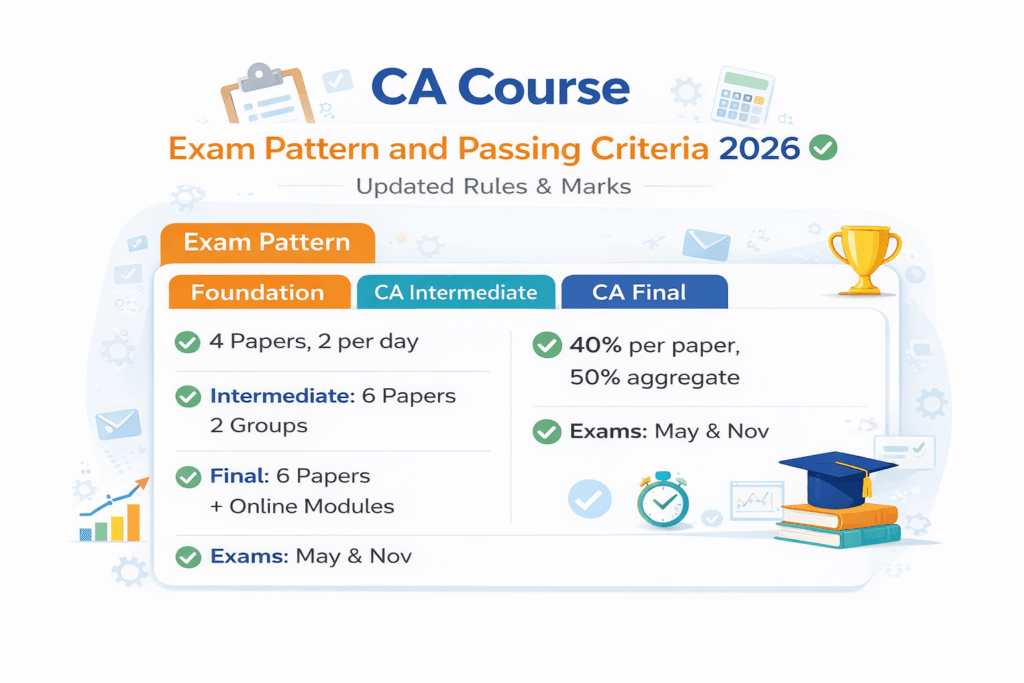
The CA exam pattern 2026 under the ICAI New Scheme uses a hybrid model with subjective + objective questions. Intermediate and Final papers follow a 30:70 split—30% case-study-based MCQs and 70% descriptive questions. Passing requires 40% per paper and 50% aggregate per group, maintaining global professional standards.
Minimum Passing Marks in CA Exams 2026
To pass CA exams 2026, students must secure:
- 40% marks in each paper
- 50% aggregate per group
The set-off rule allows excess marks in one group to cover minor deficits in another when both groups are attempted together.
Passing Criteria Table (2026):
| Level | Per Paper Min. | Aggregate Min. |
| CA Foundation | 40% | 50% (200/400) |
| CA Intermediate | 40% | 50% (150/300 per group) |
| CA Final | 40% | 50% (150/300 per group) |
Important Rules:
- Negative marking 0.25 in Foundation Paper 3 & 4 only.
- No negative marking for 30% MCQs in Intermediate & Final.
- Permanent exemption if 60+ in a paper but fail the group.
Difficulty Level and Number of Attempts
- Attempts: Unlimited for all levels.
- Registration Validity: Foundation – 4 years, Intermediate – 5 years, Final – 10 years (renewable).
- Difficulty: High, due to analytical MCQs, multi-disciplinary open-book exams, and balancing 2-year articleship alongside studies.
Key Challenges in 2026:
- Case-study MCQs: 30% marks depend on practical scenarios.
- Open-book exams: CA Final Paper 6 tests multi-disciplinary problem-solving.
- Articleship Balance: Managing 2 years of training with exam prep.
CA Articleship Training Details 2026
The CA articleship 2026 is a mandatory 2-year practical training under a practicing Chartered Accountant (CA). It provides real-world exposure in auditing, taxation, and financial management. Students must maintain a digital E-Diary on the ICAI Self-Service Portal (SSP) to track daily progress and ensure transparency. Check ICAI Official Articleship Guidelines
What is CA Articleship?
CA articleship is a hands-on learning program where students assist senior CAs in GST filing, statutory audits, and corporate law compliance. It is the first step into professional life, giving practical knowledge of how a CA office operates under ICAI 2026 rules.
Articleship Duration and Requirements 2026
The articleship duration 2026 is strictly 2 years under the ICAI New Scheme.
Eligibility Requirements:
- Pass Both Groups: Clear CA Intermediate Group 1 & 2.
- Complete ICITSS: Finish 4-week Integrated Course on IT & Soft Skills.
- Registered Mentor: Join a CA firm or practicing CA registered with ICAI.
- Leaves: Maximum 12 leaves per year (24 in 2 years).
- Industrial Training Option: Last 9–12 months can be done in an MNC/Bank with ≥ ₹50 Crore turnover (optional).
Important Notes:
- E-Diary is mandatory from Jan 2026 to log daily work.
- Eligible for CA Final 6 months after completing articleship.
Articleship Stipend in India 2026
The minimum stipend varies by city population. Big 4 firms (Deloitte, EY, KPMG, PwC) usually pay higher (₹15,000–₹20,000 approx).
| City Category (Population) | 1st Year Stipend (Min) | 2nd Year Stipend (Min) |
| Metro Cities (≥ 20 Lakhs) | ₹4,000 approx. | ₹5,000 approx. |
| Tier 2 Cities (5–20 Lakhs) | ₹3,000 approx. | ₹4,000 approx. |
| Small Towns (< 5 Lakhs) | ₹2,000 approx. | ₹3,000 approx. |
Key Points:
- Duration reduced to 2 years for faster CA journey.
- E-Diary ensures transparency of training.
- Industrial option is optional; most students train in CA firms.
- Stipend may vary depending on city and firm.
CA Salary in India 2026 (Fresher to Experienced)
The CA salary in India 2026 generally ranges from ₹8 LPA to ₹12 LPA for freshers, while experienced CAs can earn between ₹25 LPA and ₹50 LPA approx. Salary depends on skills, number of attempts, location, and reputation of the hiring organization. Chartered Accountancy remains one of the highest-paying careers in India’s financial sector.
Starting Salary of CA in India 2026
The starting salary of a newly qualified CA usually ranges from ₹65,000 – ₹95,000 per month.
Estimated Packages (2026):
- AIR Rankers: ₹15 LPA – ₹25 LPA approx.
- First Attempt Pass-outs: ₹11 LPA – ₹14 LPA approx.
- Multiple Attempt Pass-outs: ₹7 LPA – ₹10 LPA approx.
Firm Influence:
- Mid-sized firms: ₹6 LPA – ₹9 LPA
- Big 4 Firms (Deloitte, EY, KPMG, PwC): ₹10 LPA – ₹14 LPA
Average Salary After 5 Years Experience
After 5 years of experience, most CAs move into managerial roles like Finance Controller, Senior Auditor, or Financial Analyst.
- Typical Range: ₹18 LPA – ₹30 LPA approx.
- Niche Roles (M&A, International Taxation): ₹35 LPA+
Highest Paying CA Job Roles 2026
| Job Role / Designation | Estimated Salary Range (2026) | Key Skill Driver |
| Investment Banker | ₹25 LPA – ₹55 LPA approx. | Deal value & commissions |
| Chief Financial Officer (CFO) | ₹40 LPA – ₹1.5 Cr+ approx. | Strategic leadership |
| M&A Specialist | ₹22 LPA – ₹40 LPA approx. | Complexity of valuations |
| Management Consultant | ₹20 LPA – ₹45 LPA approx. | Business problem solving |
| Forensic Auditor | ₹15 LPA – ₹30 LPA approx. | Fraud detection expertise |
Key Takeaways for 2026:
- Location Factor: Mumbai, Bengaluru, Gurgaon usually pay 15–20% higher than Tier-2 cities.
- Skill Upgradation: Certifications like Data Analytics, ESG Reporting, or IFRS boost salary potential.
- Official Reference: For verified salary ranges and career updates, always check the ICAI Career Portal (official site).
CA vs ACCA vs CMA vs CPA: Quick Comparison 2026
| Feature | CA (India) | ACCA (UK) | US CMA | US CPA |
| Full Form | Chartered Accountant | Association of Chartered Certified Accountants | Certified Management Accountant | Certified Public Accountant |
| Duration | 4.5 – 5 Years | 2 – 3 Years | 6 – 12 Months | 12 – 18 Months |
| Difficulty | Very High | Moderate | Moderate | High |
| Best For | Working in India | Global Career (MNCs) | Management & Strategy | Working in/for USA |
| Salary (Fresher) | ₹8 – ₹12 LPA approx. | ₹6 – ₹9 LPA approx. | ₹5 – ₹8 LPA approx. | ₹8 – ₹13 LPA approx. |
FAQs About CA Course 2026
What career opportunities are available after completing CA Course in 2026?
After CA Course, you can work in auditing, taxation, finance consulting, corporate accounting, investment banking, or join Big 4 firms. Many also pursue entrepreneurship or advisory roles, both in India and globally, leveraging the ICAI-recognized professional qualification.
What are the top job roles for a CA?
Key roles include Finance Manager, Tax Consultant, Auditor, CFO, Forensic Accountant, and M&A Specialist. CAs are also highly valued in corporate strategy, compliance, and risk management roles across sectors like banking, manufacturing, and IT.
Can a CA work in government jobs in India?
Yes, CA graduates are eligible for senior roles in RBI, SEBI, Income Tax Department, Comptroller & Auditor General, PSUs, and other government financial institutions. CA qualification often gives preference in promotions and specialized finance roles.
Can CA pursue international careers?
Absolutely! Indian CAs can work in MNCs, Big 4 firms, and corporate finance roles abroad. With additional certifications like ACCA, US CPA, or CFA, a CA can secure high-paying global roles in taxation, auditing, or corporate finance.
What skills are essential to become a successful CA?
Strong accounting, auditing, and tax knowledge, analytical thinking, business strategy, and communication skills are crucial. Time management, software proficiency (Tally, Excel, ERP), and staying updated with financial regulations are equally important in 2026.
Is CA Course better than MBA for a finance career?
Both are valuable, but CA focuses on accounting, taxation, and auditing with practical exposure, while MBA emphasizes management, strategy, and leadership. For finance-focused roles, CA can offer quicker industry recognition and high-paying positions early in career.
Disclaimer
All information on this page is for educational and informational purposes only. We do not guarantee any specific results, salary, or career outcomes. Course fees, duration, and other details are subject to change as per ICAI or other official authorities. We do not promote any organization; always verify details from official sources before making decisions.