CIMA Course Details 2026: Complete Guide for Commerce Students
CIMA course details 2026 cover eligibility, exam structure, fees, duration, and career scope of the globally recognized management accounting qualification offered by Chartered Institute of Management Accountants. The CIMA qualification is designed for commerce students who want careers in corporate finance, business strategy, and international business leadership rather than traditional audit-focused roles.
What is CIMA? Complete Guide for Commerce Students (2026)
Chartered Institute of Management Accountants (CIMA) is a UK-based professional qualification designed for students who want careers in corporate finance and business strategy rather than traditional audit roles. It focuses on real-world financial decision-making, performance management, and leadership skills required by modern global companies.
CIA Course Fees, Eligibility & Career Insights – Check 2026 Updates Here →
CIMA Course Structure 2026: Levels, Exams and Pillars Explained
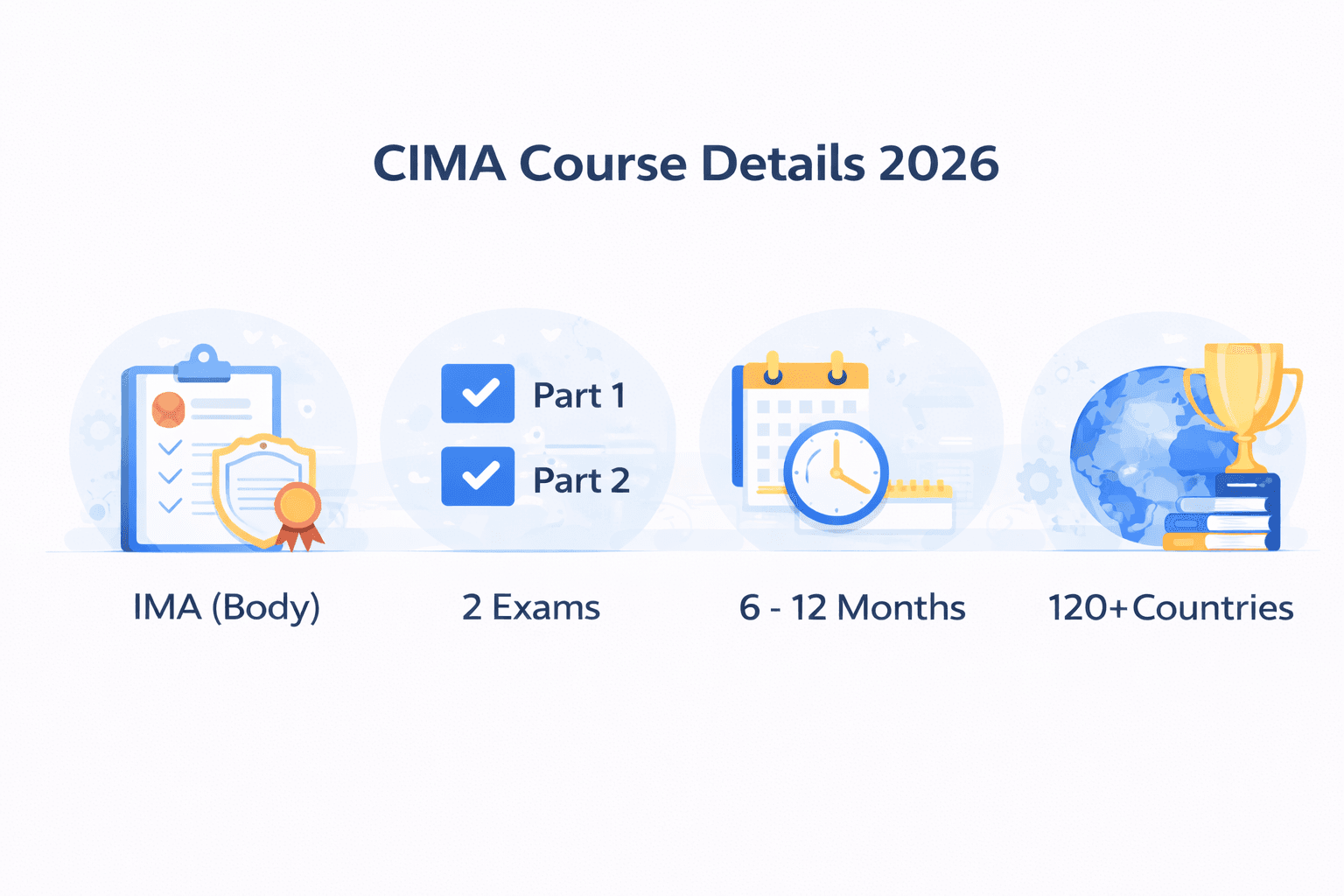
The CIMA course structure 2026 is divided into a Certificate level and the CGMA Professional Qualification awarded by Chartered Institute of Management Accountants. The professional stage includes three levels—Operational, Management, and Strategic—each covering Enterprise, Performance, and Financial pillars. Students complete Objective Tests and Case Study exams to develop technical, analytical, and leadership skills for global business roles.
The qualification has two main stages:
- Certificate in Business Accounting (Foundation Level)
This is the entry-level stage for students without a finance background.
It covers:
- Business economics
- Management accounting basics
- Financial accounting
- Ethics and governance
Many commerce graduates may receive exemptions from this level.
- CGMA Professional Qualification
This is the core professional stage. It is divided into:
- 3 Levels
- 3 Pillars (Enterprise, Performance, Financial)
The Three Pillars (Same Across All Levels)
Enterprise (E) – Strategy, digital transformation, governance, leadership
Performance (P) – Costing, budgeting, performance analysis, risk management
Financial (F) – Financial reporting, taxation, financial strategy
The Three Levels
- Operational Level
Focus: Implementing decisions (short-term focus)
Exams:
- E1: Managing Finance in a Digital World
- P1: Management Accounting
- F1: Financial Reporting and Taxation
- Operational Case Study (3 hours)
2. Management Level
Focus: Managing performance (medium-term focus)
Exams:
- E2: Managing Performance
- P2: Advanced Management Accounting
- F2: Advanced Financial Reporting
- Management Case Study (3 hours)
3. Strategic Level
Focus: Long-term strategy and leadership
Exams:
- E3: Strategic Management
- P3: Risk Management
- F3: Financial Strategy
- Strategic Case Study (3 hours)
Exam Pattern (Unchanged in 2026)
Total Exams
Without exemptions:
12 exams (9 Objective Tests + 3 Case Studies)
- 9 Objective Tests (90 minutes each)
- 3 Case Study exams (3 hours each)
- Case Studies held four times per year
- Must pass all Objective Tests before attempting Case Study at each level
FRM Course Fees, Eligibility & Career Scope – Explore 2026 Details →
Completion Requirement
To become fully qualified and earn the CGMA designation:
- Complete all three levels
- Finish three years of relevant practical experience (can overlap with studies)
Who Should Choose CIMA Course in 2026? Eligibility, Skills & Career Fit Explained
The CIMA course in 2026 is ideal for commerce students, finance professionals, and aspiring business leaders who want careers in corporate finance, strategic management, and business decision-making. It suits those seeking skills in financial analysis, management accounting, risk management, and leadership. Graduates may receive exemptions, while working professionals can start at the Operational level based on prior experience.
Target Audience: Ideal for commerce students (post-12th or graduates), finance professionals, and aspiring leaders in corporate finance, strategy, and decision-making. Perfect for those moving from traditional accounting to business-focused roles.
Skills Developed: Financial analysis, management accounting, risk management, leadership, performance management, critical thinking, business analysis. 2026 syllabus adds focus on finance business partnering, sustainability (green finance, IFRS S1/S2), generative AI, and applied problem-solving.
Eligibility & Exemptions: Graduates (B.Com, BBA) may get Certificate level exemptions. Working professionals can start at Operational or higher based on prior experience.
Career Scope: Management accountant, finance manager, business analyst, strategic planner, or even future CFO roles.
Other Notes: Requires 3 years practical experience for full CGMA designation (can overlap with studies).
The CIMA journey is divided into 3 main levels. Each level focuses on Business, Finance, Performance, and Strategy.
- Operational Level: Focuses on the short-term and helps you understand how to implement plans.
- Management Level: Focuses on the medium-term and teaches you how to manage teams and performance.
- Strategic Level: Focuses on the long-term and how to lead a company at the highest level.
Exams are computer-based and available throughout the year. This flexibility allows you to choose your exam date when you feel ready.
CIMA CGMA Qualification Fees Duration and Practical Experience Requirements 2026
CIMA CGMA fees in 2026 include one-time registration £99 (first-year subscription free), annual subscription £150, exam fees (Tier 2 India: Objective Tests £104–£178 each, Case Studies £192–£303), total estimated £2,500–£5,000 GBP without exemptions. Duration averages 3–4 years. Requires 3 years relevant practical experience for full CGMA designation.
The CIMA CGMA Professional Qualification remains a top choice in 2026 for aspiring management accountants and finance leaders. Fees follow a tiered structure for global accessibility—India falls under Tier 2 (Rest of the World), offering lower costs than Tier 1 regions.
CIMA CGMA fees in 2026 include one-time registration £99 (first-year subscription free), annual subscription £150, exam fees (Tier 2 India: Objective Tests £104–£178 each, Case Studies £192–£303), total estimated £2,500–£5,000 GBP without exemptions. Duration averages 3–4 years. Requires 3 years relevant practical experience for full CGMA designation.
The CIMA CGMA Professional Qualification remains a top choice in 2026 for aspiring management accountants and finance leaders. Fees follow a tiered structure for global accessibility—India falls under Tier 2 (Rest of the World), offering lower costs than Tier 1 regions.
- Registration Fee: One-time £99 GBP (includes first-year subscription free for new candidates).
- Annual Student Subscription: £150 GBP (paid yearly to maintain active status; due by March 31 to avoid expiration).
- Exam Fees (from 1 January 2026, Tier 2 approximate):
i. Certificate Objective Tests (each): £111 GBP.
ii. Operational Objective Tests (each): £135 GBP.
iii. Management Objective Tests (each): £154 GBP.
iv. Strategic Objective Tests (each): £241 GBP (higher for advanced levels).
v. Case Studies: Operational £241 GBP, Management ~£199–£240 GBP, Strategic higher (up to £303 GBP range).
- Practical Experience Application Fee (for membership): £199 GBP.
- Total Estimated Cost (full qualification, no exemptions, including subscriptions): £2,500–£5,000+ GBP (around ₹2.5–6 lakhs in India, plus study materials/tuition extra from providers like Kaplan or BPP). Costs drop significantly with exemptions (e.g., for graduates).
Duration: Flexible and self-paced—average 3–4 years to complete exams (9 Objective Tests + 3 Case Studies). Graduates often finish in 2–3 years with exemptions. On-demand Objective Tests speed progress, while Case Studies have 4 annual windows.
Work Experience Required: Minimum 3 years of relevant practical experience in finance, management accounting, strategy, or related roles (verified via supervisor). Experience can be gained before, during, or after exams (overlap allowed). Submit after passing final exams for full ACMA/CGMA membership—focuses on demonstrating core skills like decision-making, risk management, and business partnering, not specific job titles.
This makes CIMA affordable and achievable in India while building strong corporate finance and leadership careers. Check exact Tier 2 fees and exemptions on the official AICPA & CIMA website (aicpa-cima.com) for your personalized breakdown—register for free to access the calculator.
CIMA CGMA Career Scope, Salary & Jobs in India 2026
The CIMA CGMA career scope in India 2026 offers strong opportunities in corporate finance, management accounting, and leadership roles. Salaries range from ₹7–10 lakhs for freshers to ₹60 lakhs – ₹1.5 crores+ for senior leadership roles (CFO track). Top employers include global MNCs, consulting, tech, and manufacturing firms.
The CIMA CGMA qualification in 2026 provides excellent career opportunities for professionals focusing on business strategy, financial decision-making, and leadership—beyond traditional auditing. It is highly valued in India across MNCs, consulting, tech, manufacturing, and finance sectors.
US CMA Course Salary & Eligibility – Check 2026 Pay & Career Path →
Key Job Roles After CIMA Qualification:
- Entry-Level (0–2 Years): Management Trainee, Junior Financial Analyst, Cost Accountant
- Mid-Level (3–8 Years): FP&A Analyst, Finance Manager, Senior Management Accountant, Finance Business Partner
- Senior Level (7–10+ Years): Finance Controller, Risk Manager, Senior Finance Manager
- Leadership (10–15+ Years): Finance Director, CFO, Strategic Planner
CIMA Salary Ranges in India 2026:
| Career Stage | Experience Level | Approx. Salary (Annual) |
| Entry-Level | 0–2 Years | ₹7 – ₹10 Lakhs |
| Mid-Level | 3–8 Years | ₹12 – ₹25 Lakhs |
| Senior Level | 8–15 Years | ₹25 – ₹45 Lakhs+ |
| Leadership | 15+ Years | ₹60 Lakhs – ₹1.5 Cr+ |
Top Employers & Growth Factors:
Preferred by MNCs, consulting, tech, and manufacturing firms for strategic finance skills. The 2026 syllabus update—Generative AI, sustainability, and finance business partnering—boosts employability and salary potential.
Skills Driving Salary Growth:
Mastering AI, Green Finance, and Applied Problem-Solving, combined with three years of practical experience, positions professionals for global leadership and international career opportunities.
CTA / Reference: For personalized insights and job trends, check the official CIMA Career Hub.
CIMA Preparation Tips 2026: How to Study & Best Resources for CGMA Exams
CIMA preparation tips 2026: Use official CIMA Study Hub resources and updated study texts for the syllabus upgrade (AI, sustainability, business partnering). Practice Objective Tests and Case Studies regularly, follow a structured level-wise plan, and leverage free support programs for guidance. Focus on applied skills and problem-solving to maximize exam success.
The CIMA CGMA qualification in 2026 requires a smart, structured approach to exam preparation. The syllabus upgrade (Objective Tests from Jan 2026, Case Studies from May 2026) emphasizes finance business partnering, critical thinking, sustainability (green finance, IFRS S1/S2), generative AI, and digital tools.
Recommended Study Materials (2026-Ready) for CIMA Course
| Resource Type | Key Features | Best For |
| CGMA Study Hub | 50+ Hours Support, Practice Kits | Official Syllabus Alignment |
| Online Platforms | Tutor Support & Live Mock Exams | Interactive Learning |
| Trusted Providers | Revision Cards & Practice Exams | Intense Revision & Practice |
Study & Exam Strategy for CIMA 2026
- Build a level-wise plan covering all pillars (Enterprise, Performance, Financial).
- Prioritize Objective Tests first: master concepts and practice extensively.
- For Case Studies: analyze pre-seen material, research industries, and practice applied problem-solving.
- Use free student support programs and study communities for guidance and peer discussion.
Key Tips for Success
- Focus on practical application, not rote learning.
- Time management and regular mocks improve speed and accuracy.
- Engage in forums or student communities to clarify doubts.
Following these CIMA preparation tips 2026 ensures better exam performance, faster progression, and strong readiness for corporate finance and leadership roles.
How to Get CIMA Certification & CGMA Membership Process 2026 (India)
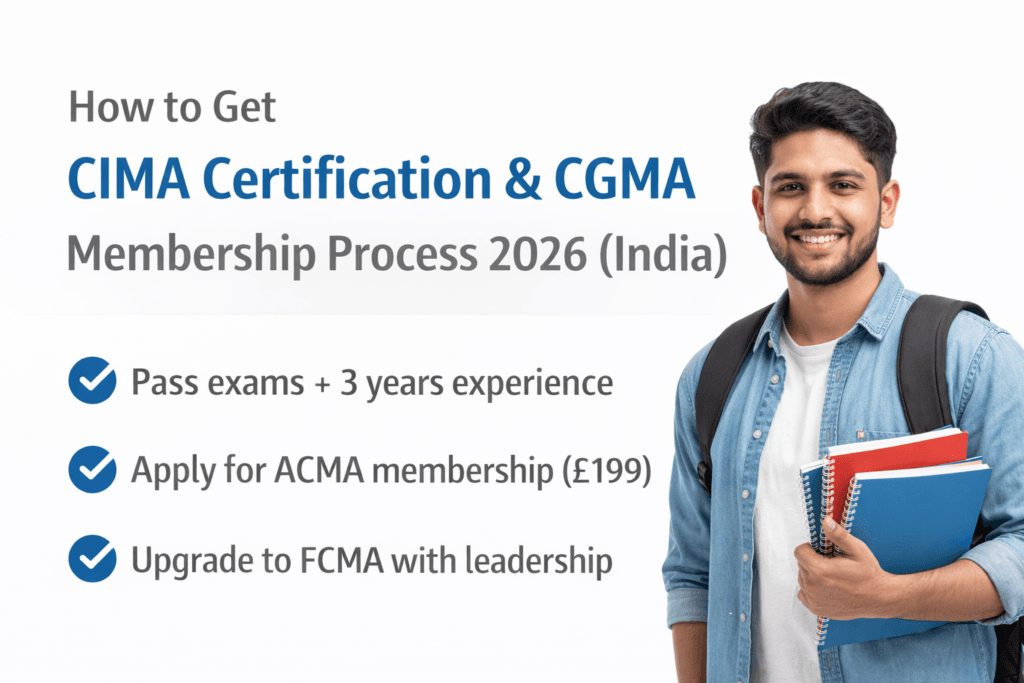
To get CIMA certification and CGMA designation in 2026: Pass all Objective Tests and Case Studies across the three levels, complete 3 years of relevant practical experience (PER, can overlap with studies), then apply for ACMA membership (£199). Upon approval, you receive ACMA/CGMA status and can later upgrade to FCMA with leadership experience.
The CIMA CGMA Professional Qualification leads to full certification and membership as a Chartered Global Management Accountant (CGMA), with designatory letters ACMA (Associate) or FCMA (Fellow). The process in 2026 remains consistent with prior years, while exams now reflect the syllabus upgrade including AI, sustainability, and business partnering.
ACCA Course 2026: Complete Step-by-Step Guide for Fees, Eligibility & Career →
Step-by-Step Process to get CIMA Course Certification:
1. Complete Exams
- Pass all 9 Objective Tests + 3 Case Studies (Operational, Management, Strategic levels).
- Exemptions may speed up progress but are not required for final steps.
2. Fulfill Practical Experience Requirements (PER)
- Minimum 3 years relevant work experience in finance, management accounting, strategy, risk, or related roles.
- Experience can overlap with study; part-time is pro-rated.
- Demonstrate skills like decision-making, business partnering, and professional behaviours.
- Verified by a supervisor via online submission.
3. Apply for Membership
- After final exam + PER, apply via your AICPA & CIMA account.
- Membership Fee: £199 GBP (one-time).
- Approval grants ACMA membership + CGMA designation.
4. Optional FCMA Upgrade
- After 10+ years membership in good standing + leadership experience.
- Apply separately (approx £120) for Fellow status.
5. Membership Benefits
- Global recognition, CPD resources, networking, and career support.
- Use prestigious ACMA/CGMA/FCMA titles for professional credibility.
India (Tier 2) Info: Process is fully online via CIMA Official Website. Prior work experience counts toward the 3-year PER requirement.
CIMA Course Details 2026 : Frequently Asked Questions (FAQs)
Q1: What is CIMA Course and who should pursue it?
: CIMA (Chartered Institute of Management Accountants) is a global professional qualification from the UK. It is best suited for students who want a career in management accounting, corporate finance, and business strategy. CIMA helps build practical skills and leadership capabilities for long-term career growth.
Q2: What is the eligibility for the CIMA course?
Students can start CIMA after completing 12th (commerce preferred) or graduation in any stream. While there is no strict finance background required, relevant work experience is mandatory for full CIMA membership after passing the exams.
Q3: How long does it take to complete CIMA?
The duration of the CIMA course usually ranges from 2 to 4 years. The exact time depends on exemptions, study pace, and how quickly students clear the exams. CIMA offers flexible exam scheduling, making it easier to plan your learning path.
Q4: How is the CIMA exam structured?
CIMA has 3 main levels: Operational, Management, and Strategic. Exams are computer-based and include both objective tests and case studies. Students can choose exam dates throughout the year, making it flexible for working professionals and freshers alike.
Q5: What is the average salary after completing CIMA in India?
Freshers and early-career CIMA professionals typically earn between ₹6 LPA to ₹10 LPA. With experience and expertise, salary growth is strong, and global opportunities in MNCs are also available. Actual salary depends on skills, location, and company profile.
Q6: Are there any exemptions for B.Com, CA, ACCA, or MBA students?
Yes. Students with prior qualifications like B.Com, CA, ACCA, or MBA can get high exemptions in CIMA exams. This reduces the total number of papers to clear and shortens the overall course duration, making it faster to complete the certification.
Q7: Is CIMA worth it for a long-term corporate career?
Absolutely. CIMA develops practical business thinking, strategic decision-making, and leadership skills. It is highly respected by global companies and MNCs, helping students secure management roles and grow steadily in corporate finance and business strategy careers.
Q8: Can final-year students start the CIMA course?
Yes. Final-year graduation students can start CIMA and appear for Operational Level exams. This allows students to complete parts of the certification before graduation and plan their career path early.
Q9: What kind of skills does CIMA develop?
CIMA builds practical business skills such as management accounting, strategic decision-making, leadership, financial analysis, and business planning. It focuses on applying concepts to real corporate scenarios rather than just theoretical knowledge.
Q10: Where can I find official resources and study material for CIMA?
A10: Official resources are available on the CIMA Global website. Students can access study guides, past papers, exam updates, and membership details. Using official resources ensures accurate and updated information.
Conclusion
Choosing a career is a big step, and I hope these CIMA Course Details have helped you see the full picture. My goal at commercecare.in is not to give you big dreams of a “lavish life,” but to show you a practical path where you can grow professionally. CIMA is a great qualification for those who love strategy and management, but remember, the degree is just a door. How far you go depends on your hard work, how you handle real-world problems, and your constant learning.
Disclaimer
The content on this website is intended for informational and educational purposes only. While we strive to provide accurate and up-to-date information about CIMA CGMA courses, fees, eligibility, career scope, and exam preparation, all details are subject to change by the Chartered Institute of Management Accountants (CIMA) or other official sources.
We do not guarantee exam results, salaries, or career outcomes. Individual experiences may vary based on qualifications, work experience, and performance. Users should always verify details from official sources, such as CIMA’s official website.
This website may contain affiliate links or references to study materials, online courses, or service providers. We may earn a commission at no extra cost to you if you choose to use these resources. However, we recommend them purely based on quality, relevance, and student benefits, not for financial gain.
By using this website, you agree to the terms above and acknowledge that the information provided is for guidance only.