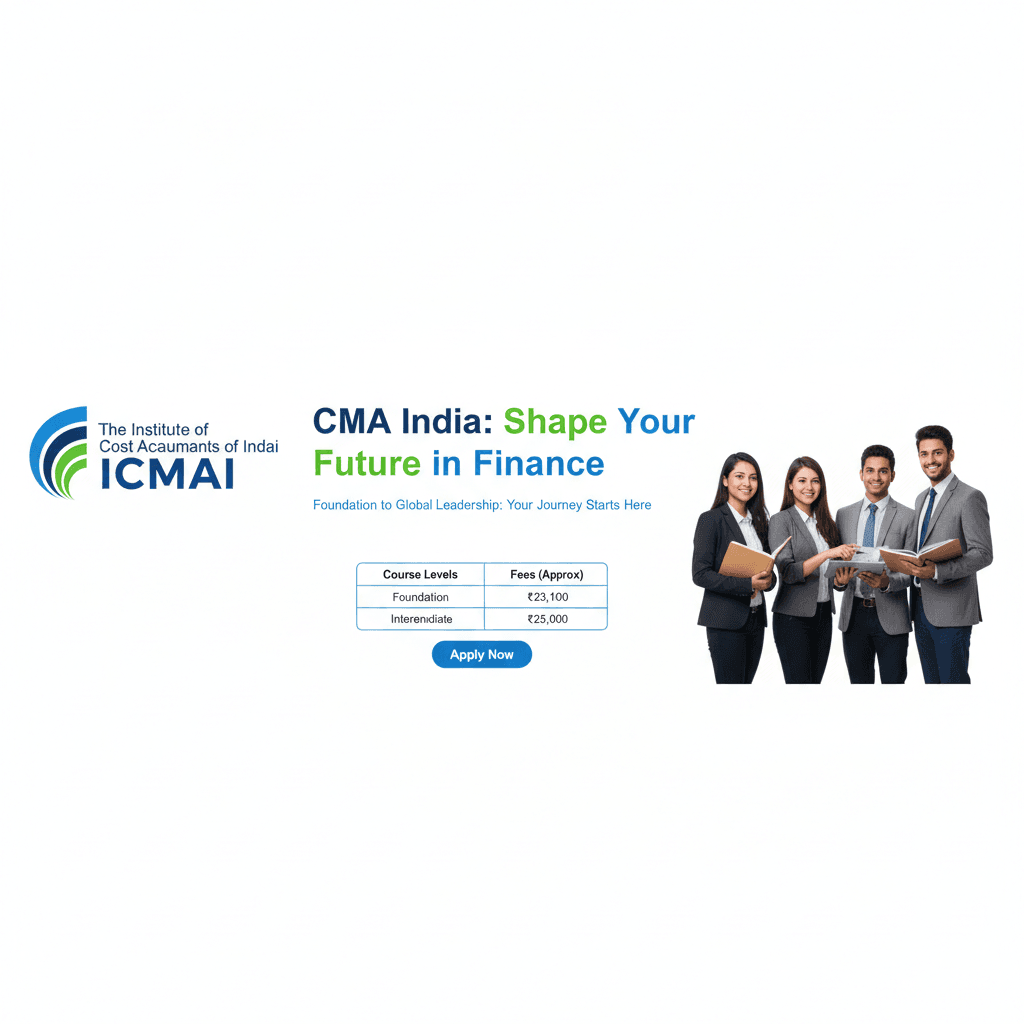
What Is CMA India Course in 2026? Full Details, Fees, Eligibility & Career Scope Explained
The CMA India course in 2026 is a professional accounting course offered by the Institute of Cost Accountants of India. This course teaches students about cost accounting, financial planning, budgeting, and business decision-making. It has three levels – Foundation, Intermediate, and Final. Students can join after Class 12. The CMA India course eligibility is simple, and the career scope includes jobs in companies, banks, and industries across India
What Is CMA India Course and What Does a Cost Accountant Do in 2026?
The CMA India course in 2026 is a professional cost and management accounting program offered by the Institute of Cost Accountants of India. This course trains students in cost control, budgeting, taxation, and financial planning. A Cost Accountant helps companies reduce expenses, improve profits, and support smart business decisions. The CMA India course is ideal for commerce students who want careers in finance, corporate management, or professional practice.
Main Work of a Cost Accountant:
- Cost Analysis: Tracking and managing production costs to ensure efficiency.
- Budgeting: Creating and monitoring financial plans for various business units.
- Profit Planning: Identifying strategies to maximize company margins.
- Compliance: Ensuring financial reporting adheres to legal and professional standards.
Students comparing this course can also explore topics like CMA vs CA difference and CMA India course registration process for better clarity.
What Is the Full Form of CMA in India in 2026?
The full form of CMA in India is Cost and Management Accountant. This professional title is awarded after clearing all three levels of the CMA India course and completing mandatory practical training. The certification proves expertise in cost control, financial planning, and business strategy.
Who Conducts the CMA India Course in India?
The CMA India course is conducted by the Institute of Cost Accountants of India, a statutory professional body established under an Act of Parliament. It regulates the syllabus, conducts national-level exams twice a year, and ensures training standards match current industry requirements in 2026.
Who Is Eligible for CMA India Course After 10th or 12th in 2026?
CMA India course eligibility in 2026 requires students to pass Class 12 from a recognized board. Students can register for the Foundation level after Class 10, but they can appear in the exam only after completing 12th. Graduates from most streams can use the direct entry route to join the Intermediate level of the CMA India course.
Basic Eligibility Criteria for CMA India Course 2026
- Class 12 Pass: Students must complete 10+2 from a recognized board such as Central Board of Secondary Education, ICSE, or any State Board.
- Direct Entry Route: Graduates from most streams (except Fine Arts) can directly register for the Intermediate level.
- Provisional Registration: Class 10 students can start early registration but must pass 12th before appearing in exams.
You can also read about the CMA India course registration process and CMA India course duration in 2026 for step-by-step clarity.
Can Science or Arts Students Apply for CMA India Course in 2026?
Yes, science and arts students can apply for the CMA India course after completing Class 12. There is no stream restriction in the eligibility rules. While commerce students may find accounting subjects familiar, the CMA syllabus starts from basics, making it suitable for students from any educational background.
What Is the Minimum Qualification Required for CMA India Course?
The minimum qualification for the CMA India course is passing Class 12 for the Foundation route. For the direct entry scheme, a Bachelor’s degree from a recognized university is required. This flexible structure allows both school students and graduates to pursue the CMA India course in 2026.
Is There Any Age Limit for CMA India Course in 2026?
There is no minimum or maximum age limit for the CMA India course in 2026. As long as a candidate meets the educational eligibility criteria, they can register and appear for the exams. This flexibility makes the course suitable for fresh students as well as working professionals.
Ultimate 2026 CMA India Course Blueprint: Complete Structure, Syllabus, Passing Rules & Training Guide
The CMA India course structure in 2026 is regulated by the Institute of Cost Accountants of India (ICMAI), a statutory professional body established under a Special Act of Parliament in 1959 and functioning under the Ministry of Corporate Affairs, Government of India.
The qualification pathway includes three examination levels, structured group-wise papers, defined passing criteria, exemption benefits, mandatory skills training, and 15 months of practical training before applying for membership.
This blueprint explains everything in one place — from syllabus to training and qualification roadmap.
How Many Levels and Groups Are There in CMA India 2026?
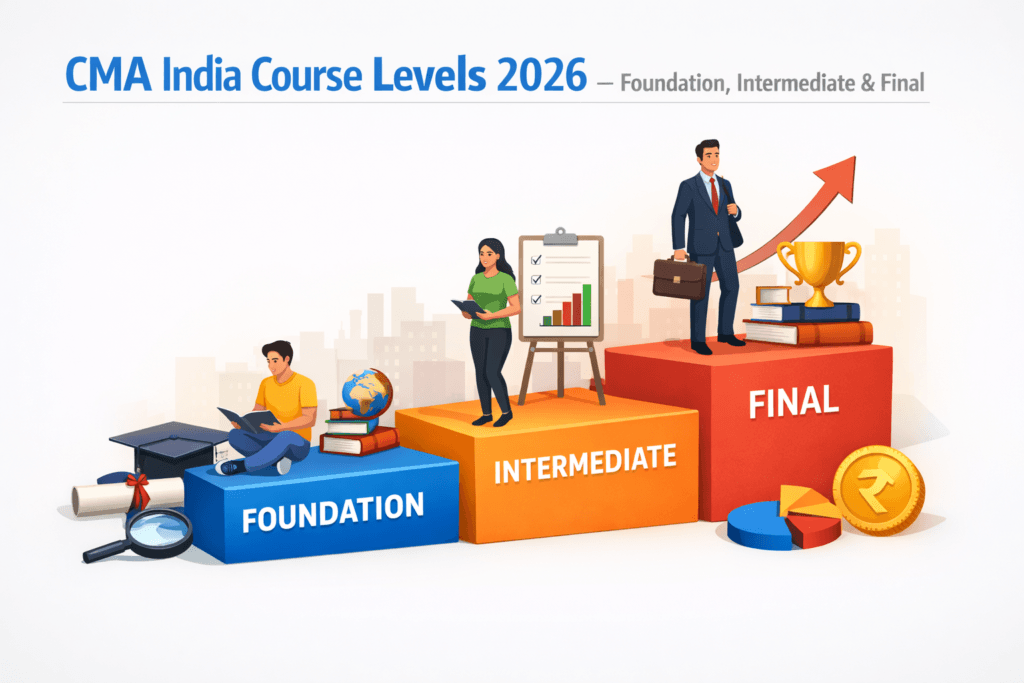
The CMA India course is divided into three progressive stages:
Foundation Level – 4 Papers (Entry Stage)
Intermediate Level – 2 Groups (8 Papers + Skills Training)
Final Level – 2 Groups (8 Papers including Elective Options)
To become a qualified Cost and Management Accountant, students must clear all groups and complete mandatory practical training requirements.
CMA India Course Duration and Attempt System 2026
Understanding the duration is essential for planning.
- Typical completion time: Around 3 to 4 years (depending on attempts)
- Exams are generally conducted twice a year (June and December cycles)
- Students may appear group-wise or both groups together (Intermediate and Final)
Proper attempt planning significantly reduces overall completion time.
CMA Foundation Syllabus 2026 (Paper-Wise Structure)
The Foundation level builds core business and accounting fundamentals. It is the entry point for students after 10+2.
Paper 1: Fundamentals of Business Laws & Business Communication
Paper 2: Fundamentals of Financial & Cost Accounting
Paper 3: Fundamentals of Business Mathematics & Statistics
Paper 4: Fundamentals of Business Economics & Management
✔ Exam Mode: Generally objective-based (MCQs)
✔ Purpose: Concept building for professional stages
CMA Intermediate Syllabus 2026 (Group-Wise Structure)
The Intermediate stage forms the technical backbone of the CMA qualification, bridging the gap between basic accounting and strategic management. The current syllabus includes Business Data Analytics and Digital Accounting components aligned with modern finance practices. For a detailed breakdown of subjects and weightage, students can refer to the official CMA Intermediate Syllabus 2026 on the Institute’s website.
🔹 Group I
Paper 5: Business Laws & Ethics
Paper 6: Financial Accounting
Paper 7: Direct & Indirect Taxation
Paper 8: Cost Accounting
🔹 Group II
Paper 9: Operations Management & Strategic Management
Paper 10: Corporate Accounting & Audit
Paper 11: Financial Management & Business Data Analytics
Paper 12: Management Accounting
Mandatory Skills Training (140 Hours)
Before appearing for Intermediate examinations, students are required to complete:
- SAP Training
- Advanced Microsoft Excel
- Soft Skills & Professional Communication
This ensures industry readiness before entering the Final stage.
CMA Final Syllabus 2026 (Advanced & Elective Structure)
The Final level focuses on strategic leadership, compliance, and advanced financial decision-making.
🔹 Group III
Paper 13: Corporate Laws & Compliance
Paper 14: Strategic Financial Management
Paper 15: Direct Tax Laws & International Taxation
Paper 16: Strategic Cost Management
🔹 Group IV
Paper 17: Cost & Management Audit
Paper 18: Corporate Financial Reporting
Paper 19: Indirect Tax Laws & Practice
Paper 20: Elective Paper (Choose One)
Elective options may include:
- Strategic Performance Management (20A)
- Risk Management in Banking (20B)
- Entrepreneurship & Start-ups (20C)
Elective options are subject to latest ICMAI notifications.)
CMA India Passing Criteria and Exemption Rules 2026
To pass any group in CMA India 2026, students must satisfy both conditions simultaneously:
Minimum 40% marks in each individual paper
Minimum 50% aggregate marks in the group
Exemption Rule
If a student scores 60 or above in any paper but fails the group overall:
That paper is exempted
Exemption is valid for the next three attempts
This structured system ensures balanced subject-level competency.
Mandatory 15 Months Practical Training (Articleship)
In 2026, completing 15 months of practical training is compulsory before applying for membership.
Training may be completed:
- In corporate finance departments
- Under a practicing CMA
- In approved industry setups
This training provides real-world exposure to cost audit, taxation, compliance, budgeting, and financial reporting.
Without completing practical training, membership approval is not granted.
Registration Timeline & Exam Planning (2026 Insight)
For proper planning:
- Foundation registrations generally align with January and July cycles.
- Intermediate and Final exams are typically conducted in June and December.
- Students should verify current cut-off dates through official ICMAI notifications before registration.
Related Guide: US CMA Course Structure and Eligibility 2026
Final Qualification Roadmap Summary
Step 1: Register for Foundation (after 10+2)
Step 2: Clear Foundation
Step 3: Register for Intermediate
Step 4: Complete 140 Hours Skills Training
Step 5: Clear Intermediate Groups
Step 6: Complete 15 Months Practical Training
Step 7: Clear Final Groups
Step 8: Apply for Membership under ICMAI
What Is the CMA India Course Fees Structure and Exam Timeline in 2026?
The CMA India course fees and exam registration timelines in 2026 are regulated by The Institute of Cost Accountants of India (ICMAI). This section explains the exact fees for each level, the distinction between single and both group exam fees, the total estimated cost, and the latest exam deadlines for the June and December 2026 cycles. For real-time updates on fee revisions, students should visit the official ICMAI Admission and Fee Structure 2026 portal.
For the most updated information on fees and exam schedules, students should always verify through the official ICMAI portal (external official reference).
What Is the Registration Fee for Each Level?
Foundation Level
- Registration Fee: ₹6,000
- Includes basic study material
- Entry point after Class 12
Intermediate Level
- Total Registration Fee: ₹23,100
- Can be paid in two instalments:
- 🟢 First Instalment: ₹12,000
- 🟢 Second Instalment: ₹11,100
- Important: This ₹23,100 fee includes the mandatory 140 Hours Skills Training (SAP, Advanced Excel & Professional Communication).
✔ This is a major advantage — no separate training fee for skills training.
Final Level
- Total Registration Fee: ₹25,000
- Instalment Structure:
- 🟢 First Instalment: ₹15,000
- 🟢 Second Instalment: ₹10,000
What Are the Exact CMA India Exam Fees in 2026?
Unlike registration fees, exam fees are paid per cycle (June & December) while filling the exam form.
Foundation Exam Fee (2026)
Single Group: ₹1,500
Intermediate Exam Fee (2026)
Single Group: ₹1,500
Both Groups Combined: ₹2,800
✔ Choosing both groups together is more cost-efficient than separate payments.
Final Exam Fee (2026)
Single Group: ₹1,600
Both Groups Combined: ₹3,200
Note: These amounts are fixed ICMAI fees for 2026 inland exam centers and are not approximations.
2026 CMA Exam Deadlines (Official Cycle)
To plan your CMA India journey effectively, knowing the exam cycle timelines is important.
June 2026 Cycle (Extended)
Registration last date was 10th February 2026 (This date has passed)
December 2026 Cycle
Registration last date is 31st July 2026
Students should complete registration and exam form submission before these deadlines to avoid late fees or missed attempts.
What Is the Total Cost to Complete CMA India Course?
After Class 12 (Foundation Route)
Estimated official cost (Registration + Exam Fees):
₹60,000 – ₹70,000+ (depending on number of attempts)
Direct Entry (Graduate Route)
Estimated official cost (Intermediate + Final):
₹50,000 – ₹60,000+
Actual total varies with number of exam attempts and timing.
Are There Any Additional Coaching Costs?
Yes — optional and not charged by ICMAI:
- Coaching or Test Series: ₹30,000 – ₹80,000+ (varies by institute)
- Extra Books & Mock Tests: Variable
- Travel & Lodging: If appearing at outside cities
Since ICMAI includes skills training in Intermediate registration, many students save money by relying on official materials and self-study.
What Is the CMA India Course Duration and Attempt System? (2026 Updated)
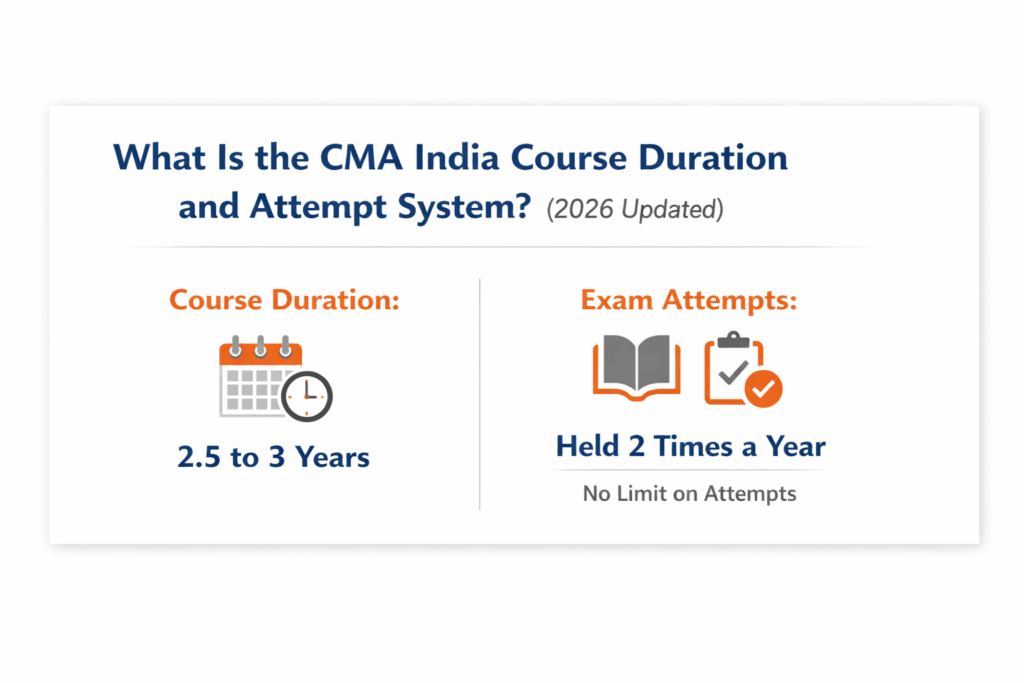
The CMA India course duration in 2026 ranges from 2 to 4 years, depending on your entry route and how efficiently you complete the mandatory training requirements. The program is regulated by the Institute of Cost Accountants of India (ICMAI) and includes academic exams, skills training, practical exposure, and a structured attempt system within a 7-year registration validity.
How Many Years Does It Take to Complete CMA India?
On average, it takes 3 to 4 years for students starting after Class 12th and 2 to 2.5 years for Graduates to become a qualified CMA. Graduation entry (Direct Entry) saves approximately 6–8 months as the Foundation level is skipped.
| Level | Average Duration | Key Mandatory Training |
| Foundation | 6-8 Months | None |
| Intermediate | 12 Months | 140-Hour Skills Training |
| Final | 12-18 Months | 10-Month Practical Training + IOTP |
Intermediate vs Final Training Requirements (2026 Clarification)
For Intermediate Exams:
- Skills Training (140 Hours): Mandatory before appearing for both groups. Includes SAP, Advanced Excel, Power BI, and Soft Skills.
- Practical Training: Not required for appearing in Intermediate exams.
For Final Exams (The 10-Month Rule):
- Form T5A: To fill the Final exam form, you must complete at least 10 months of practical training and submit Form T5A.
- IOTP (7-10 Days): Before qualifying, you must attend the Industry Oriented Training Program focusing on real-world corporate case studies and compliance.
- Final Skills Training (80 Hours): An advanced module on Business/Data Analytics and SAP Power User certification.
Registration Validity and De Novo Rule
A major 2026 update to keep in mind is that your CMA registration is not valid for life.
- 7-Year Window: Your registration for any level remains valid for 7 years.
- De Novo Registration: If you don’t clear the exams within 7 years, you must apply for De Novo Registration by paying a renewal fee (typically around ₹5,000).
- Coaching Revalidation: If you take a break longer than 3 years between attempts, you may need to revalidate your coaching certificate for a small fee (₹800–₹1000).
How Many Attempts Are Allowed in CMA India?
There is no fixed limit on the number of attempts. Students can appear as many times as needed within their 7-year registration period. Exams are conducted twice a year in June and December, providing two opportunities annually to clear your groups and move to the next level.
Can CMA India Be Completed in 3 Years?
Yes, a 3-year fast-track path is possible for disciplined students. This requires clearing both groups of Intermediate and Final in single attempts and starting your practical training immediately after Intermediate registration.
Related Guide: If you are evaluating different commerce career paths, you can also explore the BAF Course Details 2026 to compare degree-based learning with professional certifications.
How to Register for CMA India Course in 2026?
The CMA India registration process for 2026 is completely online and managed through the official student portal of The Institute of Cost Accountants of India (ICMAI). As a statutory professional body functioning under the Ministry of Corporate Affairs, Government of India, ICMAI grants a nationally regulated professional qualification in Cost and Management Accounting.
Before applying for the June or December examination term, students must complete their level-wise registration (Foundation, Intermediate, or Final). Registration and exam form submission are two separate processes, and understanding this distinction is crucial for eligibility.
What Is the Step-by-Step Registration Process?
To begin your CMA journey, follow these structured steps:
Step 1: Visit the official ICMAI Student Portal (e-Services) and click on the “Online Admission” tab.
Step 2: Select your applicable level — Foundation, Intermediate, or Final.
Step 3: Enter basic details (Name, Date of Birth, Email ID) to generate an OTP for provisional login.
Step 4: Complete the detailed application form and upload scanned documents as required.
Step 5: Pay the prescribed registration fee via Net Banking, Debit/Credit Card, or UPI.
Step 6: After document verification by the Directorate of Studies, your Registration Number will be generated. Save it for future correspondence.
Important Clarification
Registration is a one-time enrollment process. However, to appear in exams, you must separately fill out the Exam Form, which is usually released:
- March (for June Term)
- September (for December Term)
Missing the exam form deadline will make you ineligible for that attempt, even if you are registered.
What Documents and Eligibility Are Required in 2026?
Before starting your application, ensure all scanned documents are in PDF or JPEG format (generally 300 KB–600 KB).
Foundation Level
Eligibility:
Must have passed Class 10 and either appeared for or passed Class 12 from a recognized board. Appearing students can register provisionally.
Required Documents:
- 10th Marksheet
- 12th Marksheet or Admit Card (if appearing)
- Passport-size photograph
- Signature
Intermediate Level (Direct Entry)
Eligibility:
Graduates from any recognized university (except Fine Arts) are eligible. Both commerce and non-commerce graduates can apply, subject to qualifying criteria for the respective term.
Required Documents:
- Graduation Degree or Marksheet
- Identity Proof (Aadhaar/PAN)
Final Level
Eligibility:
Must have passed the CMA Intermediate level and completed the mandatory practical training requirement, including compliance with the 10-month training rule before submitting the Final exam form.
Required Documents:
- CMA Intermediate Marksheet
- Practical Training Completion Proof (Form T5A)
When Is the Last Date to Apply for CMA 2026?
Although registration remains open throughout the year, ICMAI follows strict cut-off dates for exam eligibility.
- December 2026 Term: Last date to register – 31st July 2026
- After 31st July 2026: You will be eligible only for the June 2027 term
Fee Policy
Registration fees are non-refundable. If you choose the installment option (available for Intermediate and Final levels), ensure the second installment is paid before the prescribed deadline to maintain eligibility.
Strategic Insight for 2026 Aspirants
Students are strongly advised to complete registration at least 4–5 months before their intended exam term. Early registration ensures:
- Timely access to official study material
- Completion of mandatory training modules
- Adequate preparation time before exam form release
Planning ahead significantly reduces last-minute compliance risks.
Related Career Guide
If you are planning your professional budget and long-term career strategy, comparing global certifications can help you make a smarter decision. CS Course 2026: Complete Details on Fees, Duration, and Eligibility
What Is the Articleship or Practical Training Requirement in CMA India?
Practical exposure is a mandatory pillar of the CMA India qualification in 2026. Regulated by The Institute of Cost Accountants of India (ICMAI), a statutory body under the Ministry of Corporate Affairs, this structured training ensures that students transition from theoretical concepts to real-world corporate financial management. Understanding the “10-month rule” and “15-month total duration” is critical for timely exam eligibility.
Is Articleship Mandatory in CMA India?
Yes, practical training (articleship) is compulsory for all students under the current ICMAI syllabus. While you can clear the Intermediate level without completing this training, it becomes a strict prerequisite for the Final stage.
- Eligibility for Final Exam: You cannot submit the CMA Final exam form without completing a specific portion of your training.
- Membership Requirement: Even after passing all exams, you will only be granted the CMA designation after fulfilling the total training duration.
How Many Months of Training Is Required in 2026?
The ICMAI mandates a total of 15 months of practical training. However, the timeline is strategically split to allow students to appear for their Final exams while still completing their full tenure.
- Total Duration: 15 Months.
- Exam Eligibility (The 10-Month Rule): You must complete at least 10 months of training before applying for the CMA Final examination (Both or remaining groups).
- Submission of Form T5A: This form must be submitted to ICMAI as proof of completing the initial 10 months to unlock your Final exam attempt.
Additional Training: Besides articleship, students must complete 140 hours of Skills Training (before Intermediate) and a 10-day Industry Oriented Training Program (IOTP) before the declaration of Final results.
Where Can You Complete Your CMA Training?
Unlike other professions that limit you to firms, CMA India training offers immense flexibility. You can gain experience in both practicing firms and large-scale industries.
- Practicing Cost Accountants (PCA): Working under a licensed firm or a firm of Cost Accountants.
- Recognized Organizations: This includes Manufacturing, Service sectors, Public Sector Undertakings (PSUs) like ONGC or GAIL, Banks, and Insurance companies.
- Approved Areas: Training must be in core areas such as Costing, Budgeting, Internal Audit, Taxation, and Financial Management.
Strategic Insight for 2026 Aspirants
To avoid delays in your career, the best strategy is to start your training immediately after registering for the Intermediate level. Waiting until you pass the Intermediate exams often leads to a “gap year” because of the 10-month eligibility rule for the Final attempt.
Pro Tip: If you have prior relevant work experience in a recognized organization, you may apply for partial or full exemption as per ICMAI guidelines by submitting Form T3 along with prescribed documentation and exemption fees.
What Is the Salary After Completing CMA India Course in 2026?
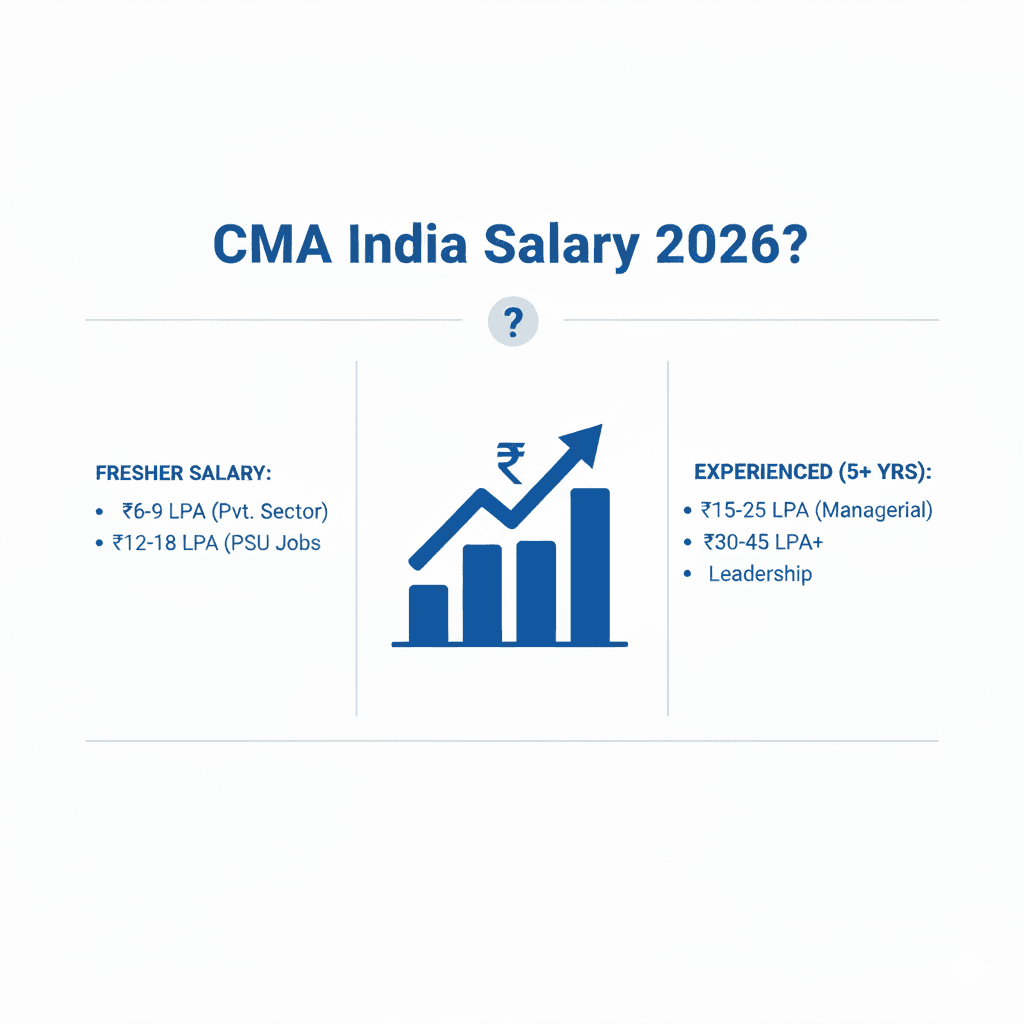
In 2026, the average salary after completing the CMA India course typically ranges between ₹6 LPA to ₹12 LPA for freshers. High-performing candidates in PSUs (like ONGC or IOCL) can secure starting packages of ₹12 LPA to ₹18 LPA. Factors such as exam attempts, rank, and technical proficiency in SAP or Power BI significantly influence the final compensation.
What Is the Salary After Completing CMA India Course in 2026? (Official Updates: ICMAI Official Website)
What Is the Average Salary of a CMA in India?
A qualified CMA in 2026 usually enters the market at a very competitive bracket. While the base might start around ₹6 Lakhs, the ceiling for talented professionals in metro cities like Mumbai and Bengaluru is much higher due to the presence of Global Capability Centers (GCCs).
- Fresher Average: ₹6.5 Lakhs – ₹10 Lakhs (Approx)
- High-End (Rankers/PSUs): ₹15 Lakhs – ₹22 Lakhs approx..
- Experience Impact: With 3–5 years in a strategic role, your package can easily cross ₹18 LPA.
PSU vs Private Sector: The Real Numbers
When you’re planning your career, it’s important to know that the “Employer Brand” changes your salary structure completely.
- Public Sector (PSUs): Companies like ONGC, BHEL, and GAIL are top recruiters. They often offer a “CTC” that includes housing, medical, and dearness allowance, making the effective package ₹12 LPA to ₹16 LPA right at the start.
- Private Sector (MNCs/Big 4): Firms like Deloitte, KPMG, and Accenture might start at ₹7 LPA to ₹9 LPA, but they offer much faster annual hikes and performance bonuses.
Who Are the Top Recruiters for CMAs?
In 2026, CMAs aren’t just limited to factories; they are leading the finance departments of tech and consulting giants.
- Manufacturing: Tata Motors, Reliance Industries, Vedanta.
- Consulting & Audit: The Big 4 (PwC, EY, KPMG, Deloitte).
- Tech & E-commerce: Amazon, Google, and Flipkart for cost-efficiency roles.
- Banking: ICICI, HDFC, and J.P. Morgan for risk and credit analysis.
Boost Your Salary: The “Skills-Based” Premium
Mastering the degree is step one, but in 2026, “Tech-Accountants” earn significantly more. Adding these to your resume can give you a 20% salary jump:
- ERP Mastery: Proficiency in SAP (FICO) or Oracle.
- Data Analytics: Using Power BI or Tableau to visualize cost trends.
- Soft Skills: The ability to explain complex financial data to non-finance managers during the Industry Oriented Training Program (IOTP).
Frequently Asked Questions (FAQs) About CMA India Course
How Many Students Clear CMA India Course in First Attempt?
The first-attempt pass rate in CMA India varies by level and exam term, but typically ranges between 10% to 25% per group. Success in the first attempt largely depends on conceptual clarity, exam strategy, and proper completion of training requirements.
Can a CMA Work Abroad?
Yes, a qualified CMA India professional can work abroad, especially in roles related to cost accounting, financial management, internal audit, and corporate finance. However, eligibility depends on employer requirements, local regulations, and sometimes additional certifications for specific countries.
Is There Negative Marking in CMA India Exams?
Negative marking applies only at the Foundation level (objective-type exams). Intermediate and Final levels follow a descriptive pattern and do not have negative marking.
What Is the Passing Percentage in CMA India?
To pass CMA India Course exams, students must score at least 40% in each paper and 50% aggregate in each group. Both conditions must be satisfied to clear a group.
Which Is Better – CMA India or CA?
CMA India Course is ideal for students interested in cost management, budgeting, and corporate finance roles, while CA is more focused on auditing, taxation, and statutory compliance. The better option depends on your career goals, strengths, and preferred industry path.
Disclaimer
This article is for informational purposes only. Eligibility, fees, exam pattern, training requirements, and other details may change as per official updates issued by The Institute of Cost Accountants of India (ICMAI).
Salary figures mentioned are indicative estimates based on industry trends and may vary depending on individual skills, performance, employer policies, and location. This content does not guarantee admission, exam success, job placement, or specific salary outcomes.
Readers are advised to verify the latest information from the official ICMAI website before making any academic or career decisions.