FRM Course 2026: Complete Guide to Financial Risk Manager Certification
FRM Course 2026 refers to the Financial Risk Manager (FRM) certification, a globally recognized credential offered by the US-based Global Association of Risk Professionals (GARP). The FRM program focuses on financial risk management, including market risk, credit risk, liquidity risk, and operational risk analysis. Clearing the FRM exam and meeting work experience requirements demonstrates advanced expertise in risk management and significantly improves global career opportunities in banking, investment, and corporate finance sectors.
FRM Course Details 2026: Exams, Eligibility & Career Scope
The FRM Course 2026 is a professional certification by GARP for finance experts. It covers financial risk management, including market, credit, and operational risks. To pursue FRM, candidates must clear two exams and meet work experience requirements. Completing it opens high-paying career opportunities in banking, investment, and corporate finance globally.

Why Pursue FRM Certification in 2026? (Benefits & Global Value)
The FRM Certification 2026 is a strategic credential for finance professionals aiming to master risk management in an evolving global market. This GARP-certified designation helps you stand out, validates your expertise, and leads to faster career progression in top-tier banks.
- Global Recognition: Respected by Goldman Sachs, HSBC, and top firms in 190+ countries.
- Career Growth: Opens senior roles like Risk Manager, Credit Analyst, or Chief Risk Officer (CRO).
- Higher Salary: Certified FRMs in India earn approx ₹10–25 LPA for mid-level positions.
- Future-Proof Skills: Acquire skills to manage liquidity, cyber, and AI-driven finance risks.
- Professional Network: Join GARP’s global network of 96,000+ certified FRMs.
Beyond a resume boost, the FRM course in 2026 provides a specialized edge, improving job mobility, earning potential, and access to global finance opportunities.
Unlock Your Global Audit Career: CIA Certification 2026 Complete Guide →
FRM Course Eligibility 2026: Can Graduates from Any Stream Apply?
Yes! Graduates from any stream can register for the FRM exams in 2026. There are no degree restrictions, minimum marks, or specific subjects required. Even final-year students, recent grads, or career switchers are eligible.
Requirements Overview:
| Aspect | Exams Registration | Full Certification |
| Education | Any stream (or final-year students) | Pass exams + 2 yrs relevant work experience |
| Age | None | None |
| Work Experience | Not required | 2 years full-time in risk-related roles |
| Stream Restrictions | None | None |
| Other | Agree to GARP policies | Submit experience proof within 10 years of Part II |
Note: While exams are open to all, they are quantitative and finance-focused. Background in math, finance, or economics helps but is not mandatory. Focus on gaining relevant work experience during or after exams to earn the full FRM® designation.
FRM Course vs Other Finance Certifications: A Quick Comparison
FRM 2026 specializes in financial risk management, while CFA focuses on investment and portfolio analysis. PRM emphasizes risk theory and practice. Choose the certification that aligns with your career goals in banking, treasury, or asset management.
Key Comparison Table 2026:
| Feature | FRM (GARP) | CFA (CFA Institute) | PRM (PRMIA) |
| Primary Focus | Financial Risk Management | Investment Analysis | Risk Theory & Practice |
| Exam Levels | 2 Levels (Part I & II) | 3 Levels (I, II, III) | 2–4 Modules |
| Duration | 1–2 Years | 2–4 Years | 1–2 Years |
| Exam Mode | Computer-Based | Computer-Based | Computer-Based |
Key Takeaways for Aspirants:
Niche Specialization: FRM provides a focused path for risk-related roles in banks, treasury, and credit departments.
Broad Investment: CFA is preferred for asset management and equity research.
Versatile Profile: Many professionals pursue both to gain expertise in risk and investment, enhancing global job mobility.
Faster Completion: FRM’s specialized curriculum often leads to quicker high-paying roles compared to broader finance programs.
FRM Course Exam Structure & Pattern 2026: Mode, Levels & Difficulty Explained
FRM Exam Structure & Pattern 2026 follows a two-part computer-based test (CBT) designed to evaluate financial risk management skills globally, including India. Part I focuses on foundational tools, quantitative analysis, and valuation models, while Part II applies these concepts to market, credit, operational, and liquidity risks. Understanding this structure helps candidates plan preparation, exam attempts, and work experience submission efficiently.
FRM Course Exam Levels (Part I & Part II)
FRM Exam Levels 2026 are designed to gradually test knowledge from foundational concepts to applied risk management skills. Part I focuses on quantitative tools, markets, and valuation, while Part II applies these concepts to specific risk types. Each part uses multiple-choice questions and has a recommended duration to guide preparation planning.
Part I – Foundations & Tools
Syllabus: Foundations of Risk Management ~20%, Quantitative Analysis ~20%, Financial Markets & Products ~30%, Valuation & Risk Models ~30%
Questions: 100 MCQs (approx. equal weight)
Duration: ~4 hours
Tip: No negative marking — guess if unsure
Part II – Applied Risk Management
Syllabus: Market Risk ~20%, Credit Risk ~20%, Operational Risk & Resilience ~20%, Liquidity & Treasury Risk ~15%, Risk Mgmt & Investment Mgmt ~15%, Current Issues ~10%
Questions: 80 MCQs (approx. equal weight)
Duration: ~4 hours
CIMA Certification 2026: Master Management Accounting & Unlock Opportunities →
FRM Exam Mode & Attempt Rules 2026
FRM Exam Mode & Attempt Rules 2026 explain how the CBT is delivered and the tentative exam windows. Candidates must clear Part I before Part II is scored, can retake exams unlimited times, and have ten years post-Part II to submit two years of relevant full-time risk experience for full certification.
- Mode: CBT in American English at Prometric centers globally
- Exam Windows (Tentative): May / August / November
- Attempt Rules: Part II must be passed within 4 years of Part I; unlimited retakes allowed; work experience submission within 10 years
FRM Difficulty Level 2026
FRM Difficulty Level 2026 highlights that the exams are challenging, with global pass rates approx. 40–60%. Part I is quantitative and mathematical, while Part II is applied and analytical. Candidates should dedicate approx. 240–300 hours per part and practice 1,500+ questions. GARP uses scaled pass/fail with quartile ranking instead of fixed scores.
FRM Course Subjects & Syllabus 2026 (Detailed Breakdown)
FRM Course Subjects & Syllabus 2026 cover foundational and applied financial risk management topics across two parts. Part I focuses on quantitative tools, financial markets, and valuation models, while Part II emphasizes applied risk in market, credit, operational, liquidity, and investment management. Understanding this updated syllabus helps candidates plan approx. 250+ hours of focused study to succeed in 2026 exams.
FRM Part I Subjects (2026)
FRM Part I 2026 lays the quantitative foundation for risk managers, covering:
- Foundations of Risk Management (20%): Risk-return, corporate governance, ethics
- Quantitative Analysis (20%): Probability, statistics, regression models
- Financial Markets & Products (30%): Derivatives, options, financial institutions
- Valuation & Risk Models (30%): VaR, stress testing, bond sensitivity
FRM Part II Subjects (2026)
FRM Part II 2026 emphasizes applied risk management, including:
- Market Risk (20%): Volatility & interest rate models
- Credit Risk (20%): Counterparty risk, credit derivatives
- Operational Risk & Resilience (20%): Cybersecurity, Basel regulations
- Liquidity & Treasury Risk (15%): Asset-liability & funding strategies
- Risk in Investment Management (15%): Hedge funds & portfolio risk frameworks
- Current Issues (10%): AI ethics, climate risk, global market shifts
FRM Course Duration 2026: How Long Does It Take to Complete?
The FRM course duration 2026 typically spans 1–2 years to pass both exams, with full certification (including 2 years of relevant work experience) taking approx. 2–3 years. Part I is quantitative-focused, Part II is applied, and each generally requires approx. 250–300 hours of study. Flexible exam windows in May, August, and November allow candidates to plan based on work or study commitments.
Time to Prepare and Pass the Exams (Core Phase)
FRM Exam Preparation 2026 usually takes 4–6 months per part for working professionals at 10–15 hours/week. Full-time students or strong quantitative backgrounds may finish faster in 3–4 months. Part I emphasizes foundational quantitative tools, while Part II focuses on applied risk management, treasury, and investment frameworks, helping candidates target approx. 500–600 total study hours.
Exam Windows & Attempt Planning 2026
FRM Exam Windows 2026 allow candidates to plan Part I and Part II attempts strategically. Tentative schedule: May, August, and November. Both parts can be taken in the same window if ready. Results arrive 6–8 weeks post-exam, and retakes are unlimited with re-registration. Most candidates space exams 3–6 months apart for effective preparation.
| Aspect | Details (Tentative 2026) |
|---|---|
| Exam Windows | May, August, November |
| Attempt Rules | Part I and Part II can be taken in same window if ready |
| Results | 6–8 weeks after exam |
| Retakes | Unlimited (re-register + pay fees) |
| Recommended Gap | 3–6 months between exams for better prep |
💻 Digital Marketing Course 2026: Complete Beginner-Friendly Guide →
Full Certification Timeline (Including Work Experience)
The FRM certification 2026 requires candidates to pass both exam levels and submit proof of at least two years of full-time professional risk management experience. This experience can be earned before, during, or after the examination phase.
Certification Requirements for FRM
- Exams: Successfully clear both FRM Part I and Part II within the stipulated 4-year gap.
- Experience: Demonstrate 2 years of full-time relevant work in identifying or managing risk.
- Submission: Log your experience via the GARP portal for official verification.
- Deadline: You have a flexible window of up to 10 years post-Part II to submit your work proof.
Summary Table
| Aspect | Typical Time (2026) | Notes |
| Study Hours per Part | Approx. 250–300 hours | 10–15 hrs/week realistic for working professionals |
| Time per Part | 4–6 months | Faster for students or strong quant background |
| Time for Both Parts | 1–2 years | Pass Part I first; Part II can follow next window |
| Full Certification | 1–3 years | Includes 2 years relevant work experience |
| Max Allowed | 4 years (Part II after Part I) | Flexible spacing; no penalty |
FRM Course Fees Structure 2026: Complete Cost Breakdown
The FRM fees structure 2026 typically ranges between $1,600 and $2,000 USD (approx ₹1.35 Lakh to ₹1.75 Lakh) for both Part I and Part II exams. This total generally covers the one-time enrollment fee for new candidates and the individual registration costs for each part. Registering during the early-bird window is usually the most effective way to save approx $200 to $400 on your total certification investment.
FRM Course Registration & Exam Fees (Mandatory GARP Fees)
The FRM exam fees are paid directly to GARP in USD. Costs vary slightly in INR depending on currency rates.
- One-Time Enrollment Fee: ~$400 USD (~₹33,000–₹35,000) — Required for new Part I candidates only.
- Early Registration Fee: ~$600 USD per part (~₹50,000–₹52,000) — Ends ~3 months before the exam.
- Standard Registration Fee: ~$800 USD per part (~₹66,000–₹70,000) — Available until ~1 month before the exam.
- Total Mandatory Investment: Typically $1,600–$2,000 USD (~₹1.35–1.75 Lakh) for both levels.
Study Material & Coaching Costs 2026
Optional but highly recommended for better pass rates.
- Official Printed Books: ~$300 USD (~₹25,000) per part
- Third-Party Prep Providers: $300–$1,200 USD (~₹25,000–₹85,000) for full bundles
- Coaching in India: ₹30,000–₹1,00,000 per part (online/offline)
- Self-Study: Free resources + GARP digital materials, minimal extra cost (~₹15,000–₹20,000)
Estimated Total Investment for Indian Aspirants
| Expense Category | Approx USD | Approx INR (Feb 2026) |
| Mandatory Fees (Early) | $1,600 | ₹1.35–1.45 Lakh |
| Mandatory Fees (Standard) | $2,000 | ₹1.65–1.75 Lakh |
| Prep Materials & Coaching | $200–$1,200 | ₹17,000–₹85,000 |
| Total Estimated Budget | $1,800–$2,800 | ₹1.5–2.5 Lakh+ (self-study), up to ₹3.5–5 Lakh (premium prep) |
Pro Tips for India Aspirants
- Register early to save ~$200–$400.
- Many banks/MNCs reimburse exam fees after passing.
- Use an international card with low forex fees to reduce extra charges.
- Online prep works well; expensive travel or coaching is optional if disciplined.
FRM Course Career Scope & Salary 2026: High-Paying Opportunities
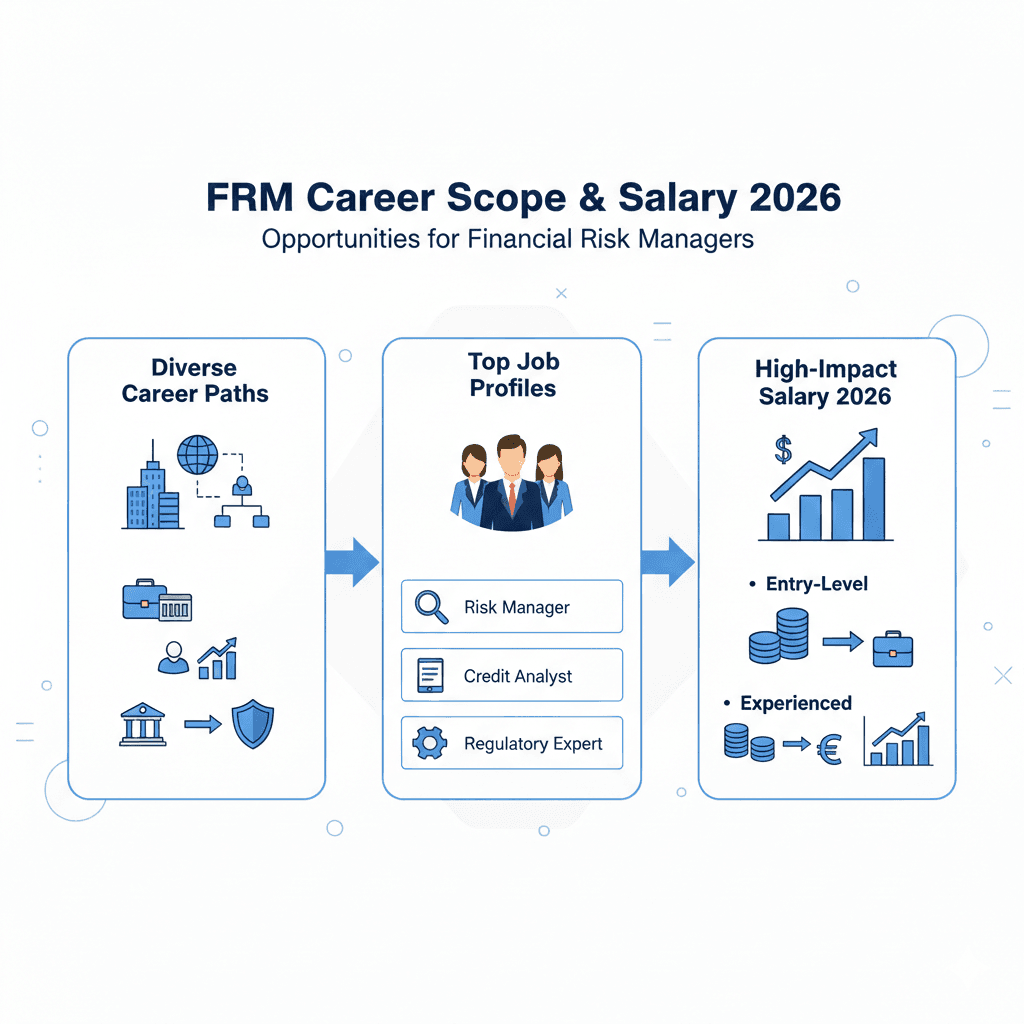
FRM Career Scope & Salary 2026 offer high-demand, recession-resilient opportunities in risk management, driven by market volatility, AI integration, and climate-related financial risks. FRM-certified professionals are sought after in investment banks, asset management firms, fintechs, and consulting globally, with career paths ranging from Risk Analyst to Chief Risk Officer (CRO), offering fast progression and international mobility.
Career Progression & Roles
- Entry-Level (0–2 yrs): Risk Analyst, Credit Risk Associate — ₹5–10 LPA (India)
- Mid-Level (3–6 yrs): Senior Analyst/Manager — ₹12–25 LPA (India)
- Senior (7+ yrs): Heads of Risk / CRO-track — ₹25–50+ LPA (India)
- Global Recognition: FRM is valued in 190+ countries; roles include Operational Risk Specialist, Market/Liquidity Risk Manager, Chief Risk Officer.
Salary Trends for FRM Course 2026
| Experience | India (₹ LPA) | US (USD) | UK (£) | Singapore (SGD) |
| Entry (0-2 yrs) | 5–10 | 75K–100K | 50K–80K | 80K–120K |
| Mid (3-6 yrs) | 12–25 | 100K–150K | 80K–120K | 100K–150K |
| Senior (7+ yrs) | 25–50+ | 150K–250K+ | 120K–180K+ | 150K–220K+ |
| Top (CRO/Head) | 50–80+ | 250K–500K+ | 150K+ | 180K+ |
Note: Bonuses/profit-sharing add 20–100% in trading/investment firms; India packages often include PF, health benefits.
🛠️ MarTech Tools 2026: Complete Beginner-Friendly Guide →
Top Companies Hiring FRM Professionals
- Global Banks & Investment Firms: JPMorgan, Goldman Sachs, Morgan Stanley, HSBC, Citigroup, Deutsche Bank, Standard Chartered, Barclays
- Indian Banks/NBFCs: ICICI, HDFC, SBI, Axis Bank, Kotak Mahindra, YES Bank
- Big 4 Consulting: Deloitte, PwC, EY, KPMG (risk advisory roles, ₹15–30 LPA mid-level)
- Fintech & Others: Paytm, Razorpay, Groww, PhonePe; asset managers like BlackRock, Franklin Templeton
Pro Tip for 2026 Aspirants: Check Naukri, LinkedIn, GARP Jobs portal for FRM-specific listings. Regulatory, AI/cyber risk, and fintech roles are hottest this year.
How to Get FRM Certification in 2026: Step-by-Step Process
The FRM 2026 certification process is a systematic four-step journey managed by the Global Association of Risk Professionals (GARP). To earn the designation, candidates must enroll in the program, pass both Part I and Part II exams, demonstrate two years of relevant professional experience, and adhere to ethical standards. Most aspirants complete the full cycle within approx 1 to 3 years.
Step 1: Create GARP Account & Enroll
- Visit my.garp.org, create free account.
- New candidates: register for Part I → pay enrollment fee $400 + exam fee ($600 early / $800 standard).
- Access official Learning Objectives, practice questions, and schedule exam.
Step 2: Prepare & Pass FRM Part I
- Study ~240–300 hours (~4–6 months).
- Exam: 100 MCQs, 4 hours, CBT at Prometric.
- Windows 2026: May 9–15, Aug 7–8, Nov 14–20.
- Results in ~6–8 weeks; pass → proceed to Part II.
Step 3: Prepare & Pass FRM Part II
- Similar prep ~240–300 hours (focus on applied risk & 2026 updates).
- Exam: 80 MCQs, 4 hours, same windows (Part II scored only if Part I passed).
- Unlimited retakes (fees required).
Step 4: Submit Work Experience & Get Certified
- Submit proof of 2 years full-time professional risk experience.
- Can be before, during, or after exams.
- Agree to GARP’s ethics/code of conduct.
- Receive official FRM® certificate and digital badge.
- Optional: Join GARP membership ($195/year) for networking/CPD.
Quick 2026 Timeline.
- Feb–Mar: Register early for May/Aug Part I.
- Mar–Jul: Study & pass Part I.
- Aug–Feb: Study & pass Part II.
- Post exams: Submit work experience → get certified.
Total duration: 1–2 years (exams + experience overlap possible).
Pro Tips: Early registration saves $200 per exam and ensures Prometric slots. Track deadlines strictly (ET time zone). Download GARP FRM 2026 Candidate Guide for complete details.
FRM Course Work Experience Requirement 2026: Qualifying Criteria
FRM work experience requirement 2026 mandates at least 2 years of full-time professional experience in financial risk management to earn the FRM® designation. GARP evaluates the relevance individually, and experience can be gained before, during, or after exams. Roles must involve risk identification, measurement, monitoring, or management to qualify.
Minimum Requirement
- Duration: 2 years full-time (24 months equivalent). Part-time or internships usually don’t qualify.
- Relevance: Meaningful work applying FRM concepts (VaR, stress testing, credit/market risk models).
Qualifying Examples:
- Risk Analyst, Credit/Market Risk roles in banks (SBI, HDFC, ICICI).
- Treasury/ALM/Liquidity Risk in NBFCs or banks.
- Operational Risk, Compliance, or Regulatory Risk positions.
- Portfolio/Investment Risk in asset management firms.
- Risk consulting/advisory at Big 4 (Deloitte, PwC, EY, KPMG).
- Fintech, insurance, or corporate roles with daily risk tool application.
Non-Qualifying: Pure accounting, audit without risk focus, general finance, sales, student jobs.
Submission Guidelines
- Provide detailed description (~300+ words per role) including job title, employer, dates, and day-to-day risk responsibilities.
- Submission via my.garp.org after passing Part II. GARP may request employer verification.
- Deadline: Within 10 years of passing Part II. Missed deadline = re-enroll, pay fees, retake exams.
Timing Flexibility
- Experience can be from multiple jobs; combined duration counts.
- Can be accrued anytime within 10 years before Part II pass date.
- Freshers can pass exams first, then gain qualifying work experience.
Quick 2026 Summary Table for FRM course
| Aspect | Details |
| Minimum Duration | 2 years full-time |
| Relevance | Meaningful risk role (ID, measurement, monitoring, management) |
| Timing Flexibility | Before, during, or after exams; up to 10 years prior to Part II |
| Submission Window | Within 10 years of passing/sitting Part II |
| What Doesn’t Count | Internships, part-time, student jobs, non-risk roles |
| Submission Requirement | Online form + detailed description (300+ words); possible employer verification |
| Consequence of Missing Deadline | Re-enroll, repay fees, retake both exams |
Bottom line 2026: Focus on real, relevant risk roles and document your responsibilities clearly. Start early if you are a fresher — exams first, experience can follow, giving you flexibility while ensuring FRM® eligibility.
FRM Course Roadmap 2026: Beginner to Certified Risk Manager
The FRM Course 2026 roadmap is a 1.5–2 year journey from foundational finance knowledge to earning the official FRM® designation. It covers Part I & II exam preparation followed by 2 years of verified work experience. Starting early, maintaining 15 hrs/week study, and following this structured plan ensures a smooth path to certification.
Phase 1: Preparation & Enrollment (0–2 Months)
Key Actions:
Create a free GARP account at my.garp.org
Register for Part I (May, August, or November 2026)
Pay one-time enrollment fee $400 USD
Early-bird registration saves $200–$400
Resources:
2026 Study Guide (Official or third-party)
Practice questions and e-books via GARP portal
Pro Tip:
Lock in early exam slot for 3 tier cities or India centers to avoid last-minute stress
Phase 2: Mastering FRM Part I (3–6 Months)
Study Hours: 250–300 hours focused on quantitative tools & valuation models
Key Topics:
Financial Markets & Products (30%)
Foundations of Risk Management, Quantitative Analysis
Exam: 100 MCQs, 4 hours, computer-based testing (CBT)
Success Tips:
Attempt 4+ full-length mock exams
Complete syllabus in 12 weeks, reserve last 4 weeks for 1,500+ practice questions
Phase 3: Applied Risks & Part II (7–12 Months)
Study Hours: 250–300 hours
Focus Areas:
Market Risk (20%)
Credit Risk (20%)
Operational & Regulatory Risk (20%)
Current Issues (2026): AI in Finance, Climate Risk, Tokenization, Basel Updates
Exam Window: Part II must be passed within 4 years of Part I
Milestone: Exam Complete after passing Part II
Phase 4: Work Experience & Certification
Requirement: 2 years full-time relevant financial risk experience
Timing: Can be before, during, or after exams; up to 10 years prior to Part II pass
Submission:
Detailed job description (~300 words/role)
Employer verification if requested
Submit via GARP portal (my.garp.org)
Frequently Asked Questions (FAQs) About FRM Course Details 2026

1. What is the FRM course and who should do it?
FRM (Financial Risk Manager) is a global certification offered by GARP (USA). It is best for students and professionals who want a career in risk management, banking, investment, and finance.
2. What is the eligibility for the FRM course?
Graduates from any stream can apply for the FRM course. Final‑year students are also eligible to appear for FRM Part 1. No specific finance degree is compulsory.
3. How difficult is the FRM course for students?
FRM is considered moderate to high in difficulty. It is concept‑based and requires logical understanding rather than memorization. With proper study planning, many students clear it successfully.
4. What is the salary after completing the FRM course?
In India, FRM professionals usually earn ₹6 to ₹10 LPA at the entry level. Salary depends on skills, experience, job role, and organization.
5. Is the FRM course details worth it for a global finance career?
Yes, FRM is valued by global banks, financial institutions, and MNCs. It is a good option for students who want long‑term growth in risk management and finance roles.
Disclaimer:
All information provided here is for educational and reference purposes only. FRM exam fees, dates, syllabus, and career details are based on the latest 2026 updates but may change anytime. Readers should always verify directly with official sources like GARP before making financial, career, or exam-related decisions. We do not provide personalized financial or professional advice.