
CFA Course Details 2026: Fees, Eligibility, Duration, Syllabus, Salary & Career Scope
CFA course details 2026 refers to a global professional finance certification called Chartered Financial Analyst offered by the CFA Institute. This program teaches investment analysis, portfolio management, and financial reporting skills. It is widely recognized by banks, investment firms, and asset management companies, making it one of the most respected certifications in the finance industry.
CFA course details 2026 include important information about fees, eligibility, duration, syllabus, salary, and career scope. Students and graduates choose this certification to build careers in investment banking, financial analysis, and portfolio management in India and international markets.
What is CFA Course? Full Form, Meaning and Complete Overview
CFA course details 2026 refers to the Chartered Financial Analyst certification offered by the CFA Institute. It is a professional finance program that covers investment analysis, portfolio management, and financial reporting. The certification is recognized by banks, investment firms, and asset management companies in many countries.
The program has three levels, and each level focuses on finance knowledge and professional ethics. Many students review course eligibility, fees, and career scope before starting this certification to understand its long term career value.
Explore CPA Course Details Eligibility Duration and Salary ↗
CFA Full Form and Global Recognition
CFA full form is Chartered Financial Analyst, which is a globally recognized finance credential. It is accepted by financial institutions and investment firms across different countries. This recognition allows candidates to apply for finance and investment roles in domestic and international markets.
The certification represents strong knowledge of financial analysis and portfolio management. Because of its global acceptance, it is often preferred for roles related to investment and financial research.
Why CFA is the Gold Standard in Finance and Investment Industry?
The CFA certification is considered a gold standard because of its comprehensive finance curriculum and professional relevance. It focuses on investment analysis, ethical practices, and portfolio management concepts used in real finance roles.
Employers recognize this certification as proof of advanced finance knowledge and professional standards. This makes it relevant for candidates planning careers in investment banking, portfolio management, and financial analysis.
CFA Course Eligibility Criteria 2026 (India & Global Requirements)
CFA course eligibility 2026 refers to the minimum education or work experience requirements needed to register for the program conducted by the CFA Institute. Candidates must either have a bachelor’s degree or be in the final year of graduation. Additionally, a valid international passport is mandatory for exam registration and identity verification.
Alternative pathways under CFA course eligibility 2026 allow candidates to qualify through approximately 4,000 hours of relevant professional work experience. This experience should be completed over a minimum period of around 3 years in finance or similar professional roles.
CFA Course Eligibility
| Category | Requirement Details (Approx) |
| Education | Bachelor’s degree or Final Year Graduation |
| Work Experience | ~4,000 hours over minimum 3 years |
| Document | Valid International Passport is mandatory |
| Stream | Open to Commerce, Science, and Arts |
Explore CA Course Eligibility Exams Fees and Salary ↗
Educational Qualification Required for CFA Course
CFA course eligibility 2026 requires candidates to complete graduation or reach the final year of a bachelor’s degree from a recognized university. Students from commerce, science, or arts streams can apply because there are no specific stream restrictions. This flexibility makes the certification accessible to students from diverse academic backgrounds.
Candidates using the professional experience pathway must complete around 4,000 hours of relevant work over at least 3 years. This pathway is designed to support working professionals who want to transition into the investment industry without a traditional degree.
Can You Do CFA After 12th or During Graduation?
CFA course eligibility 2026 does not allow direct registration after the 12th standard because a graduation-level qualification is required. Students must complete their degree or at least reach the final year of college before they can register for the CFA Level 1 exam.
However, many students choose to start their preparation during the early years of graduation. Starting early helps candidates understand the complex syllabus and allows them to complete the certification much faster once they become eligible to sit for the exam.
CFA Course Duration and Levels Explained (Level 1, Level 2, Level 3)
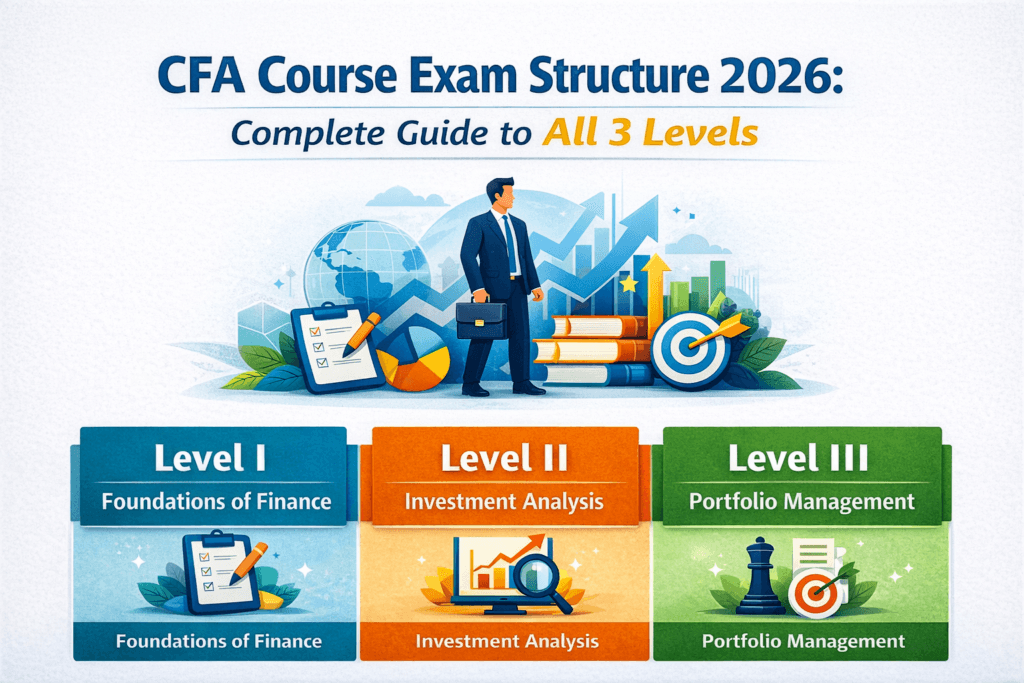
CFA course duration 2026 usually takes 2 to 4 years to complete all three levels of the Chartered Financial Analyst program. The program has Level 1, Level 2, and Level 3 exams. Level 1 teaches basic investment tools, Level 2 focuses on asset valuation, and Level 3 is about portfolio management and wealth planning.
The program is designed by the CFA Institute. Full details about registration and exam schedule are available on the official CFA website.
CFA Level 1 Exam Details and Structure
CFA Level 1 exam 2026 tests basic finance, ethics, and investment knowledge. It is computer-based and includes multiple-choice questions on quantitative methods, economics, financial reporting, and ethics. Students usually spend around 300 hours preparing.
Update 2026: Level 1 is now held 4 times a year. Candidates must also complete Practical Skills Modules (PSM) like Python or Financial Modeling to get their results. Passing Level 1 allows registration for Level 2.
CFA Level 2 and Level 3 Exam Overview
CFA Level 2 and Level 3 exams 2026 focus on advanced investment and portfolio management skills. Level 2 emphasizes asset valuation, financial modeling, and applying investment concepts. Level 3 focuses on portfolio management, wealth planning, and professional ethics.
Pass Rates & Preparation: Level 2 and 3 are more challenging than Level 1. Students often spend 300–400 hours per level. Completing Practical Skills Modules (PSM) is mandatory to receive certification. Official exam structure and schedule are available on the CFA Institute portal.
CFA Course Fees in India 2026 (Complete Cost Breakdown with INR Conversion)

CFA course fees in India 2026 refer to the total cost to register and appear for all three levels of the Chartered Financial Analyst program. Level 1 and Level 2 fees are the same, while Level 3 costs slightly more. All payments are in USD, and Indian candidates pay 18% GST on top of the converted INR. (Official CFA Institute site)
Full and official fee details are available on the CFA Institute website.
CFA Registration Fees and Exam Fees Structure
CFA registration fees 2026 include level-wise exam costs and optional rescheduling charges. The one-time enrollment fee has been removed, so candidates now only pay the exam registration fees for each level.
| Level | 2026 Fee (USD) | Approx INR (before GST) |
| Level 1 Early Registration | $1,140 | ₹98,000+ |
| Level 1 Standard Registration | $1,490 | ₹1,28,000+ |
| Level 2 Early Registration | $1,140 | ₹98,000+ |
| Level 2 Standard Registration | $1,490 | ₹1,28,000+ |
| Level 3 Early Registration | $1,240 | ₹1,06,000+ |
| Level 3 Standard Registration | $1,590 | ₹1,37,000+ |
Exam rescheduling fee is usually USD 250 (≈ ₹20,000+). (Official CFA site)
Total CFA Course Cost Including Study Materials and Other Charges
Total CFA course cost in India 2026 ranges between ₹3.5 lakh – ₹4.5 lakh, depending on registration timing and choice of study materials or coaching.
| Cost Component | Approx Range (INR) |
| Exam fees (all three levels with early registration + 18% GST) | ₹3,50,000 – ₹4,00,000+ |
| Study materials (optional) | ₹10,000 – ₹60,000+ |
| Practice tools / mock tests | ₹5,000 – ₹20,000+ |
| Coaching (optional) | ₹30,000 – ₹1,50,000+ |
Tip: Early registration and self-study can significantly reduce overall expenses. (Official CFA site)
CFA Scholarship 2026: Types, Eligibility and How to Reduce CFA Course Fees
CFA scholarship 2026 refers to special fee-reduction awards from the CFA Institute that help candidates lower the cost of CFA Program exam registration. These scholarships are designed to support students, working professionals, and those with financial need. (Official CFA Institute Scholarship Page)
Candidates can reduce their CFA exam fees and make the program more affordable by applying for official scholarships in the 2026 cycle.
CFA Access Scholarship Eligibility and Application Process
The CFA Access Scholarship 2026 is for candidates who need financial support to afford the CFA exam. The scholarship now reduces exam fees to USD 400 plus any applicable tax (earlier USD 300). (Official Access Scholarship Details)
Eligibility:
- Must meet CFA Program enrollment requirements
- Should not already be registered for the exam or awaiting results
Application Process & Tentative Dates 2026:
Applications open four times aligned with exam sessions:
- February Exam Window: Nov 15 – Dec 15, 2025
- May Exam Window: Feb 15 – Mar 15, 2026
- August Exam Window: May 15 – Jun 15, 2026
- November Exam Window: Aug 15 – Sep 15, 2026
Complete the online form with honest financial details
Submit before the window closes to be considered
CFA Women’s Scholarship Benefits and Requirements
As of 2026, the CFA Women’s Scholarship has been discontinued. Women candidates can no longer apply for this separate scholarship. (Official Update)
Alternative Options:
Women can apply for the Access Scholarship
Students can also apply for the Student Scholarship if enrolled at a CFA-affiliated university
CFA Course Syllabus 2026 (Level-wise Subjects and Topics List)
CFA course syllabus 2026 refers to the official list of subjects and topics tested in Level 1, Level 2, and Level 3 exams of the Chartered Financial Analyst program. It is designed by the CFA Institute to develop strong finance, investment, and portfolio management skills. (Official CFA Curriculum)
Candidates preparing for CFA exams should understand topic areas and their weightage to focus study time effectively.
CFA Level 1 Subjects and Topics (2026)
Level 1 focuses on foundational finance and investment tools. Each subject has a weightage (%) for exam scoring. (CFA Level 1 Official)
| Subject | Weightage (%) |
| Ethical and Professional Standards | 15% |
| Quantitative Methods | 10% |
| Economics | 10% |
| Financial Statement Analysis | 15% |
| Corporate Issuers | 10% |
| Equity Investments | 11% |
| Fixed Income | 10% |
| Derivatives | 5% |
| Alternative Investments | 4% |
| Portfolio Management | 10% |
Level 1 builds the foundation needed for Levels 2 and 3.
CFA Level 2 Subjects and Topics (2026)
Level 2 emphasizes asset valuation and practical financial analysis. Each subject has a weightage (%) indicating its importance. (CFA Level 2 Official)
| Subject | Weightage (%) |
| Ethical and Professional Standards | 10-15% |
| Quantitative Methods | 5-10% |
| Economics | 5-10% |
| Financial Statement Analysis | 15-20% |
| Corporate Issuers | 5-10% |
| Equity Investments | 10-15% |
| Fixed Income | 10-15% |
| Derivatives | 5-10% |
| Alternative Investments | 5-10% |
| Portfolio Management | 5-10% |
Level 2 tests application of Level 1 concepts in real-world scenarios.
CFA Level 3 Subjects and Topics (2026)
Level 3 focuses on portfolio management, performance evaluation, and advanced investment strategies. A new 2026 update introduces Specialized Pathways, where candidates choose one of: Portfolio Management, Private Wealth, or Private Markets. (CFA Level 3 Official)
| Subject | Weightage (%) |
| Ethical and Professional Standards | 10-15% |
| Portfolio Management & Wealth Planning | 40-55% |
| Equity Investments | 10-15% |
| Fixed Income | 10-15% |
| Derivatives | 5-10% |
| Alternative Investments | 5-10% |
| Specialized Pathways (Portfolio Mgmt / Private Wealth / Private Markets) | Optional, integrated in Portfolio Mgmt |
Level 3 includes scenario-based questions, real-world investment planning, and the Specialized Pathway for deeper focus.
CFA course syllabus 2026 is structured to move candidates from fundamentals in Level 1, through asset valuation in Level 2, to advanced portfolio management and Specialized Pathways in Level 3. Including topic weightage and Specialized Pathways makes it easier for students to focus on high-impact subjects for exam preparation. (Official CFA Curriculum)
Mandatory CFA Practical Skills Modules (PSM) 2026 – New Requirement
The CFA Practical Skills Modules (PSM) 2026 are compulsory practical learning modules introduced to develop real-world finance and analytical skills. Candidates must complete at least one practical module at each CFA level to receive their exam results.
These modules focus on hands-on learning in financial analysis, Python, and portfolio construction.
| CFA Level | Module Examples | Skills Developed |
| Level 1 | Python Fundamentals, Financial Analyst Skills | Basic coding and financial analysis |
| Level 2 | Financial Modeling, Python for Finance | Valuation and analytical modeling |
| Level 3 | Portfolio Construction, Private Markets Analysis | Portfolio strategy and investment execution |
Each module typically requires around 10 to 20 hours to complete and is an essential part of the updated CFA curriculum. These practical modules ensure candidates gain job-ready skills along with theoretical knowledge.
Summary of CFA Course Syllabus and Subjects (2026)Summary of CFA Course Syllabus and Subjects (2026)
The CFA syllabus 2026 is structured to develop complete expertise in finance and investment management. Level 1 focuses on finance fundamentals and ethics, Level 2 focuses on valuation and analysis, and Level 3 focuses on portfolio management and wealth planning. Completing both theoretical subjects and Practical Skills Modules helps candidates build strong technical and practical skills required for global finance careers.
How to Register for CFA Course 2026 (Step-by-Step Registration Process)
The CFA course registration process 2026 is completed online through the official CFA Institute portal. Candidates must create an account, select the exam level, pay the exam registration fees, and schedule their exam at an authorized Prometric center. Following the correct steps ensures successful enrollment and exam confirmation.
CFA Institute Registration Process Explained
Follow these updated steps to complete your CFA Institute registration for the 2026 exam:
Step 1: Create CFA Institute Account
Visit the official CFA Institute website and create your candidate account using your email ID and personal details. This account will be used for registration, scheduling, and results.
Document Checklist (Keep Ready Before Registration)
Having these documents ready makes the CFA registration process faster and error-free:
- Valid international passport (mandatory ID proof)
- Passport-style photograph (as per guidelines)
- Personal details (name, date of birth, address)
- Education details (degree or current qualification)
- International payment method (debit card or credit card)
Step 2: Choose Exam Level and Exam Window
Select CFA Level 1, Level 2, or Level 3 and choose your preferred exam window (Feb, May, Aug, or Nov depending on level availability).
Step 3: Complete Application and Candidate Information
Fill in your education, work experience (if applicable), and identification details. Ensure your name exactly matches your passport to avoid exam-day issues.
Step 4: Pay CFA Exam Registration Fees
Pay the exam registration fees using debit card, credit card, or other supported payment methods. After successful payment, you will receive an official registration confirmation email.
Step 5: Receive Authorization to Schedule Exam
Once registration is confirmed, CFA Institute will provide access to the Prometric scheduling system to book your exam slot.
How to Schedule CFA Course Exam at Prometric Centers
After completing CFA registration, candidates must schedule their exam through Prometric, the official testing partner.
Step 1: Open the Prometric Scheduling Portal
Use the scheduling link available in your CFA Institute account dashboard.
Step 2: Select Exam Country and City
Choose your preferred exam location. In India, exams are conducted in major cities such as Mumbai, Delhi, Bangalore, Hyderabad, Chennai, and Kolkata.
Step 3: Choose Exam Date and Time Slot
Select the available date and time within your exam window. Early booking increases the chances of getting your preferred slot.
Step 4: Confirm and Download Appointment Confirmation
Confirm your slot and download the exam appointment letter. This confirmation is required on exam day along with your passport.
Summary: The CFA course registration process 2026 includes creating a CFA Institute account, preparing required documents, paying exam registration fees, and scheduling the exam at a Prometric center. Early registration helps secure preferred exam slots and ensures a smooth exam experience.
CFA Exam Dates 2026 and Registration Deadlines (India Exam Centers)
CFA exam dates 2026 include multiple exam windows and fixed registration deadlines. Candidates must complete registration before the Early Bird or Standard deadline to secure their exam slot and avoid late fees. Registering early also increases the chances of getting the preferred exam center and date.
| Exam Window | Level | Early Bird Deadline (Approx) | Standard Deadline (Approx) |
| February 2026 | Level 1, Level 3 | August 2025 | November 2025 |
| May 2026 | Level 1, Level 2 | October 2025 | February 2026 |
| August 2026 | Level 1, Level 2, Level 3 | January 2026 | May 2026 |
| November 2026 | Level 1, Level 2 | April 2026 | August 2026 |
Important Registration Rules 2026:
- Early Bird deadline offers lower exam fees
- Standard deadline has higher fees but same exam access
- Registration usually closes 3–4 months before exam window
- Exam scheduling deadline is separate and must also be completed on time
CFA Course Exam Frequency and Attempts Allowed per Level
CFA exam frequency 2026 allows candidates multiple attempts per year depending on the level.
Exam frequency:
Level 1: 4 times per year (Feb, May, Aug, Nov)
Level 2: 3 times per year (May, Aug, Nov)
Level 3: 2 times per year (Feb, Aug)
Attempts policy:
Maximum 2 attempts per level per year
Minimum 6 months gap required between attempts
No fixed lifetime attempt limit, but rules must be followed
List of CFA Exam Centers in India (Prometric Locations)
CFA exam centers in India 2026 are available in major cities through authorized Prometric testing centers.
Major exam cities:
- Mumbai
- New Delhi
- Bangalore
- Hyderabad
- Chennai
- Kolkata
- Pune
- Ahmedabad
Exam center tips:
- Select your center early during scheduling
- Seats are limited in popular cities
- Exact center address is provided after scheduling confirmation
Summary: CFA exam dates 2026 include four Level 1 exam windows and fixed Early Bird and Standard registration deadlines. Candidates should register early to save fees and secure their preferred exam center in India.
CFA Work Experience Requirements 2026 (Charter holder Eligibility)
CFA work experience requirements 2026 refer to the practical professional experience needed to earn the Chartered Financial Analyst designation after passing all exam levels. Candidates must complete approximately 4,000 hours of relevant work experience over a minimum period of 36 months. This experience can be gained before, during, or after completing the CFA exams.
Minimum Work Experience Required for CFA Charter
Minimum CFA charter work experience requirement is about 4,000 hours completed over at least 3 years. The work must involve financial analysis, investment evaluation, or supporting investment decisions. This requirement ensures candidates gain real-world investment knowledge along with theoretical exam learning.
Eligibility
Total Requirement: Approximately 4,000 hours
Minimum Duration: At least 36 months or 3 years
Core Purpose: Investment analysis or decision-making support
What Counts as Relevant Work Experience for CFA?
Relevant CFA work experience includes any role that contributes to the investment decision process. Experience in banking, asset management, consulting, or financial analysis is generally accepted if it supports investment evaluation.
Common accepted roles include:
Investment roles such as Equity Research Analyst, Portfolio Analyst, and Risk Analyst
Finance roles such as Corporate Finance Analyst, Credit Analyst, and Financial Consultant
Support roles that provide financial research, investment data, or analytical tools
Summary: CFA work experience requirements 2026 include completing about 4,000 hours of relevant finance experience over at least 3 years. This practical experience is required to receive the CFA Charter after passing all three exam levels.
CFA Salary in India 2026 (Level-wise Salary and Career Growth)
CFA salary in India 2026 refers to the average compensation earned by candidates after passing different CFA exam levels and becoming a Charterholder. The salary depends on exam level, job role, skills, and company type. Candidates working in investment firms, banks, and global finance companies usually earn higher salaries.
Salary in India 2026 (Approx Range)
Level 1 Passed: ₹4 lakh to ₹7 lakh per year
Level 2 Passed: ₹6 lakh to ₹12 lakh per year
CFA Charter holder: ₹10 lakh to ₹25 lakh+ per year
Senior Roles (5 to 10 years experience): ₹20 lakh to ₹50 lakh+ per year
Salary growth improves significantly after completing all levels and gaining relevant work experience.
CFA Level 1, Level 2, and Charterholder Salary Comparison
CFA Level 1 salary in India 2026 usually ranges between ₹4 lakh and ₹7 lakh per year for entry-level finance roles. Common jobs include Financial Analyst, Junior Analyst, and Investment Analyst trainee roles.
CFA Level 2 salary in India 2026 increases to around ₹6 lakh to ₹12 lakh per year because candidates develop stronger valuation and analytical skills. Employers prefer Level 2 candidates for research and investment analysis roles.
CFA Charterholder salary in India 2026 typically ranges from ₹10 lakh to ₹25 lakh or more per year depending on experience and employer. Charterholders certified by the CFA Institute are highly valued in global finance and investment firms.
Highest Paying Jobs After CFA Certification
Highest paying jobs after CFA certification in India 2026 are available in investment management, research, and portfolio management roles. These roles offer strong salary growth and global career opportunities.
High-Salary Roles
Portfolio Manager: ₹15 lakh to ₹40 lakh+ per year
Equity Research Analyst: ₹8 lakh to ₹20 lakh+ per year
Investment Banker: ₹12 lakh to ₹30 lakh+ per year
Risk Manager: ₹10 lakh to ₹25 lakh+ per year
Wealth Manager: ₹8 lakh to ₹22 lakh+ per year
Summary: CFA salary in India 2026 grows steadily from entry-level analyst roles to high-paying portfolio and investment management positions. Completing all levels and gaining experience helps candidates achieve the highest salary growth in the finance industry.
Frequently Asked Questions (FAQs) About CFA Course 2026
What career opportunities are available after completing the CFA course in 2026?
After completing the CFA course, candidates can work in roles such as Equity Research Analyst, Portfolio Manager, Investment Analyst, Risk Analyst, or Financial Consultant. CFA professionals are hired by asset management companies, investment banks, and consulting firms. The certification is globally recognized and helps candidates build careers in core finance and investment management.
What Are the Top Job Roles After CFA Course Certification?
After completing the CFA course, candidates can work as Equity Research Analyst, Portfolio Analyst, Investment Banker, Risk Analyst, or Portfolio Manager. These roles involve analyzing financial data, managing investments, and supporting strategic financial decisions in asset management companies, banks, and financial institutions.
CFA vs MBA vs FRM vs CA – Which is Better for Finance Career?
CFA course is the best choice for students who want a specialized career in investment and finance. Each qualification has a different focus, but the CFA program is globally recognized for roles in investment analysis, portfolio management, and asset management.
Is CFA Course Better than MBA or CA?
CFA course is better than MBA or CA for students who want a specialized career in investment and finance. The CFA program focuses deeply on portfolio management, equity analysis, and asset valuation, which are core skills for investment roles. In comparison, MBA covers broader management topics, and CA focuses mainly on accounting and taxation.
Disclaimer:
This content is for informational and educational purposes only. Salary figures and career details are approximate and may vary based on skills, experience, employer, and location. We do not guarantee any specific salary or job outcome. Always refer to official sources and employers for the latest and accurate information.