Stock Market and Trading Course for Beginners 2026: Let’s Begin from Zero Step by Step
In many people’s minds, the stock market has become a symbol of financial disaster. And honestly—this fear is not completely wrong. Yes, the Stock Market Basics for Beginners teaches you Step by step why the stock market can destroy your money if you start investing or trading by:
- watching movies or web series,
- following tips from friends or relatives,
- trusting random YouTube or Telegram channels,
- or reacting blindly to daily news.
If you invest this way, no one in the world can save your money from losses.
Let’s understand this with simple logic.
If you ride a bicycle without learning, you will fall.
If you cook without knowing how, the food will get spoiled. So why do people expect to earn money from the stock market without learning anything?

Stock Market Basics for Beginners: Learn to Invest Smartly Without Blind Tips
Earning money is never easy, and earning from the stock market is no exception. But that does not mean it is impossible.
The real problem is not the stock market.
The real problem is blind following.
If you invest based on someone else’s advice and you lose money, always remember one simple truth:
The money was yours.
The decision was yours.
And finally, the loss is also yours. That is why blaming others makes no sense. The Stock Market Basics for Beginners teaches you step by step to make informed decisions and avoid these mistakes.
Stock Market Basics for Beginners 2026 in India: Learn First, Then Invest
If you truly want to earn money from the stock market, the first rule is simple:
Learn before you invest.
A structured Stock Market Basics for Beginners will help you understand step by step at very simple language.
Understand how markets work, how risks are managed, how decisions are made. Do not blindly trust tips, signals, or promises of quick profit. Take time, gain proper knowledge, and then enter the market with confidence.
Stock Market Basics for Beginners 2026: More Than Just Investing — Learn How to Think
A stock market course is not only about investing your own money. After learning properly, you can also:
- work as a market executive or analyst,
- build a career in trading support or research,
- enter finance-related roles in companies,
- or guide others responsibly.
Today, people are slowly realizing that money grows by investing, not by keeping it idle at home or in a savings account.
Stock Market & Trading Course for Beginners: Career Paths, Roles & Step-by-Step Roadmap 2026
If you complete a structured Stock Market & Trading Course for Beginner, you will clearly understand:
- what job roles are available,
- how a long-term career can be built,
- and what roadmap to follow step by step.
Stay connected with us, and we will guide you through the complete stock market learning journey—from basics to career opportunities.
What Is the Stock Market? A Beginner-Friendly Explanation (2026)
The stock market is a place where shares of companies are bought and sold. When you buy a share, you become a small owner of that company.
For example:
The stock market (share market) is like a big wholesale vegetable market, where companies sell a part of their ownership, and investors buy it. Just like in a vegetable market you find potatoes and onions, in the share market you find shares of different companies.
Companies in the Stock Market (Like Farmers in a Market)
Just like a farmer needs extra money to grow crops and improve farming, companies also need capital to expand their business, launch new products, or enter new markets.
To raise this money, companies sell a small part of their ownership to the public in the form of shares.
Shares / Stocks (Like Vegetables in the Market): Simple Explanation for Beginners
When a company sells a small portion of its ownership, that portion is called a share or stock.
For example, imagine a company divides its total ownership into 1,000 small parts, known as shares.
If you buy 10 shares, you become the owner of 10 parts of that company.
This is very similar to buying 10 kilograms of potatoes from a market—once you buy them, they belong to you.
BSE (Bombay Stock Exchange) & NSE (National Stock Exchange): Explained for Beginners 2026
Just like a market (mandi), these are the two biggest platforms in India where buying and selling of shares happens.
They are like large shops where all the farmers — meaning companies — come to sell their shares.
What Is a Stock Market Index? (The Market’s Thermometer) Explained for Beginners 2026
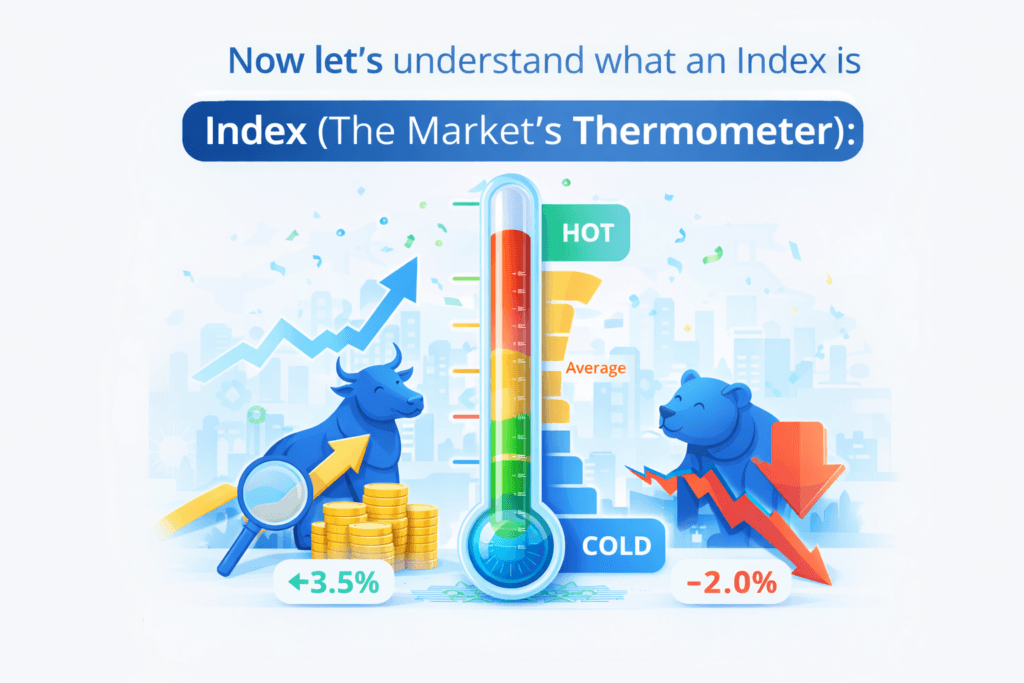
Just like a thermometer tells us the body’s temperature, an index tells us the overall health of the stock market—such as Sensex (BSE) and Nifty (NSE).
Sensex includes 30 large companies, while Nifty includes 50 large companies.
When the share prices of these companies go up, the index rises, which means the market is performing well.
When their share prices fall, the index goes down.
“Ab baat karte hain SEBI ke role ki…”
Role of SEBI in the Stock Market: Explained for Beginners 2026

SEBI (Securities and Exchange Board of India):
Just like banks are regulated by the RBI to keep money safe, in the same way, the stock market is regulated by SEBI to ensure investors’ money is protected and all rules are followed. SEBI acts like the supervisor or regulator of the stock market.
It makes sure that everyone follows the rules, no fraud takes place,
and investors’ interests are protected so that no one is cheated.
SEBI Guidelines – Official Link
What Is Market Capitalization (Market Cap)? Explained for Beginners with Example
“First, let’s understand a new concept—Market Capitalization.
Market capitalization means the total value of a company.
Just like when you want to know the value of a house, you check how much money you would get if you sold it,
in the same way, market cap tells us the value of a company.
Suppose a company has a total of 100 shares, and the price of each share is ₹100.
So, what will be the market cap of that company?
Market Cap = Total Number of Shares × Share Price
Market Cap = 100 × ₹100 = ₹10,000
This figure shows how much money you would need if you wanted to buy the entire company.
Based on market capitalization, companies are classified as:
Small Cap: Companies with a value of less than ₹5,000 crore
Large Cap: Companies with a value of more than ₹20,000 crore
Mid Cap: Companies with a value between ₹5,000 crore and ₹20,000 crore
Market Leader & Monopoly Stocks: Meaning and Examples
Now let’s talk about Market Leaders and Monopoly Stocks
These two terms are different, but people often get confused between them.
Market Leader:
A market leader is a company that is ahead of others in its sector.
It has the highest market share, and its competitors are behind it.
Example: In the Indian car market, Maruti Suzuki is a market leader.
Monopoly Stock:
A monopoly stock means the company has complete control over its sector.
There is no major competitor at all—it’s a one-sided game.
Example: IRCTC has a monopoly in railway ticket booking.
Let’s understand with another example:
In the dairy industry, Amul may be a market leader,
but it does not have a monopoly because competitors like Parag and Mother Dairy also exist.
However, Indian Railways has a monopoly because there is no real alternative.
If you want to book railway tickets online, IRCTC is the only platform available.
Promoter (Company Owner): Meaning and Role in a Company
Who Is a Promoter in the Stock Market? The Owner Behind the Company
A promoter is a person or a group that starts a company
or holds the largest stake in it.
Promoters are the ones who run the company
and have a long-term vision for its growth.
Simple example: Ratan Tata is a promoter of the Tata Group.
It’s just like a restaurant started by a chef
that chef becomes the promoter of the restaurant.
FII (Foreign Institutional Investor) & DII (Domestic Institutional Investor): Meaning and Role
“Now let’s talk about FIIs and DIIs
These two groups are major players in the stock market,
and their buying or selling has a strong impact on market movements.
FII (Foreign Institutional Investors): Meaning and Role in the Stock Market
These are foreign companies or investment funds that invest in the Indian stock market,
such as large investment firms from the US or Europe.
When FIIs invest money in India, the market usually moves upward.
DII (Domestic Institutional Investors): Meaning and Role in the Stock Market
These are large Indian institutions that invest within the Indian market,
like big banks, LIC, or mutual funds.
When DIIs buy shares, they provide stability and support to the market.Easy analogy:
In a cricket match, FIIs are like the foreign team that has come to play,
and DIIs are like our home team.
Both influence the final result of the match.
Broker and Brokerage in the Stock Market: Meaning, Role, and How They Work
Broker:
A broker is a company that gives you access to the stock market.
It helps you buy and sell shares on your behalf.
Examples include Zerodha, Angel One, and Upstox.
Brokerage:
Brokerage is the fee you pay to the broker every time you place a trade.
It’s similar to buying goods from a shop—you pay the shopkeeper for the service. This fee varies from broker to broker.
Some brokers charge a fixed fee per trade, while others charge a percentage of the transaction amount.
Demat and Trading Accounts: Meaning, Differences, and How They Work in Stock Market
Both of these work together—one is incomplete without the other.
Demat Account:
Think of this as your digital locker.
All the shares you buy are stored here in electronic form.
Just like money is kept digitally in a bank account, shares are kept digitally in a Demat account.
This account is only for holding shares, not for buying or selling.
Trading Account:
This is the account used to buy and sell shares.
When you place a buy order, it goes through your trading account.
When you place a sell order, that also happens through the trading account.
After you buy shares, they move from the trading account into your Demat account.
Think of a bank:
Your Savings Account is like a trading account—you use it to deposit or withdraw money.
Your Locker is like a Demat account—where you safely store valuable items like jewellery.
CDSL and NSDL: Meaning, Role, and Key Differences in the Stock Market (2026)
These are like two big banks—but for shares.
In India, only these two entities hold your shares in digital form.
CDSL — Central Depository Services Ltd.
NSDL — National Securities Depository Ltd. Your Demat account is opened with either CDSL or NSDL.
This is just like opening a bank account with HDFC or SBI.
Both do the same job—the only difference is the organization that manages them.
Key Trading Terms: Meaning and Simple Explanations
| Term | Definition | Key Insight |
| Watchlist | A personalized list of selected stocks used to track their price movements and performance. | Helps traders focus on specific opportunities without getting distracted by the whole market. |
| Market Timing | The strategy of making buy or sell decisions by predicting future market price movements. | Aimed at entering at the lowest possible price and exiting at the highest. |
| Open | The price at which a security first trades upon the opening of an exchange (NSE/BSE) on a given day. | Indicates the initial sentiment of investors as the market opens. |
| High | The maximum price at which a stock traded during the course of the trading session. | Represents the point where sellers became stronger than buyers during the day. |
| Low | The minimum price reached by a stock during a specific trading day. | Shows the level of price support or the lowest point of confidence for the day. |
| Close | The final price at which a stock is traded on a particular trading day. | Used as the standard benchmark to calculate daily gains or losses. |
| Volume | The total number of shares or contracts traded during a specific period. | Higher volume indicates high liquidity and strong interest in the stock. |
| 52-Week High | The highest price that a stock has achieved during the last 52 weeks (one year). | Acts as a resistance level; many traders watch if a stock can break this peak. |
| 52-Week Low | The lowest price that a stock has dropped to during the last 52 weeks (one year). | Acts as a long-term support level; used to identify if a stock is “cheap” or in a downtrend. |
Practical Example
If a stock (e.g., Reliance or HDFC Bank) has a 52-Week High of ₹3,000 and a 52-Week Low of ₹1,500:
- Trading near ₹2,950 suggests the stock is in a strong “Bullish” phase (near its yearly peak).
- Trading near ₹1,550 suggests the stock is in a “Bearish” phase or potentially at a value buying zone.
Continue Learning: Stock Market Course – Part 2
Continue Learning: Stock Market Course – Part 3
Continue Learning: Stock Market Course – Part 4
Types of Trading Orders: Meaning and How They Work
In simple terms, an “Order” is just an instruction you give to your broker to buy or sell a stock. Here are the common ones you will use:
| Order Type | What it means in plain English | Practical Example (INR) |
| Market Order | “I want to buy this stock right now at whatever the current market price is.” | If Reliance is trading at ₹2,500, and you place a Market Order, you get it instantly at approximately ₹2,500. |
| Limit Order | “I only want to buy this stock if the price drops to a specific level that I choose.” | If HDFC is at ₹1,650, but you think it’s too high, you set a Limit Order at ₹1,630. The trade only happens if the price hits ₹1,630. |
| Stop-Loss (SL) | “I am buying this stock, but if it starts falling, sell it automatically at this price to save me from a big loss.” | You buy a stock at ₹500. You don’t want to lose more than ₹20. You set an SL at ₹480. If it crashes, your trade closes at ₹480 automatically. |
| Stop-Loss Target | “I want to lock in my profits. If the stock reaches this high price, sell it and take my profit.” | You buy at ₹500 and expect it to go up. You set a target at ₹550. Once it hits that, the system sells it for you, and you walk away with ₹50 profit. |
Why this matters for your course:
- Market Orders are for speed (you don’t want to miss the move).
- Limit Orders are for discipline (you don’t want to overpay).
- Stop-Loss is for survival (you don’t want to blow up your account).
FAQs: Stock Market Basics for Beginners
What is a Stock Market Basics for Beginners?
It is a step-by-step training program designed to teach newcomers how the stock market actually works. It helps you understand investing, trading strategies, risk management, and market analysis.
Who should join this course?
Anyone who wants to learn how to invest and trade wisely should consider it. Whether you’re a student, a working professional, or someone looking to build a career in finance, it’s an ideal starting point with strong foundational knowledge.
How long does the course usually take to complete?
Most beginner courses are structured for 3–6 months to build a solid base, but we explain concepts up to an advanced level so you can continue learning and grow further. The journey doesn’t stop after completion — keep practicing, follow advanced modules, and stay updated with market changes for long-term success.
What topics are covered in the course?
It typically includes stock basics, indices like Sensex and Nifty, market trends, risk management, technical analysis, demat and trading accounts, and hands-on trading exercises to help you trade with confidence.
Do I need any prior knowledge to join?
No prior experience is required at all. The course is built specifically for complete beginners and starts from scratch, explaining every concept in simple, easy-to-understand language.
Can this course help me build a career in finance or trading?
While it doesn’t guarantee direct jobs, completing it gives you practical skills in trading, market analysis, and investing. These skills open doors to career opportunities in finance, research, trading support, or even managing your own investments professionally.
How is this course different from self-learning?
Self-learning can be confusing and risky because of misinformation and scattered information. A structured course provides a clear guided roadmap, real-life examples, and mentor support to help you avoid common beginner mistakes.
Can I start investing while taking the course?
Yes, you can — but it’s better to first master the basics thoroughly and start with paper trading first. The course teaches you market mechanics properly, which greatly reduces the risk of making blind or emotional investments.
Is the course suitable if I have no commerce background?
Absolutely yes! It’s completely beginner-friendly and uses simple language to explain everything. Even if you come from a non-commerce background, you’ll be able to understand stocks, indices, and trading fundamentals easily.
What is the main benefit of a Stock Market Basics for Beginners?
The biggest benefit is building real knowledge and confidence. After finishing a Stock Market & Trading Course for Beginners, you can analyze stocks, manage risks effectively, and create a solid foundation for a successful journey in finance or trading.
Conclusion
Stock Market Basics for Beginners is not just about investing your money—it’s about learning to make informed decisions, understanding market trends, and building a sustainable career in finance. By enrolling in a Stock Market Basics for Beginners, you will gain the knowledge and confidence to analyze stocks, manage risks, and explore job opportunities in trading, market analysis, or research.
Remember: success in the stock market comes from learning first, investing wisely, and staying disciplined. With consistent practice and guidance, the skills you gain from this Stock Market Basics for Beginners can help you turn knowledge into opportunities while minimizing unnecessary risks.
Disclaimer
The information provided in this Stock Market Basics for Beginners content is for educational purposes only. Stock market investments carry risks, and past performance does not guarantee future returns. CommerceCare or this course does not promise any fixed returns, salaries, or profits. Always consult a SEBI-registered financial advisor before making any investment decisions. Individual results may vary based on your knowledge, risk appetite, and market conditions.