
Let’s Begin Step by Step to Understand the Stock Market Better
In the previous post, we talked about the basics of the stock market course for Beginner — what it is, how it works, and why beginners should first understand the foundation before putting money into it.
Now that you have a basic idea, the next important question is very simple:
How do people actually invest money in the stock market?
In this Stock Market Strategies for Beginners 2026, we will understand the two main ways to invest in the stock market — Investment and Trading. We will also talk about different types of trading, holding periods, risk, returns, and how beginners can manage risk in a practical way.
Explore Part 1: Stock Market Basics for Beginners Here
Investment vs Trading: Stock Market Strategies for Beginners (2026)
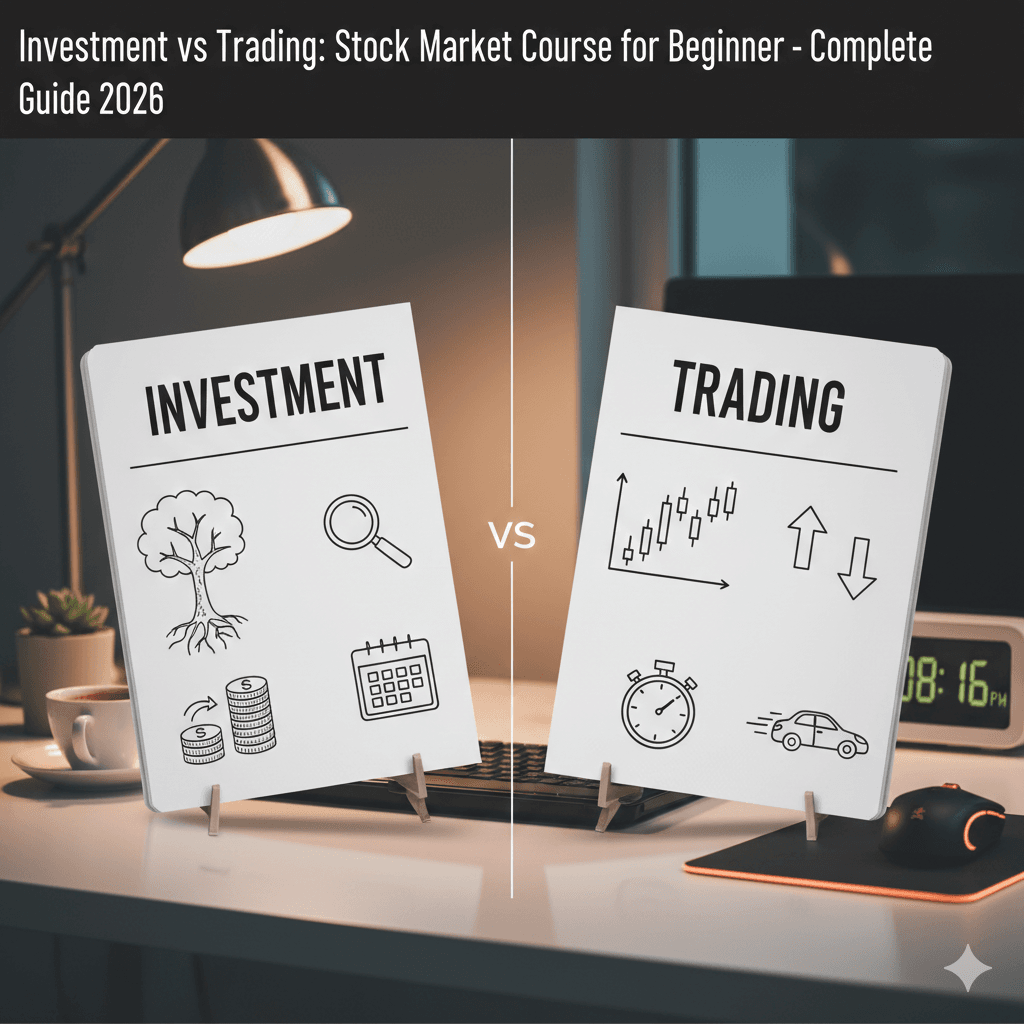
Many people think investment and trading are the same.
But the truth is, there is a big difference between the two.
In the stock market, the way money is invested, the time period, the level of risk, and the goal are different for investment and trading.
What Is Investment in the Stock Market?
Investment means putting your money for the long term.
Here, your goal is to become a part owner of a company. You trust the company’s growth and hold its shares for many years.
An investor mainly focuses on fundamental analysis.
For example, if you believe that TCS will become a much bigger company in the next 10 years, you buy its shares today and hold them for the long term.
What is “Trading” in the Stock Market?
Trading means buying and selling shares for the short term.
Here the goal is not to become an owner of the company. Instead the aim is to earn profit from changes in share prices.
A trader mainly focuses on technical analysis. For example, if a trader believes that HDFC Bank’s share price may go up in the next two days the trader buys the share and sells it after two days.
Investment vs Trading Comparison Table (2026)
| Basis | Investment | Trading |
| Time Period | Long-term | Short-term |
| Main Goal | Become a part owner of a company | Earn profit from price changes |
| Holding Period | Years | Minutes to days |
| Analysis Used | Fundamental analysis | Technical analysis |
| Risk Level | Generally lower | Generally higher |
| Returns | Grow slowly over time | Faster but uncertain |
| Suitable For | Long-term wealth building | Short-term profit seekers |
| Stress Level | Lower | Higher |
| Capital Requirement | Can start with small amounts | Often needs active capital |
Types of Trading in the Stock Market: Strategies for Beginners (2026)
Trading can be of different types depending on when you buy and sell shares.
1.Intraday Trading: Meaning, How It Works, and Key Risks
“Intra” means “within”. In this type, you buy and sell shares on the same day.
The market opens at 9:15 AM and closes at 3:30 PM, so you must close your positions within this time frame. If a trader does not exit the position before 3:30 PM, the system automatically closes the trade at the market closing time.
For example, if you buy a share at 1:00 PM, you must sell it before 3:30 PM.
Explore Stock Market Fundamentals for Beginners Part 3
Explore Stock Market Terminology for Beginners: Key Concepts & Terms Explained (2026 Guide PArt 4)
2. Swing Trading: Meaning, How It Works, and Time Horizon
In swing trading, your holding period may range from a few days to a few weeks. You earn profit from the stock’s price swings. The holding period is flexible. If the price moves against you or if you believe the stock needs more time, you can choose to hold the position for additional days, depending on your strategy and risk tolerance. For example, if you expect a stock to increase by 10% next week, you buy it today and sell it next week.
3. F&O (Futures and Options) Trading: Meaning, How It Works, and Risks
This is a more advanced form of trading where contracts are traded instead of shares.
You do not need to invest a large amount of money, but the risk is much higher.
Suppose you believe that a stock currently trading at ₹1,000 will move up in the coming days. Instead of buying the share, you enter a futures or options contract by paying a smaller amount called margin.
If the price moves in your favor, even a small price change can generate higher profit. However, if the price moves against you, losses can also increase quickly.
It is very risky
Important Note:
Futures and Options trading is highly risky, especially for beginners. It is strongly recommended to first understand how F&O works in detail. Before investing real money, beginners should practice paper trading for at least 2 to 3 sessions. This helps you understand market movements and risk better. Only after proper learning and practice should you take any real trading decision.
Whenever you buy a stock, you have two options:
Intraday vs Delivery Trading: Holding Period Comparison Table
| Feature | Intraday Trading | Delivery Trading |
| Trading Basis | T+0 (Same day buy & sell) | T+2 (Shares credited after 2 days) |
| Buy & Sell | Must be bought and sold on the same day | Can be sold any day after delivery |
| Demat Account | Shares are not transferred | Shares are transferred to Demat |
| Holding Period | Few hours | 1 day to several years |
| Suitable For | Short-term traders | Investors & long-term holders |
Holding Period Comparison in Stock Market Trading Strategies (2026)
| Type | Holding Period |
| Intraday Trading | Few hours |
| Swing Trading | Few days to a few weeks |
| Long-Term Investment | Several years |
Risk and Returns in Stock Market Strategies for Beginners 2026

Just like in life, every activity has some risk, the same applies to the stock market.
Learning to manage risk is the first sign of a smart investor.
Return: This is the money you earn from your investment.
For example, if you invest 100 rupees and it becomes 110 rupees, your return is 10 rupees.
Risk: This is the possibility that you may incur a loss.
For example, if you invest 100 rupees and it falls to 90 rupees, you have a loss of 10 rupees. Remember, high risk is directly linked to high return. If you want higher returns, you must be ready to take higher risks.
Risk–Reward Ratio in Trading for Beginners
This is a simple formula that tells you how much risk you are taking for the expected return.
Formula: Risk–Reward Ratio = Possible Loss / Possible Profit
Example:
If you invest in a stock and your target profit is 20 rupees, but you don’t want to lose more than 10 rupees,
then your risk–reward ratio is 10 / 20 = 0.5. This means for every 1 rupee of risk, you expect 2 rupees of reward.
A good investor always chooses trades or investments with a favorable risk–reward ratio.
Risk Management in Stock Market Strategies for Beginners (2026)
These are strategies to reduce potential losses in your investments.
Stop–Loss:
A stop-loss is an automatic order placed to limit a loss to a certain level.
For example, if you buy a share at 100 rupees and don’t want it to go below 95 rupees, you place a stop-loss at 95 rupees.
If the share reaches 95, it is automatically sold, preventing a bigger loss.Diversification:
Diversification means not putting all your eggs in one basket.
Don’t invest all your money in one stock or one sector.
For example, if you invest only in IT companies and the IT sector faces a problem, your entire investment may suffer.
Instead, spread your money across IT, Banking, FMCG, and Healthcare sectors.
This way, if one sector goes down, other sectors balance your losses.
Asset Allocation:
This is slightly different from diversification.
Here, you divide your investment across different asset classes, such as stocks, gold, bonds, and real estate.
For example, you may invest 50% in stocks, 30% in bonds, and 20% in gold.
When the stock market falls, gold and bonds usually rise, reducing your overall risk.
Compounding
Albert Einstein called compounding the “eighth wonder of the world”.
It means earning interest on interest.
When you earn returns from an investment and reinvest them, your total investment starts earning returns on the returns.Example:
If you invest 100 rupees and get a 10% return, you have 110 rupees.
Next year, you earn 10% not on 100, but on 110 rupees.
This helps your money grow exponentially.
Compounding works best in long-term investments.
What Is Unrealised Profit and Loss in the Stock Market?
Whenever we buy a share, we always keep an eye on its price. But did you know that profit or loss can be of two types? Let’s understand with a simple example.
Unrealised Profit:
Suppose you buy a Reliance share at ₹2,500. Today, its market price is ₹2,700.
You have not sold the share yet, but you see a gain of ₹200.
This ₹200 gain is called Unrealised Profit. Until you sell, it is just a number.
Unrealised Loss:
Similarly, if the Reliance share falls from ₹2,500 to ₹2,300, you see a loss of ₹200.
Until you sell the share, this ₹200 loss is called Unrealised Loss.Note: As long as the trade is open, the profit or loss is unrealised.
Trusted External Resources to Learn Stock Market
What Is Realised Profit and Loss in the Stock Market?
Realised profit and loss are the amounts you actually gain or lose. This happens when you sell your position (share).
Realised Profit:
In the above example, if you sell the Reliance share at ₹2,700, the ₹200 gain is now in your account. This is called Realised Profit.
Realised Loss:
If you sell the share at ₹2,300, the ₹200 loss is now final. This is called Realised Loss. When you sell your shares at a loss, it is called a realised loss because only the remaining amount after the loss is credited to your Demat account.Note: When the trade is closed, the profit or loss becomes realised.
What Is Profit Booking and Loss Booking in the Stock Market?
These terms are commonly used in trading. They are basically technical terms for realised profit and realised loss.
Profit Booking:
When you have an unrealised profit on a share and sell it to convert the gain into cash, it is called Profit Booking.
Example: Selling Reliance at ₹2,700 and booking ₹200 profit.
Loss Booking:
When you have an unrealised loss on a share and sell it to finalise the loss, it is called Loss Booking.
Example: Selling Reliance at ₹2,300 and booking ₹200 loss. These processes show discipline in investing and controlling decisions.
Bonus Tip: Discipline
Profit and loss are not just numbers; they also test your patience and discipline.
A smart investor plans in advance when to book profit and when to cut loss.
What Is the Psychology of Trading and Investing in the Stock Market?
Successful trading and investing is not just about numbers or charts; your mindset plays a key role.
- Patience: The market moves at its own pace. Profits take time to grow, and losses may happen. A patient investor waits for the right opportunities.
- Avoid Emotional Decisions: Decisions driven by fear or greed often lead to mistakes. Stick to your plan and do not react to every market movement.
- Follow a Strategy: Always have a clear entry and exit plan. This helps reduce errors and maintain discipline.
Common Mistakes Beginners Make in the Stock Market
Even experienced investors make mistakes, but beginners should be extra careful. Here are the top mistakes to avoid:
- Overtrading: Buying and selling too frequently without a proper plan.
- Ignoring Stop-Loss: Not using stop-loss orders can increase losses.
- Lack of Diversification: Putting all money in one stock or sector increases risk.
- Chasing Tips: Relying on rumors or “hot tips” without research.
- Focusing Only on Short-Term Gains: Ignoring the power of long-term investment and compounding.
Mini Summary Table of Key Stock Market Terms (Part 2)
| Term | Key Point |
| Investment | Long-term, part-owner, fundamental analysis |
| Trading | Short-term, profit from price changes, technical analysis |
| Intraday | Buy & sell same day, short holding period |
| Swing | Hold for a few days or weeks, profit from price swings |
| F&O | Futures & Options, advanced trading, higher risk |
| Risk | Possibility of loss in investment or trading |
| Return | Profit earned from investment or trading |
| Stop-Loss | Automatic order to limit loss |
| Diversification | Spread investments across stocks/sectors |
| Asset Allocation | Spread investments across asset classes |
| Compounding | Earning return on previous returns |
| Unrealised Profit/Loss | Profit or loss while trade is open |
| Realised Profit/Loss | Profit or loss after selling the trade |
FAQ – Stock Market Strategies for Beginners 2026
What is a Stock Market Strategies for Beginners 2026?
A Stock Market Strategies for Beginners 2026 is designed to teach basic concepts like investment, trading, risk management, and profit and loss in a simple and structured way.
Who should learn about the stock market strategies for beginners 2026?
Anyone who wants to grow money, understand investing, or build financial knowledge can learn the stock market, especially students, working professionals, and beginners.
Do I need prior knowledge to start learning stock market basics?
No prior knowledge is required. Most beginner resources start from zero and explain concepts step by step using simple examples.
How long does it take to understand stock market fundamentals?
With regular learning and practice, a beginner can understand the basics in a few weeks. A well-structured Stock Market Course for Beginners helps speed up this process.
Is trading risky for beginners?
Yes, trading involves risk. Beginners should first focus on learning concepts, risk management, and paper trading before using real money.
What is the difference between investment and trading?
Investment focuses on long-term wealth creation, while trading aims to earn short-term profits from price movements.
Can beginners earn money from the stock market?
Yes, beginners can earn money if they learn properly, manage risk, and stay disciplined. Stock Market Strategies for Beginners 2026 helps build the right foundation.
What is paper trading and why is it important?
Paper trading means practicing trades without real money. It helps beginners understand market behavior without financial risk.
Is long-term investing better than short-term trading?
For most beginners, long-term investing is safer because it benefits from compounding and reduces the impact of short-term market fluctuations.
Is it necessary to follow rules and guidelines while investing?
Yes, following market rules and official guidelines is important for safe and responsible participation. A Stock Market Strategies for Beginners 2026 usually explains these basics clearly.
Conclusion : Stock Market Strategies for Beginners 2026
The stock market can be a powerful tool for building wealth, but it requires knowledge, patience, and discipline. Stock Market Strategies for Beginners 2026 focus on helping new investors understand the basics clearly before taking real financial risks.
As a beginner, it is important to understand the difference between investment and trading, types of trading, risk and returns, and strategies like stop-loss, diversification, and compounding.
Always remember: higher returns come with higher risk, and a smart investor plans in advance, manages risk, and makes informed decisions. By learning step by step and practicing responsibly, anyone can start their journey in the stock market safely and effectively.
Disclaimer
The content on this page is for educational and informational purposes only.
It does not constitute financial advice, recommendation, or an offer to buy or sell any financial products.
Investing and trading in the stock market involve risk of loss. Past performance is not indicative of future results.
Readers should do their own research, consult a certified financial advisor, and make decisions based on their personal financial situation. The website and authors do not take responsibility for any financial losses incurred by following this content.