The real meaning of Stock Market Terminology for Beginners is not just to memorize difficult words, but to clearly understand them in simple language. Everyone wants to enter the stock market, but terms like IPO, Market Cap, Bull-Bear Market, Bonus Shares, Stock Split, Right Issue, etc., often confuse or scare beginners. In this guide, we will decode these technical stock market words step by step with real-life examples, so you can start your investment journey confidently without any confusion. If you want to learn how the stock market works, understanding terminology is your first and strongest step.
Start Here: Stock Market Basics Every Beginner Must Know
Stock Market Basics for Beginners: Complete Guide 2026
Stock Market Strategies for Beginners 2026 – Part 2
Stock Market Fundamentals for Beginners Part 3
Why Do Companies Go Public? Importance of IPO in Stock Market Terminology for Beginners
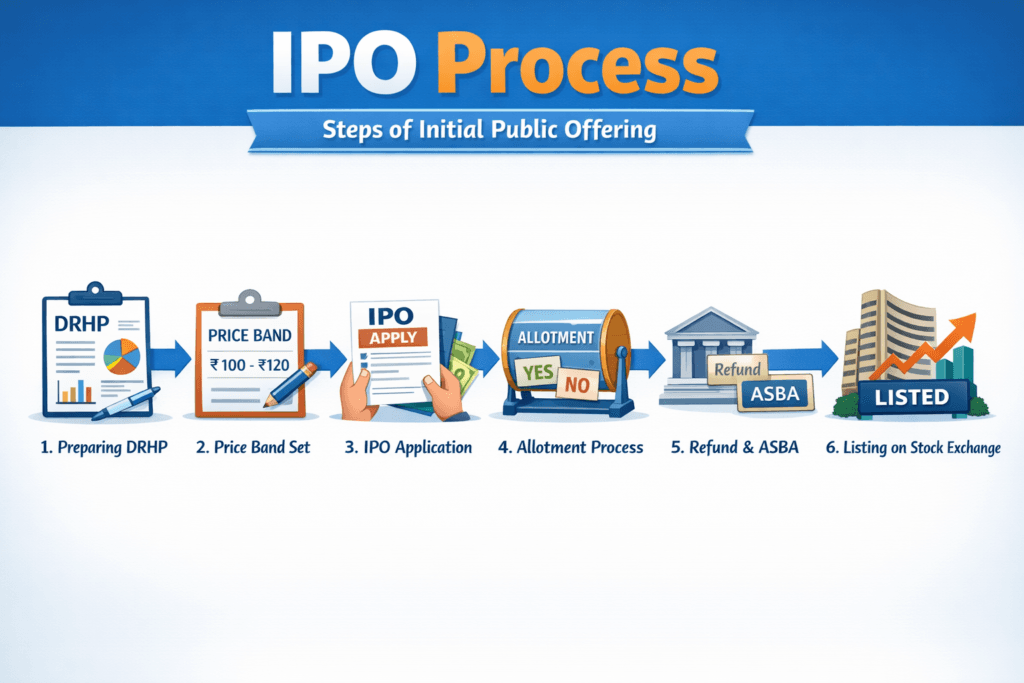
“To understand the logic behind an IPO, let’s look at a practical example. Imagine XYZ Electric, a booming scooter brand that needs ₹1,000 Crore for a new plant. Instead of taking a heavy bank loan and suffocating under monthly interest, they launch an IPO.
By raising money from the public, XYZ Electric gets the funds interest-free, keeping the company debt-free and healthy. Beyond raising funds, an IPO also builds brand trust and improves the company’s market image. For beginners learning Stock Market Terminology for Beginners, understanding this simple debt vs equity idea is a key step toward becoming a smarter investor.
Primary vs Secondary Market: Key Differences Explained for Stock Market Beginners
| Market Type | Explanation |
|---|---|
| Primary Market | This is the market where shares are offered for the first time directly by the company to investors. IPO (Initial Public Offering) is part of the primary market. |
| Secondary Market | After the IPO, shares are listed on BSE or NSE, and regular trading starts. In this market, investors buy and sell shares among themselves. |
Types of IPO (IPO Types Explained for Beginners Step by Step 2026)
Fixed Price Issue:
In a Fixed Price Issue, the company announces one fixed price for its IPO. All investors apply for shares at the same price, and there is no bidding range.
Book Building Issue:
In a Book Building Issue, the company provides a price band (for example, ₹100–₹110). Investors place their bids within this range. After reviewing the demand, the company decides the final issue price and allots shares accordingly.
IPO Terminology for Beginners: Explained with Real-Life Examples
Oversubscribed in IPOs: Meaning and Examples
When the demand for shares is more than the shares available, the chance of getting an allotment becomes low.
Example: A company issues 40 lots, which means a total of 1,000 shares
(1 lot = 25 shares).
Now, 50 investors apply for the IPO, and each investor applies for 1 lot.
So, total demand becomes:
50 lots × 25 shares = 1,250 shares
But the company has issued only 1,000 shares.
Since the demand (1,250 shares) is higher than the supply (1,000 shares), this IPO is called oversubscribed. In this case, the company can allot only 40 lots, and the remaining 10 lot applications will be rejected or refunded.
Undersubscribed in IPOs: Meaning and Examples
When the demand for shares is less than the shares available.
Example: A company issues 40 lots, which means a total of 1,000 shares
(1 lot = 25 shares).
This time, only 30 investors apply for the IPO, and each investor applies for 1 lot.
So, total demand becomes:
30 lots × 25 shares = 750 shares
But the company has issued 1,000 shares.
Since the demand (750 shares) is lower than the supply (1,000 shares), this IPO is called undersubscribed. In this case, all 30 investors will get full allotment, and the remaining 10 lots (250 shares) will remain unsubscribed.
Listing Gain in IPOs: Meaning and Examples
When the listing price is higher than the issue price. For example, if the issue price is ₹100 and the listing price is ₹120, the listing gain is ₹20.
Example A company launches an IPO at an issue price of ₹100 per share.
After the IPO, the shares get listed on the stock exchange at a listing price of ₹120 per share.
So, the profit on listing day is:
₹120 − ₹100 = ₹20 per share
This ₹20 profit is called Listing Gain. It means investors who got allotment made a profit immediately when the shares started trading on the exchange.
Listed at a Discount in IPOs: Meaning and Examples
Example: A company brings an IPO at an issue price of ₹100 per share.
After the IPO, the shares get listed on the stock exchange at a listing price of ₹85 per share.
So, the loss on listing day is:
₹100 − ₹85 = ₹15 per share
Since the listing price is lower than the issue price, the stock is said to be listed at a discount. It means investors who got allotment are in loss on the listing day itself.
Lot Size in IPOs: Meaning and Examples
In an IPO, you have to apply for a fixed number of shares together. For example, one lot = 15 shares.
Example: A company launches an IPO and says: 1 lot = 10 shares.
- If you want to apply for the IPO, you cannot apply for 1, 2, or 5 shares.
- You must apply in multiples of 1 lot (10 shares).
Example:
Someone applies for 2 lots → 2 × 10 = 20 shares
You apply for 1 lot → 10 shares Here, “lot size” = 10 shares, the fixed number of shares you must buy in a single application.
Price Band in IPOs: Meaning and Examples
Example: A company announces an IPO with a price band of ₹100 – ₹110 per share.
- Investors can bid any price within this range.
- Example: Aftab bids ₹105, you bid ₹110.
- Company finally decides the issue price based on all bids, say ₹108.
Here, “Price Band” = ₹100 to ₹110, the range in which investors can place their bids.
Applying and Allotment in IPOs
Applying for an IPO and getting shares. In oversubscribed IPOs, getting shares is not guaranteed.
Grey Market Price (GMP) in IPOs
An unofficial market where IPO shares are traded before they are officially listed. A positive GMP indicates an expected listing gain.
How IPO Grey Market Price (GMP) Works: Complete Guide for Beginners
Suppose a company’s IPO is about to open, but the shares are not listed yet on the stock exchange. Even before listing, some investors start buying and selling the shares informally in what is called the grey market. For example, if the IPO issue price is ₹100, investors may trade it in the grey market at ₹120. This price, ₹120, is known as the Grey Market Price (GMP). A positive GMP usually indicates that the shares are expected to list at a gain, while a negative GMP suggests the shares may list at a discount. It’s important to remember that GMP is unofficial and not recognized by the stock exchange.
Why an IPO Matters for Stock Market Beginners and Investors
An IPO is a great opportunity to invest in a company at an early stage. However, not every IPO turns out to be good, which is why proper research and analysis are very important before investing.
Corporate Actions Explained for Stock Market Terminology for Beginners (Bonus, Split, Dividend, Delisting, Right Issue, Buy Back & Voting Rights)
Bonus Shares in the Stock Market: Meaning and Examples
Definition:
When a company gives additional shares for free to its existing shareholders based on the shares they already own, it is called Bonus Shares.
Example:
If a company announces a 1:1 bonus and you own 100 shares, you will receive 100 extra shares for free. After the bonus, you will have 200 shares in total. The share price automatically adjusts, so the total value of your investment remains the same as it was before the bonus.
Stock Split in the Stock Market: Meaning and Examples
Definition:
In a stock split, a company divides one share into two or more shares.
Example:
A 1:10 stock split means you get 10 shares for every 1 share you own. If you have 1 share priced at ₹1,000, after the split you will have 10 shares, each priced at ₹100.
Delisting in the Stock Market: Meaning and Examples
Definition:
Delisting means when a company’s shares are permanently removed from the stock exchange, and trading in those shares comes to an end.
Example:
If a company wants to become private or does not follow stock exchange rules, it may choose to delist its shares. For example, Vedanta attempted a voluntary delisting in 2021.
Ex-Date in the Stock Market: Meaning and Examples
Definition:
Ex-Date is the date after which, if you buy the shares, you will not receive the dividend, bonus, or stock split benefit.
Example:
If a company’s dividend record date is 15 May and the Ex-Date is 13 May, then buying the shares after 13 May means you will not get the dividend.
Rights Issue in the Stock Market: Meaning and Examples
Definition:
When a company needs money, it offers new shares to its existing shareholders first, usually at a price lower than the market price.
Example:
A 1:1 Rights Issue means if you have 50 shares, you get the option to buy 50 more shares.
Buying these shares is optional, not compulsory.
Buyback in the Stock Market: Meaning and Examples
Definition:
Buyback means when a company buys back its own shares from the market.
Example:
Companies like Infosys and TCS regularly do buybacks.
If a company offers a buyback price of ₹1200 while the market price is ₹1100, investors get a premium price for their shares.
Voting Rights in the Stock Market: Meaning and Examples
Definition:
When you buy shares of a company, you become a partial owner of the company. Because of this ownership, you get voting rights.
Example:
In the AGM (Annual General Meeting), shareholders can vote on important decisions such as appointing directors, approving dividend policies, or decisions related to mergers and acquisitions.
What Is Market Psychology? Understanding Greed and Fear in Stock Market Terminology for Beginners

Friends, stock prices do not depend only on a company’s performance. They are also influenced by investors’ thinking and emotions. This thinking and emotional behavior of investors is called Market Psychology.
You may study technical charts or analyze company fundamentals, but without understanding market psychology, your understanding of the stock market will always remain incomplete.
Bull and Bear Market Explained: Market Trends and Mood for 2026
First of all, it is important to understand the mood of the market.
A Bull Market is when the market keeps moving upward for a long period. The term comes from a bull, which attacks by pushing upward. During a bull market, investors feel optimistic and confident, expecting prices to rise further.
A Bear Market is when the market keeps falling continuously. The term comes from a bear, which attacks by pushing downward. During a bear market, investors feel fear and disappointment. This is a simple way to understand the overall mood of the stock market.
Bullish and Bearish Sentiment in the Stock Market: Understanding Investor Mindset
Bullish Sentiment refers to a situation where investors believe the market will move upward, so they are in a buying mood.
Bearish Sentiment refers to a situation where investors expect the market to fall, so they prefer to sell.
Example:
When COVID-19 first started, most investors feared a market crash. This fear created a bearish sentiment. As the situation slowly improved and confidence returned, investors became optimistic again. This led to a bullish sentiment, and the market started moving upward.
Trading Psychology in the Stock Market: Understanding Market Moves (2026)
Trading psychology means controlling your emotions. The biggest challenge in the market is not outside—it is inside you.
Greed: The desire to make more profit often leads to losses.
Fear: The fear of loss often stops you from making the right decision.
A successful trader is someone who understands the market trend but does not let emotions control decisions. Risk management and discipline are the real weapons of a trader.
Top Takeaways: Stock Market Terminology for Beginners Summary
Look friends… understanding market psychology and controlling your own emotions is the first step to success in the stock market. If you learn to manage your emotions, you have already won half the battle
Stock Market Terminology for Beginners 2026: Key Concepts to Master Market Psychology – Part 2

Blue-Chip Stocks in the Stock Market: The “Sachin Tendulkar” of Investing
Definition: Blue-chip stocks are shares of large, well-established, and financially stable companies.
Simple Example: Just like Sachin Tendulkar or MS Dhoni in cricket—always consistent performers—companies like Reliance, HDFC Bank, Infosys, and TCS are considered blue-chip in the stock market.
Why the Name Blue-Chip? In casinos, the highest value chip is blue. That’s where the term comes from.
Key Points:
- Provide stable returns in the long term
- Less affected by market ups and downs
- Considered a “safe bet” for investors
Another Example: In the US market, companies like Apple, Microsoft, and Coca-Cola are also considered blue-chip.
Penny Stocks in the Stock Market: The “Budget-Friendly but Risky” Players
Definition: Penny stocks are shares that cost very little—often less than ₹10–₹20. New investors like them, but wrong decisions can get them into trouble.
Simple Example: If a blue-chip stock is like a branded car, a penny stock is like an old second-hand bicycle—cheap, but can go wrong anytime.
Key Points:
- Stocks of small or new companies
- High risk, but high return potential
- 99% chance of losing money, but if the company grows, it can give 10–20x returns
Another Example: You may have heard of Suzlon Energy or Yes Bank, which investors once treated like penny stocks.
Multibagger Stocks – The “Future Stars” of the Stock Market
Definition: Multibagger stocks are shares whose price increases many times. Here, “bag” means 100% return.
Simple Example:
- Stock ₹100 → ₹200 = 1 Bagger
- Stock ₹100 → ₹500 = 5 Bagger
Key Points:
- Mostly found in small or mid-cap companies
- High growth potential… can become blue-chip stocks in the future
Real-Life Example: Titan and Eicher Motors were once multibagger stocks… today they are in the blue-chip category.
Pro Tip: A good investor always looks for future multibaggers, but patience and research are necessary.
Key Takeaways: Stock Market Terminology for Beginners You Must Remember
Friends, now you have a clear idea of how Blue-Chip, Penny, and Multibagger stocks are different. Whenever you choose a stock, remember these concepts—they will make your investing decisions more mature and strong.
Understanding Market Cap: Large, Mid & Small Cap Companies 2026

| Company Type | Market Cap Value | Simple Example | Key Points | Investor Tip |
|---|---|---|---|---|
| Large Cap | More than ₹20,000 Crore | Big factory running for years, products everywhere (Reliance, HDFC Bank, TCS) | • Stable• Less affected by market volatility• Returns are slow but consistent & secure | Safe option for beginners; good for stable returns |
| Mid Cap | ₹5,000 Crore to ₹20,000 Crore | Growing factories running fast (Indiamart, Federal Bank, AU Small Finance Bank) | • Higher growth potential• More volatile than large-cap• Can become large-cap in future | Suitable if you can take moderate risk; potential growth story |
| Small Cap | Less than ₹5,000 Crore | Small new factories trying new products | • Highest growth potential• Highest risk | Only for risk-ready investors; research & diversify before investing |
| Term | Meaning / Example |
|---|---|
| Stock Symbol | Short code identifying a stock (e.g., Reliance = RELIANCE, TCS = TCS) |
| Ticker | Short form showing live price on exchange (often same as stock symbol) |
Investor Tip: Before investing in small-cap companies, do your research. Diversify your investments and don’t put all your money in one stock.
Stock Market Terminology for Beginners: Essential Company Types You Must Know
Large Cap = Stable growth, secure
Mid Cap = Growth with moderate risk
Small Cap = High growth with high risk Always invest according to your risk profile and financial goals.
Official Stock Market References
Common FAQs: Stock Market Terminology for Beginners
Why is it important to learn stock market terminology for beginners?
Learning stock market terminology for beginners is the first step toward becoming a successful investor. Without understanding basic terms like IPO, Market Cap, or Dividends, it is impossible to analyze stocks or follow financial news. Mastering this stock market terminology for beginners ensures you make informed decisions rather than relying on guesswork.
What are the most essential terms in stock market terminology for beginners?
The most essential terms in stock market terminology for beginners include “Market Capitalization” (to understand company size), “Bull and Bear Markets” (to understand market mood), and “IPO” (to understand how companies go public). Familiarizing yourself with these basics of stock market terminology for beginners will help you navigate the trading world with confidence.
Does stock market terminology for beginners include corporate actions?
Yes, understanding corporate actions like Bonus issues, Stock Splits, and Buybacks is a vital part of stock market terminology for beginners. These actions directly impact the share price and the number of shares you hold, which is why they are a key chapter in any guide focused on stock market terminology for beginners.
Conclusion
Understanding Stock Market Terminology for Beginners is the first step to becoming a smart investor. From IPOs and market caps to blue-chip, penny, and multibagger stocks, knowing these terms helps you make informed decisions and avoid common mistakes. Remember, the stock market can be unpredictable, but a strong grasp of basic terminology gives you confidence and clarity.
By learning Stock Market Terminology for Beginners, you can spot opportunities, manage risks, and plan your investment journey better. Keep practicing, stay updated, and always align your choices with your financial goals.
Disclaimer
This article on Stock Market Terminology for Beginners is for educational purposes only. It does not constitute financial advice. Always do your own research or consult a professional before making any investment decisions. Investments in the stock market involve risk, and past performance does not guarantee future results.